



 Home
Home
Where Does A Solar Energy Storage System Lose Usable Energy?
A solar energy storage system delivers less energy than it receives because conversion, battery operation and supporting equipment consume energy along the path.
That statement does not mean every gap on a dashboard is a physical loss. Energy may remain stored at the end of the measurement period, be reserved for another purpose or never enter the battery because solar output is limited. Understanding the difference starts with a clear boundary: where the energy is measured, over what interval and under which operating conditions.
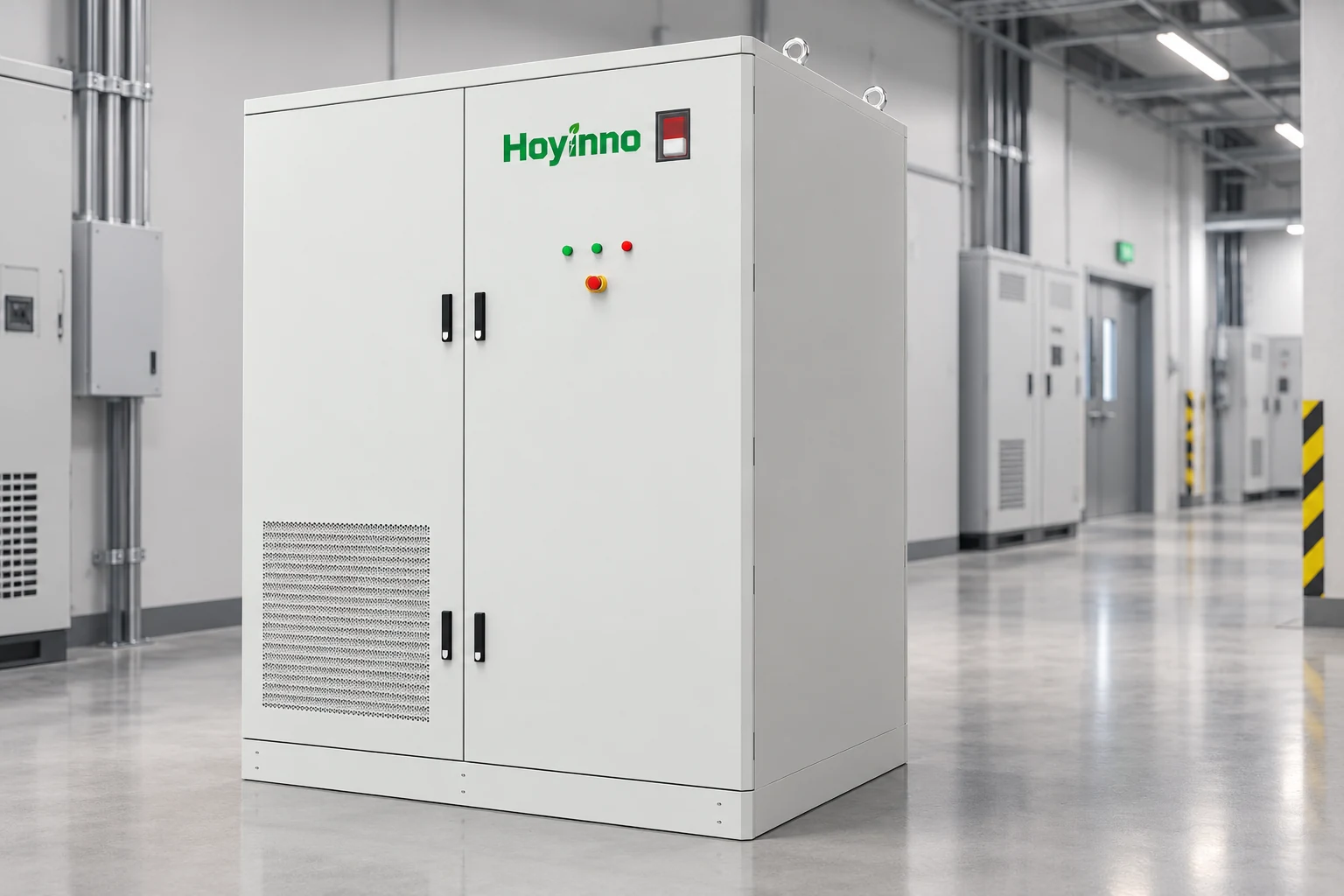
This explanation follows the energy path rather than assigning a universal efficiency percentage. Hoyinno's product and engineering pages provide equipment and service context, including a modular cabinet example. No numerical performance claim for that cabinet is inferred from its appearance. The examples are conceptual and the images are editorial illustrations, not site measurements.
Draw The Boundary Before Calculating The Gap
Power Describes The Rate; Energy Describes The Amount
Power is the rate of energy transfer, commonly expressed in kilowatts. Energy accumulated over time is commonly expressed in kilowatt-hours. A brief power reading does not establish the total energy delivered during a long interval. Two systems can have the same instantaneous discharge power while delivering different amounts because they operate for different durations or follow different schedules.
Stored Energy At The End Is Not Automatically A Loss
If the battery ends the interval with more stored energy than it had at the start, some of the input remains available for later use. If it ends with less, the output may partly come from energy stored before the interval began. A comparison of input and output alone can therefore misstate performance unless the change in stored energy is accounted for or the test begins and ends at comparable states.
Conceptually, energy entering a defined boundary is divided among energy leaving it, change in stored energy and energy consumed or dissipated within it. Measurement uncertainty must also be considered. This energy balance is a bookkeeping relationship, not a device-specific rating. The engineering service context is relevant because the boundary depends on the actual system design.
Before asking where energy was lost, establish where it was measured and whether the battery finished in a comparable state.
Follow The Electrical Conversion Path
Count The Stages That Energy Actually Passes Through
Solar modules produce direct-current electricity. Inverters convert between DC and AC where the architecture requires it. The US Department of Energy describes both solar-storage integration and the role of inverters in changing electrical form. The particular route depends on how generation, storage and loads are connected; it should be read from the project design rather than assumed from the word “hybrid.”
Conversion losses occur because real equipment is not perfectly efficient. Their size depends on the operating point and equipment, so a peak figure for one component should not be applied to every hour of system operation. A route with fewer stages may reduce some conversion requirements, but that fact alone does not establish the overall outcome. Controls, loading and supporting demand still matter.
Include Connections Between The Main Components
Cables, connections and other equipment along the selected boundary can also dissipate energy. Whether those effects are included in a quoted result depends on the meter locations. A measurement at a battery terminal does not automatically include the path to the facility load. Conversely, a measurement at a wider facility boundary can include unrelated consumption unless the analysis separates it.

The modular cabinet product page identifies one equipment format. Its photograph cannot reveal every conversion stage or the complete project boundary. Those details belong in the approved electrical design and technical documentation. A cabinet should not be treated as if it describes all equipment between a solar module and the final load.
Distinguish Battery Losses From Supporting Demand
The Battery And Its Auxiliaries Answer Different Questions
Charging and discharging involve physical processes that do not return all input energy as usable electrical output. Separately, controls, communications and thermal management may consume electricity while enabling the installation to operate. These auxiliary loads are part of a wider system assessment even when they are excluded from a narrower battery measurement.
State clearly whether the supporting demand is supplied from the battery, an external connection or another part of the installation. Otherwise, a result can appear better simply because one energy input was not counted. The reporting convention should remain consistent between the compared periods and should explain how idle, charging and discharging operation are treated.
Hoyinno's service information provides context for the operational questions that follow installation. The relevant question is not whether supporting equipment exists, but how its demand is measured and interpreted. Necessary cooling or control power should be recorded honestly rather than hidden to improve a headline number.
Keep Reserves, Limits And Curtailment In Separate Categories
A Reserved Portion Remains Different From Dissipated Energy
A control policy can retain energy for backup or limit the operating range. Energy held in reserve is unavailable for the current scheduled task, but it has not necessarily disappeared. Similarly, a power limit can restrict how quickly energy is delivered without establishing that the underlying stored amount has been lost. Capacity, discharge rate and dispatch permission are related but distinct concepts.
The energy management system information is useful context for these distinctions. An operating rule can change when energy is used, which demand receives priority and when a device waits. Those decisions should be visible in an explanation of the observed output. A restricted operating window should not be described as conversion inefficiency.
Curtailed Solar May Never Enter Storage
Solar generation can be limited when there is insufficient demand, storage cannot accept more energy or another system constraint applies. That unrealized generation is different from energy that entered storage and was later dissipated. Mixing the two obscures whether the issue is generation utilization, storage capacity, power limits or electrical efficiency.

For a solar energy storage system, an explanation of “missing energy” should classify each part before combining totals. A weather-related reduction, a deliberate generation limit and a storage conversion loss call for different interpretations. The off-grid application context can introduce additional operating priorities, but the actual project controls must determine the analysis.
Use A Classification Table To Avoid Double Counting
The following categories help organize a review. They are not a prediction of which category dominates a particular installation. Some quantities require separate metering or an agreed estimation method. Where a quantity cannot be isolated, describe the uncertainty instead of manufacturing a precise allocation from a single dashboard total.
| Observed difference | Possible interpretation | Evidence needed | Common mistake |
|---|---|---|---|
| Input exceeds output over a short interval | Some energy remains stored | Comparable start and end conditions | Calling the entire difference a loss |
| Output falls during standby-heavy operation | Supporting demand has a larger relative effect | Operating duration and auxiliary consumption | Applying a cycling result to idle periods |
| Solar potential exceeds accepted generation | Generation may have been limited before storage | Generation and dispatch records | Assigning all curtailment to the battery |
| Scheduled discharge stops with energy remaining | Reserve or operating limits may apply | Control settings and state information | Equating reserve with dissipated energy |
| Two efficiency figures disagree | Different boundaries or conditions may be used | Meter locations, time windows and included loads | Comparing percentages without their definitions |
Keep each energy flow in one category for a given boundary. If auxiliary demand is already included in a net output measurement, subtracting it again would double count it. If a figure excludes that demand, it should not be described as the net energy delivered to the load without an adjustment and a clear explanation.
Make Measurements Comparable Before Interpreting Them
A meaningful comparison records the meter locations, interval, operating mode, state conditions and treatment of supporting demand. It also identifies whether the figures are measured, modelled or taken from a component document. These evidence types can support one another, but they should not be presented as interchangeable observations.
- Use aligned timestamps and the same energy units.
- Identify which direction of flow each meter records.
- State the start and end operating conditions.
- Record included and excluded supporting consumption.
- Keep estimated quantities and uncertainty visible.
The operation and maintenance context is relevant to recurring review because settings, operating patterns and equipment condition can change. A result should be interpreted against the conditions under which it was obtained. A difference between two months should prompt a check of those conditions before it is labelled deterioration.
There is no single percentage that describes every solar energy storage system across every boundary and duty cycle. A component's best operating point, a controlled round trip and a month of net site operation answer different questions. The useful result is the one whose definition matches the question being asked and whose assumptions remain visible.
Frequently Asked Questions
Is Unused Battery Capacity The Same As Energy Loss?
No. A reserve, operating limit or remaining stored amount can reduce energy available for a particular task without being a physical loss. The control policy and measurement interval determine how that amount should be reported.
Does A Higher Component Efficiency Guarantee More Site Output?
No. Site output also depends on the electrical route, operating point, supporting demand, dispatch and available generation. Compare results at the boundary relevant to the task rather than assuming one component figure describes the whole installation.
Why Can Standby Change The Apparent Result?
Supporting equipment may consume energy while little useful energy is delivered. Over a long interval, that demand can represent a larger share of the measured input. Record operating duration and mode before comparing the result with a cycling test.
Can Solar Curtailment Be Added To Battery Losses?
It can be reported in a broader utilization assessment, but it should remain a separately defined category. Generation that never entered storage is different from energy consumed or dissipated inside the storage boundary.
What Should Be Checked First When Two Dashboards Disagree?
Check meter locations, units, timestamps, direction conventions and included loads. Then compare state conditions and operating modes. A disagreement in definitions should be resolved before drawing a conclusion about physical performance.
Usable energy becomes easier to explain when conversion losses, supporting demand, stored-energy changes and deliberate operating limits remain distinct. Follow the path, define the boundary and preserve the conditions alongside the result. That produces a clearer explanation than treating every difference as one undifferentiated loss.
 A BESS Battery Energy Storage System Coordinates More Than Stored Energy
  Address: A401, Junxu Junchuang Park, 03A Qingyi Road, Nanhai District, Foshan City, Guangdong Province, China





