



 Home
Home
A BESS System Has Distinct Ready, Running And Unavailable States
A bess system can be ready without delivering power, running under limits, or unavailable for a particular service even while parts of it remain energized.
One Status Word Cannot Describe The Whole Installation
A battery energy storage installation brings together stored energy, conversion equipment, controls, auxiliary systems and an electrical connection. A short dashboard label summarizes some of that information for a particular purpose. It rarely describes every subsystem at once. Understanding what the label covers is therefore essential before interpreting what the installation can do.
Read Status Within Its Defined Boundary
A battery rack, power conversion unit and site controller can each report an operating state. Their labels may differ because they describe different boundaries. A rack can be ready while a site-level permission prevents dispatch. A controller can be communicating normally while a separate subsystem is unavailable. These are not necessarily contradictory reports.
Keep Physical Appearance Separate From Logical Status
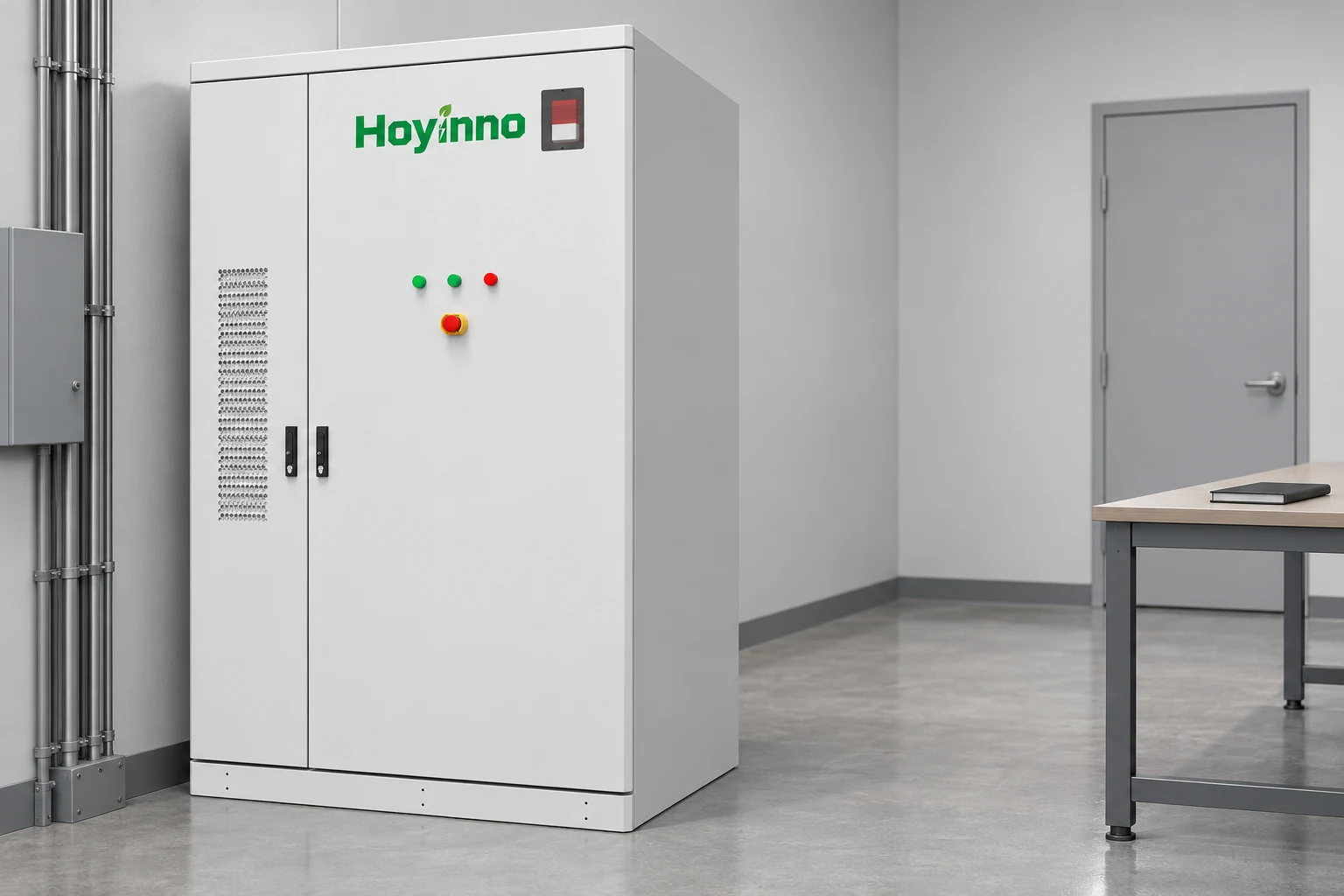
A cabinet photograph shows its exterior, not its internal permissions, measurements or protection conditions. Indicator colors may help an operator when interpreted through the correct legend, but their meaning should not be guessed from color alone. A green lamp in a promotional image is not proof of readiness, and a red element may be a physical control rather than an active alarm.
The 418kWh liquid-cooled cabinet page supplies the exterior example used here. The image identifies the product presentation. It does not establish a specific firmware state machine, available power, operating conditions or the meaning of each visible indicator.
Ready Means Conditions Are Met For A Defined Next Step
Readiness usually expresses the ability to proceed under specified conditions. It does not mean that a command has already been issued or that power is flowing. The useful definition includes the intended action: ready for communication, ready for connection and ready to accept a power request can describe different stages.
Separate Local Readiness From Site Permission
A subsystem may satisfy its own checks while the wider installation remains constrained. A site schedule, external permission or another component's status can prevent the next action. The status hierarchy should show how a local ready signal contributes to the site decision, rather than allowing each individual ready indication to be mistaken for a site-wide conclusion.
Consider a hypothetical installation whose conversion equipment reports ready while the site controller is waiting for permission to export. That observation can be explained without assuming that the equipment has failed. The next useful evidence is the permission state and its documented source, together with a time-aligned record of the request. The example describes a logical relationship, not a setting to change.
The energy management system information provides context for the supervisory role. Sandia's energy-storage management discussion describes coordination between energy management and conversion equipment, including use of battery information when determining operating modes. That conceptual relationship should not be read as a claim that every installation implements identical names or transitions.
| Conceptual Description | What It May Establish | What It Does Not Establish | Useful Companion Evidence |
|---|---|---|---|
| Ready | Defined prerequisites are satisfied | That a power request exists or is being delivered | Scope, permissions and time of update |
| Standby | The system is waiting within a defined mode | That it can respond to every possible request | Mode definition and applicable limits |
| Charging | A charging mode or measured inward flow is reported | Which measurement boundary or sign convention is used | Command, actual power and meter location |
| Discharging | A discharging mode or outward flow is reported | That the requested output is fully achieved | Measured response and active constraints |
| Unavailable | A defined service cannot currently be provided | That every part is de-energized or damaged | Reason, scope and recovery criteria |
| Unknown or stale | Current evidence is insufficient | That the last known condition still applies | Communication quality and data timestamps |
These are explanatory categories, not a universal list of manufacturer codes. An availability status should always be read against the service it describes. Availability for one operating mode may not imply availability for another, and a communication status may say nothing about the capability of the electrical equipment.
A Command And Its Measured Response Are Different Facts
A dispatch command expresses an intended action. Measurements describe what occurred at a particular observation point. The two should be compared, but they should not be treated as interchangeable. A request may be accepted, limited, delayed or refused according to documented conditions.
Follow Request, Acknowledgment And Actual Response
A clear event record distinguishes the request, its receipt or acknowledgment, the applicable permissions and the measured outcome. If the record contains only a requested value, it cannot prove delivery. If it contains only measured power, it may not explain why that power was chosen. The relationship between both is what makes the record interpretable.
State The Measurement Boundary And Direction
Battery-side power, converter output and a site connection measurement refer to different places. Auxiliary consumption and other equipment can affect what is observed at each boundary. Before comparing values, identify the measurement point, units, sign convention and sampling interval. A positive value does not universally mean discharge across all data systems.

Running Can Include Limits And Transitions
An installation can operate while its permitted response changes. The word running does not guarantee unrestricted capability. Limits can arise from equipment conditions, energy management objectives or site requirements. A good explanation identifies the active limit and the boundary to which it applies, without assuming that every limit indicates a fault.
Understand A Transition As A Sequence
Moving between modes may require several documented conditions to occur in order. A display captured during that sequence can show different subsystem states. The important distinction is between an expected transition and an unresolved condition. That distinction comes from the documented sequence, timing and event record, not from impatience with a status that has not yet changed.
Site engineering information provides context for integrating equipment and controls. The actual project documentation should define interfaces and acceptance conditions. A conceptual article cannot supply a safe switching sequence, protection threshold or method for bypassing an interlock, and a status explanation should never be used as one.
Distinguish An Operating Limit From A Service Failure
A limit describes a constraint on a response. Whether that constraint represents a service failure depends on the agreed service and its conditions. An installation may behave correctly within its permitted envelope while being unable to satisfy a particular external request. The equipment's behavior and the service outcome should be reported as related but separate conclusions.
This distinction is useful for a bess system because commercial expectations, control objectives and equipment conditions are often discussed by different teams. A single word such as available can hide those differences. A shared definition should state which service is available, under what conditions and according to which evidence.

Unavailable Is A Scoped Conclusion, Not A Physical Inspection
Unavailable means that a defined capability cannot currently be provided. It does not by itself identify the cause, establish damage or prove the absence of electrical energy. The label may reflect planned work, an unmet condition, a protection response or insufficient current data. The reason must be read from applicable records.
A communication interruption deserves particular care. The last displayed operating state may remain on a screen after the underlying data stops updating. Treating that value as current can create a false picture of the installation. A useful interface makes freshness and data quality visible alongside the value or state it reports.
Information about operation and maintenance services helps frame the support responsibilities, but a generic service page does not decide whether a particular event is safe to clear. Interpretation, recovery and any physical intervention belong to the authorized personnel and the supplied procedures for the actual installation.
A status label describes a control or reporting condition within a defined scope. It is not evidence that equipment is safe to touch, isolated or free of stored energy.
The appropriate record states the reason reported, the affected scope, the time it began and the criteria for confirming recovery. It should preserve an unknown cause as unknown. Replacing uncertainty with an assumed fault or an assumed normal condition can misdirect both technical analysis and service reporting.
Build A Time-Aligned Explanation From Existing Records
A useful status explanation is a small narrative supported by timestamps, definitions and observations. It should say what was requested, what the controls reported and what was measured. The objective is to understand the sequence, rather than to collect every available screen without a clear question.
- Identify the subsystem and service described by the label.
- Check the documented meaning and software context.
- Record data freshness and clock alignment.
- Compare the dispatch command with acknowledgments and permissions.
- Locate the measured response at a named boundary.
- State the conclusion and any remaining uncertainty separately.

The site services overview can help identify which support discussion is relevant, while the actual installation records determine the finding. An availability status becomes useful when its scope and evidence are understood. Without those boundaries, comparisons between dashboards can confuse different reporting conventions with different equipment behavior.
Frequently Asked Questions
Can Ready And Zero Power Both Be Correct?
Yes. Readiness may indicate that prerequisites are met while no active power request exists. The mode definition, current permissions and measured boundary determine how that combination should be interpreted.
Does Charging Always Mean The Same Sign On A Meter?
No. Sign conventions depend on the measurement system and its defined direction. Confirm the meter location, units and convention before comparing a reported value with a charging or discharging label.
Can Running Equipment Still Be Unavailable For A Service?
Yes. A subsystem may be operating while the installation cannot provide a specific requested service. The service definition and active constraints determine that availability conclusion.
Does A Lamp Color Establish The System State?
Only the correct equipment legend and current operating context can establish its meaning. A product photograph or an assumed color convention cannot replace the supplied control documentation.
What Is The Right Treatment Of Stale Data?
Mark the current condition as uncertain where the evidence is no longer fresh. Preserve the last known value with its timestamp, but do not present it as a confirmed current observation.
The clearest explanation of a bess system keeps readiness, requested action, actual response and service availability distinct. Linking those concepts through documented scope and time-aligned evidence makes a short status label useful without asking it to describe more than it can.
 Where Does A Solar Energy Storage System Lose Usable Energy?
  Address: A401, Junxu Junchuang Park, 03A Qingyi Road, Nanhai District, Foshan City, Guangdong Province, China





