



 Home
Home
An Energy Management System For Battery Storage Coordinates Every Operating Layer
An Energy Management System for Battery Storage coordinates measurements, operating limits, dispatch priorities, alarms, and commands across the site. It is a supervisory layer rather than a substitute for the battery management system, power conversion controls, protection equipment, or human operating procedures. Its value comes from turning many local devices into one controlled operating sequence while respecting the limits reported by those devices.
The EMS Sits Above Fast Local Controls
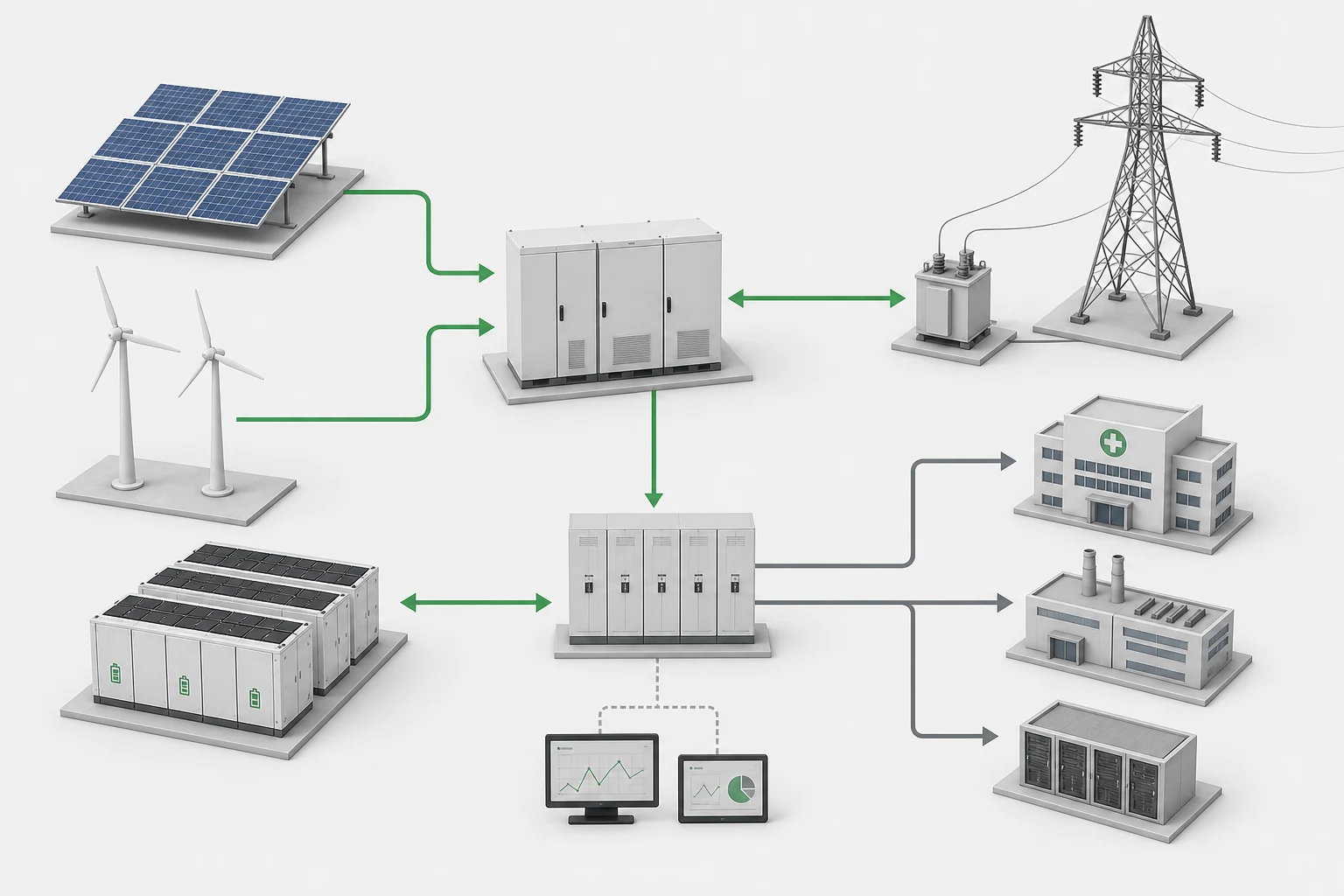
A battery site contains several control time scales. Protection devices act when limits are crossed. Battery management systems observe cells, temperatures, contactors, and available power. A power conversion system regulates the electrical interface. The EMS receives selected states and constraints, then decides what the site should do next.
Supervision Is Different From Device Protection
The EMS may request a power setpoint, reserve band, operating mode, or ramp rate, but local controllers must still refuse an unsafe instruction. This separation prevents a high-level economic or grid-service objective from overriding cell, inverter, transformer, or interconnection limits. A sound architecture defines which layer owns each decision, how an instruction is acknowledged, and what happens when communications disappear.
A Command Needs A Measured Feedback Loop
A setpoint alone does not prove that the site delivered the requested response. The supervisory loop compares commands with measured power, energy, state, voltage, frequency, temperature, and device availability. When actual behavior diverges, the controller may reduce the request, switch modes, raise an alarm, or hand control to a fallback routine. Timestamp quality and consistent units matter because stale or mismatched measurements can produce a technically valid but operationally wrong command.

Dispatch Converts Site Objectives Into Feasible Setpoints
Dispatch answers when to charge, discharge, wait, or reserve storage capacity. Objectives can include peak reduction, solar use, backup readiness, ramp control, or grid services. One battery cannot maximize them all, so priorities and constraints must be explicit.
Objectives Need A Clear Priority Order
Consider a site that expects a high evening load, variable solar output, and possible grid interruption. Charging from midday solar supports later load, holding reserve supports resilience, and limiting grid demand supports tariff control. If storage capacity is insufficient for all three, the EMS needs a documented priority rule. A hidden optimization score is difficult to commission; an explainable hierarchy lets operators understand why the site accepted, limited, or rejected a request.
Constraints Define The Feasible Operating Envelope
BESS dispatch controls should consider available power, usable energy, state and temperature limits, conversion efficiency, ramp capability, site import or export limits, reserve commitments, equipment outages, and maintenance states. These inputs change over time. The controller should therefore calculate a feasible command from current conditions rather than repeatedly issuing an ideal schedule that local devices must clip.
State, Forecasts, And Quality Of Data Shape Every Decision
Supervisory control is only as reliable as its inputs. State estimates, meters, forecasts, price signals, and device availability arrive with different timing and confidence. The EMS should flag missing, stale, implausible, or conflicting data before automatic use.
State Of Charge Is A Decision Variable, Not A Single Truth
State of charge limits protect operational headroom and help separate normal dispatch from emergency or reserve behavior. The value is estimated rather than directly measured, and accuracy can vary with temperature, rest time, aging, and calibration. Supervisory logic should consume the BMS estimate and allowed power while keeping a configurable operating band. It should not invent a more aggressive limit merely to meet a schedule.
Forecast Error Requires Reserve And Replanning
Solar, wind, site load, and market signals rarely match a day-ahead plan exactly. A practical EMS updates its schedule when measured conditions change, protects a reserve margin, and records why dispatch moved away from the plan. The useful design question is not whether forecasting is perfect, but whether error produces a bounded correction rather than oscillation, exhausted energy, or a surprise loss of backup capability.
Interfaces Decide Whether The Site Operates As One System
A controller may have sophisticated algorithms yet fail at integration. The power conversion system interface, BMS, meters, protection, generators, inverters, switchgear, and supervisory platform must agree on units, quality flags, authority, and timing.
Map Signals By Meaning, Owner, And Failure Behavior
An interface schedule should define each point, source device, engineering unit, update rate, valid range, quality indicator, write permission, and fallback action. For example, a state-of-charge percentage without a validity flag may be less useful than an older value marked as stale. A remote-enable point without an authority rule can create competing commands. Testing should include lost packets, frozen values, bad scaling, time drift, and recovery after reconnection.
Cybersecurity And Access Are Operating Requirements
Remote monitoring, fleet coordination, and maintenance create valuable visibility, but they also expand the control boundary. Good practice separates operational technology from ordinary business access, assigns least-privilege roles, records configuration changes, protects credentials, and defines how software updates are approved and rolled back. Security should be verified together with availability so a protective measure does not remove the operator’s ability to manage a real event.
Operating Modes Need Explicit Entry And Exit Conditions
Mode names matter only when transitions are defined. Typical states include standby, grid-connected charge or discharge, islanded operation, reserve, maintenance, derated, and fault. Microgrid operating modes may add generator start, load shedding, resynchronization, and black start. Each transition needs prerequisites, authority, timeout, interlock, and fallback.
| Operating State | Primary EMS Decision | Required Feedback | Failure-Safe Response |
|---|---|---|---|
| Standby | Hold readiness while avoiding unnecessary cycling | Device available, limits valid, contactor and PCS status known | Remain unavailable until states agree |
| Grid-connected dispatch | Issue feasible active and reactive power requests | Meter power, grid voltage and frequency, battery limits | Ramp down or transfer authority on invalid input |
| Islanded operation | Balance generation, storage, and prioritized loads | Frequency, voltage, reserve, generator and load status | Shed approved loads or move to controlled shutdown |
| Reserve mode | Preserve energy and power headroom for a defined event | Reserve target, forecast uncertainty, availability | Raise a shortfall alarm and replan |
| Maintenance | Block automatic dispatch to isolated equipment | Permit, lockout state, maintenance authority | Reject remote start until release is confirmed |
| Fault or derated | Limit operation and coordinate recovery | Alarm cause, available capacity, protection status | Keep the most restrictive valid limit |
Alarms, Records, And Human Decisions Complete The Loop
An alarm system should help an operator decide, not merely display device messages. Events need severity, cause, affected asset, acknowledgment, escalation, and an operating procedure. History should preserve commands, response, limit changes, modes, user actions, and communication quality.
Commissioning Should Test Scenarios, Not Just Points
Point-to-point checks confirm that signals arrive, but scenario tests prove coordination. Useful tests include a sudden load change, renewable forecast error, state-of-charge boundary, device derating, lost meter, failed communications, grid loss, generator start, island transition, resynchronization, alarm acknowledgment, and restart after shutdown. The technology and support scope can frame responsibilities, while the project test plan must still define evidence and acceptance.
Records are also necessary for performance review. A recurring difference between commanded and measured power may indicate meter placement, response limits, device tuning, or network delay. Repeated reserve shortfalls may indicate an unrealistic schedule rather than a battery fault. The EMS should make these distinctions visible enough for engineering review instead of converting every deviation into the same generic alarm.

How To Read An EMS Description Without Overclaiming
An Energy Management System for Battery Storage may be described through monitoring, strategies, peak management, alarms, analytics, remote O&M, and grid or off-grid functions. These are possible capabilities; actual performance depends on configured devices, protocols, objectives, protection, and commissioning. Distinguish available functions from those included and tested for the project.
- Ask which devices, protocols, and points are supported in the proposed architecture.
- Define who supplies and validates load, renewable, tariff, and grid-service inputs.
- Record the hierarchy among safety, resilience, operational, and economic objectives.
- Specify local fallback behavior for loss of cloud, site network, meter, or forecast data.
- Require scenario-based acceptance results and a recoverable configuration baseline.
The BESS portfolio, power conversion page, and commercial and industrial solutions provide context. They are starting points for definition, not proof that every feature applies to every cabinet or site.
Frequently Asked Questions
Is An EMS The Same As A Battery Management System?
No. The BMS focuses on battery condition, protection, contactors, temperatures, state estimates, and allowable power. The EMS supervises site objectives and coordinates commands across batteries, conversion equipment, meters, generators, renewable sources, and loads while respecting BMS limits.
Can The EMS Keep Operating If The Cloud Connection Fails?
It can if local site control, data, schedules, and fallback logic are designed for that condition. The project should define which functions remain local, what data becomes unavailable, how long autonomous operation is acceptable, and how the system reconciles records after communications return.
Why Can Two EMS Platforms Produce Different Dispatch?
They may use different objectives, forecasts, reserve assumptions, constraints, update intervals, equipment models, and priority rules. The difference is not automatically an error. It should be explainable through the configured inputs and verified against the project’s operating requirements.
What Data Is Essential For Commissioning?
Essential data normally includes device availability, power and energy measurements, state and allowable limits, voltage and frequency, mode and alarm status, command acknowledgment, timestamp and quality flags, and relevant site or grid signals. The final list depends on the architecture and use case.
How Should Operators Judge Whether The EMS Is Working Well?
Review safety and limit compliance first, then availability, command tracking, reserve delivery, mode-transition behavior, alarm quality, data completeness, and the project-specific objective. Economic savings alone can hide unsafe or unsustainable operation if constraints and battery use are not considered.
An Energy Management System for Battery Storage is therefore best understood as a disciplined coordination layer: it observes the site, calculates a feasible action, issues commands through controlled interfaces, confirms the response, and records enough context for operators to understand and improve the next decision.
 Which Project Inputs Turn A Custom BESS Solution Into A Buildable Design?
  Address: A401, Junxu Junchuang Park, 03A Qingyi Road, Nanhai District, Foshan City, Guangdong Province, China