



 Home
Home
Which Project Inputs Turn A Custom BESS Solution Into A Buildable Design?
A Custom BESS Solution becomes buildable when duty cycle, site conditions, interfaces, safety evidence, and acceptance tests are defined together. A capacity target and a cabinet picture are not enough for an engineering handoff. Project teams need one controlled basis of design that states what the system must do, where it will operate, how it will connect, how performance will be judged, and which party owns every unresolved interface.
Start with the operating objective, not a nominal capacity
Convert load and generation data into a duty cycle
A useful duty-cycle model begins with time-series load, generation, tariff, outage, and grid-quality data at a resolution appropriate to the intended service. It states the analysis period, missing-data treatment, growth assumption, seasonal cases, critical loads, export limits, and renewable curtailment logic. Power and energy should be modeled separately because a short high-power event and a long energy-shifting window place different demands on cells, converters, cooling, and operating reserve.
The model should also define state-of-charge boundaries, expected cycles, idle periods, recharge opportunity, backup reserve, and allowable grid import. These inputs shape battery storage design far more reliably than selecting a catalog capacity first. Sensitivity cases can show whether the preferred configuration remains useful when demand grows, solar output changes, tariffs move, or a critical outage lasts longer than the central estimate.
State performance at the point that matters
Performance requirements should name the measurement boundary. Cell, DC block, inverter, transformer, and point-of-connection values are not interchangeable. Define whether usable energy, power, efficiency, response time, availability, and auxiliary consumption are assessed at the DC bus, AC terminals, or site meter. Also state ambient and state-of-charge conditions for the test. Without that boundary, two compliant-looking proposals may include different losses and cannot be compared fairly.
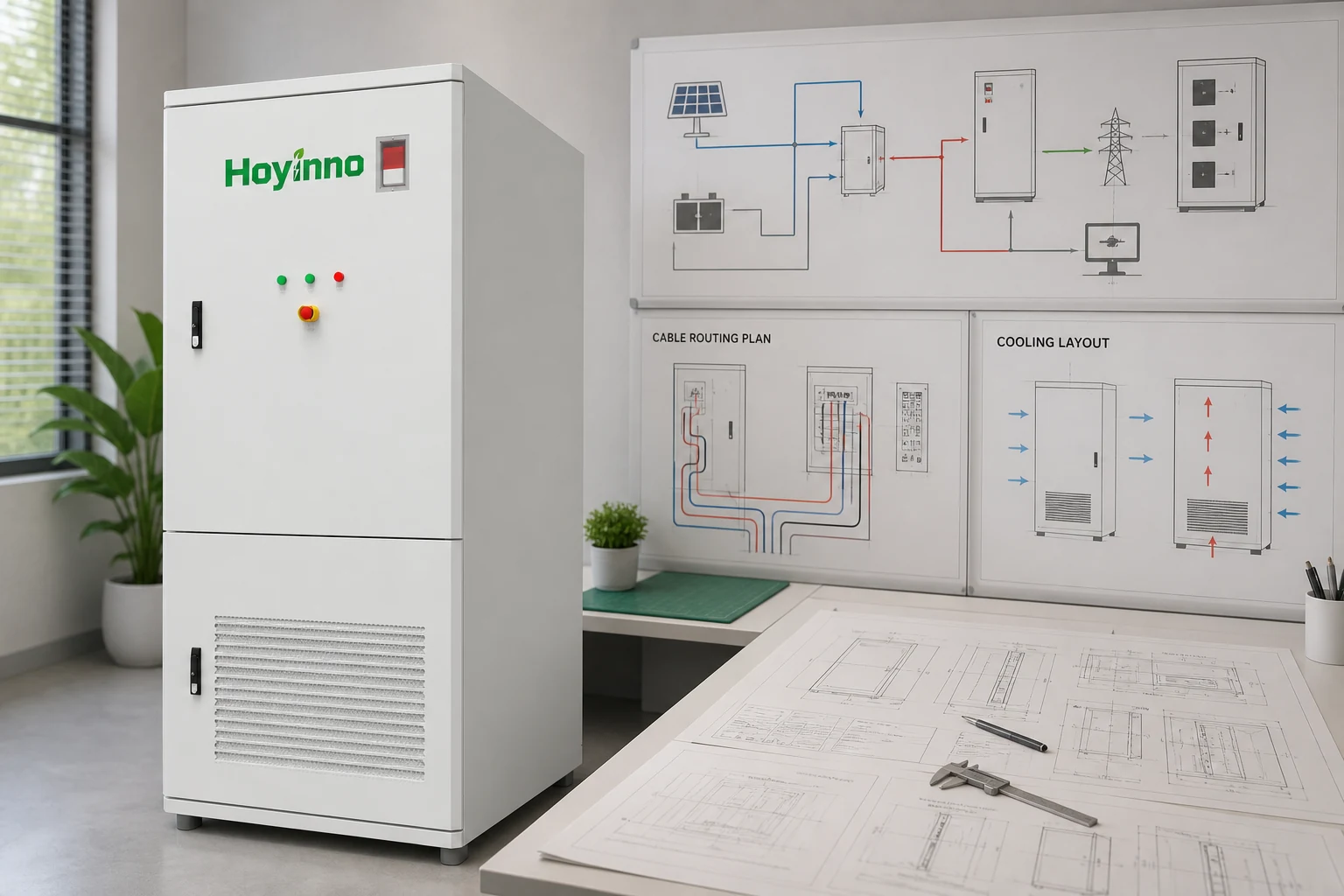
Translate the site into explicit design conditions
Design for heat, humidity, dust, and access
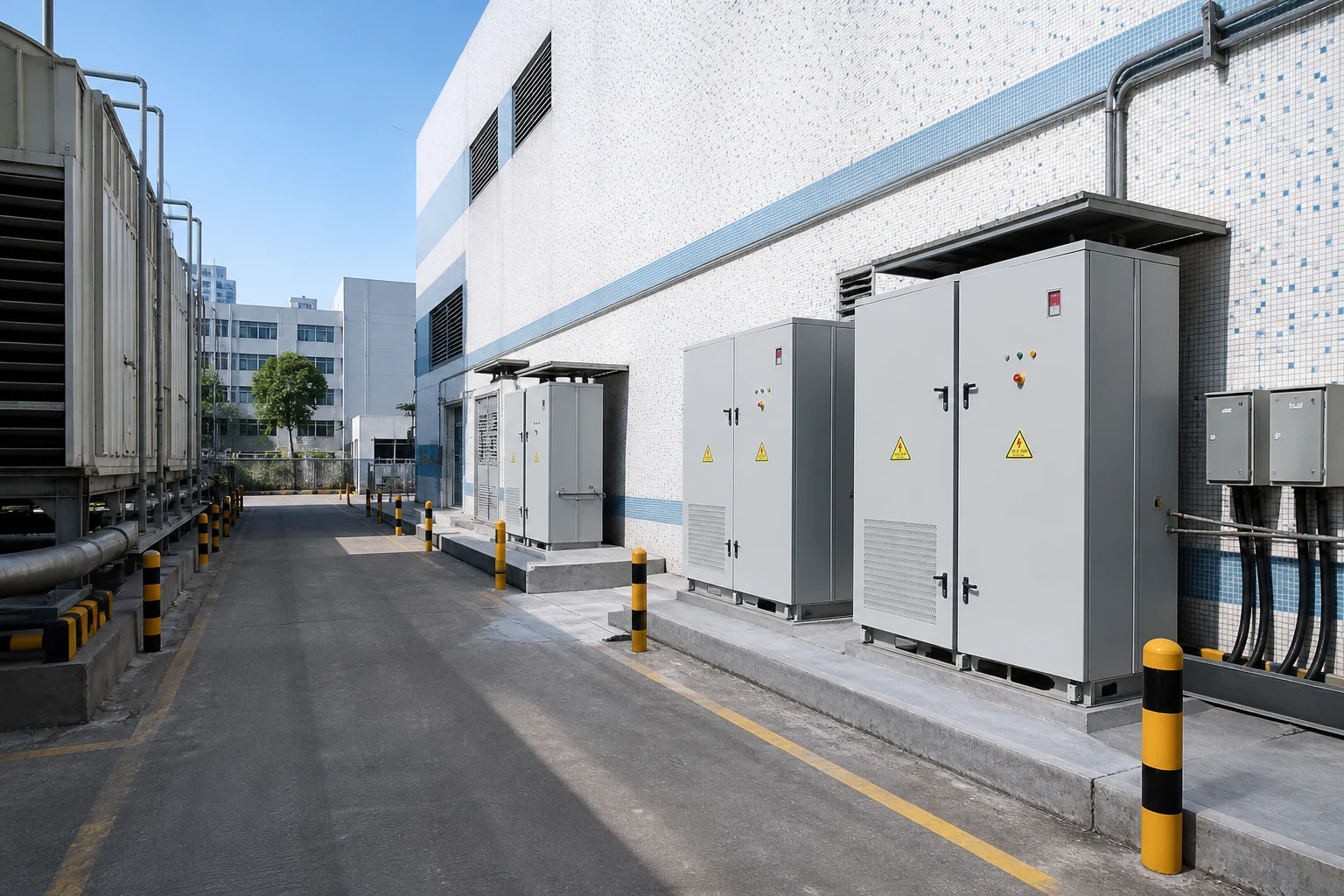
Hot and humid climates require attention to condensation control, cooling duty, auxiliary energy, corrosion protection, seals, filtration, sensor placement, and maintenance intervals. Dust-prone or coastal locations may need different inspection and replacement practices. High altitude may affect cooling and electrical clearances. The specification should ask bidders to disclose derating assumptions and environmental limits, then connect those assumptions to guaranteed performance and the site maintenance plan.
Physical access is equally important. Cabinet spacing, fire-service approach, equipment doors, cable trench routes, drainage, noise-sensitive boundaries, security, lighting, and crane or forklift paths need early coordination. The commercial and industrial application context and project case library can inform questions, but the final arrangement must be checked against local rules, land constraints, service procedures, and emergency planning.
Freeze electrical and controls interfaces
Use an interface register
The register should name each physical, electrical, communications, software, civil, and contractual interface; the data or deliverable required; responsible party; due date; and acceptance method. Typical entries include cable terminations, transformer parameters, protection settings, meter mapping, communications protocols, time synchronization, remote access, weather data, dispatch commands, alarm priorities, cybersecurity controls, and data ownership. Closing these entries is more reliable than assuming that “integration included” covers every boundary.
For a Custom BESS Solution, controls logic deserves its own functional description. It should define operating modes, command priority, limits, transitions, fail-safe states, restart behavior, loss-of-communications response, alarm handling, state estimation, reserve management, and manual override. The document should state which functions are demonstrated in simulation, factory testing, site testing, and ongoing performance monitoring.

Build a safety and compliance evidence plan
Trace evidence to the offered configuration
Ask whether cells, modules, racks, enclosures, power conversion, controls, thermal management, and suppression elements in the offered configuration match the tested or assessed configuration. Record any substitutions and the technical basis for equivalence. Safety functions should be mapped from detection through control action, isolation, alarm, ventilation or suppression response as applicable, and notification. That map helps reviewers see gaps that remain hidden when documents are presented as an undifferentiated compliance folder.
Emergency planning should define who receives alarms, who may isolate equipment, what information responders need, which hazards remain after shutdown, and how post-event access is controlled. Local fire and permitting authorities should be engaged at the appropriate design stage. This article does not claim that a particular same-site cabinet holds any certification; it describes evidence questions that a project team can apply to the offered configuration.
Compare proposals on one requirement matrix
| Requirement group | Input to define | Evidence to request | Acceptance question |
|---|---|---|---|
| Duty cycle | Power, energy, duration, cycles, reserve, dispatch priorities | Simulation basis, sizing report, degradation assumptions | Does the model reproduce the stated operating cases? |
| Site | Climate, altitude, access, civil and environmental limits | Derating, thermal, layout, foundation and maintenance inputs | Are site limits reflected in performance and service planning? |
| Interfaces | Single line, protection, communications, ownership boundaries | Interface register, functional description, study list | Is every boundary assigned and testable? |
| Safety | Applicable rules, hazard controls, emergency coordination | Traceable reports, drawings, analysis and response plan | Does evidence match the offered configuration and site? |
| Acceptance | Factory, site and performance test criteria | Procedures, instruments, tolerances and signed records | Can pass, fail and remedy be decided objectively? |
A disciplined set of BESS project requirements should separate mandatory pass/fail items from scored preferences and commercial adjustments. Clarifications must be incorporated into the final contract documents rather than left in email. The resulting matrix becomes a control document for design review, factory testing, commissioning, and change management—not merely a procurement spreadsheet used once.
Make acceptance tests part of the design
Write tests with pass, fail, and remedy rules
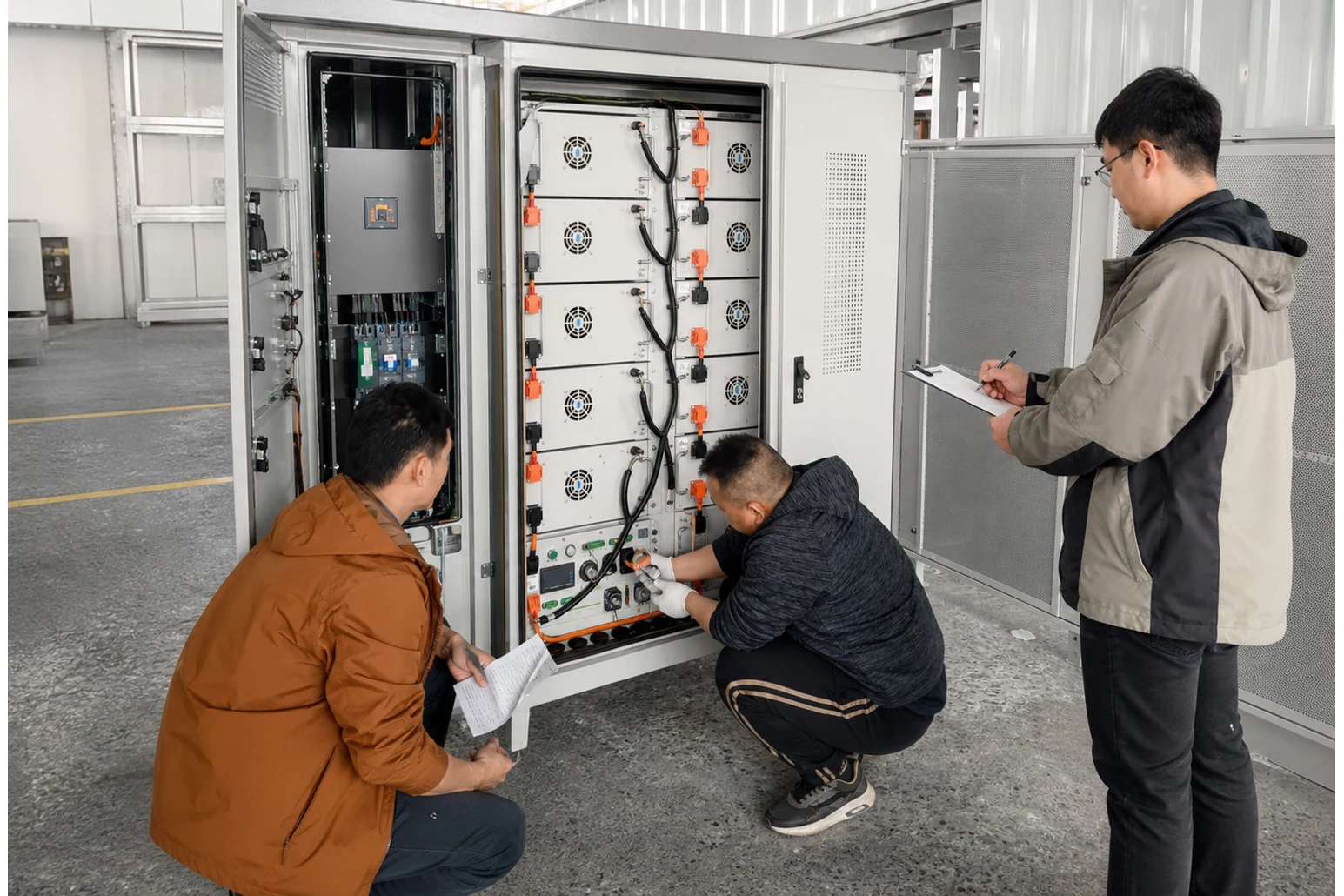
Each procedure should identify prerequisites, configuration, instruments and calibration, data rate, test sequence, safety controls, expected result, tolerance, witnesses, records, and disposition. It should also explain retest rights, schedule effects, and remedies. System integration testing is especially valuable when it exercises command priority, communications loss, protection trips, mode transitions, alarm routing, and recovery across vendor and site-control boundaries.
Documents should be staged as deliverables rather than collected at the end. A project register can track drawings, calculations, manuals, software versions, settings, test procedures, reports, training, spare-parts lists, warranty conditions, and as-built records. Final acceptance should state which open items may remain on a controlled punch list and which prevent commercial operation or handover.
Control change through delivery and operation
Operations planning should define preventive maintenance, remote support, alarm response, data retention, access control, spares, training, performance checks, and warranty evidence. The service scope overview and technology support context can prompt questions, while the contract states actual response times, exclusions, site responsibilities, and support boundaries.
Frequently Asked Questions
What data is needed before BESS sizing?
Collect time-series load and generation data, tariff and grid constraints, outage history, critical-load definitions, operating objectives, growth assumptions, desired reserve, site conditions, available footprint, interconnection limits, and project-life expectations. State data resolution and quality. Where evidence is incomplete, create explicit scenarios and sensitivity cases rather than hiding uncertainty inside a single capacity number.
How should power and energy be specified?
Define required power, duration, usable energy, state-of-charge window, charge and discharge limits, response, duty cycle, operating conditions, and the electrical measurement boundary. Clarify whether values are at the battery DC side, inverter terminals, transformer output, or site connection. Include auxiliary loads and expected derating so bidders calculate and guarantee values on a comparable basis.
Which site conditions most often change design?
Temperature, humidity, dust, salt exposure, altitude, flooding, drainage, wind, seismic basis, access, transport limits, foundation conditions, fire-service approach, noise boundaries, and maintenance clearance can all affect configuration. Their importance varies by site. Provide measured or code-based inputs and require disclosure of derating, enclosure, cooling, corrosion, inspection, and replacement assumptions.
What should an interface register cover?
Cover electrical terminations, voltage and grounding, protection, metering, communications, protocols, time synchronization, cybersecurity, controls ownership, civil loads, cable routes, auxiliary services, drainage, fire systems, remote support, data rights, and document handoffs. Each interface needs an owner, required input, due date, review state, and acceptance method so that scope gaps become visible before site commissioning.
When is a custom design buildable?
It is buildable when ranked operating cases, site inputs, performance boundaries, architecture, interface responsibilities, safety and compliance evidence, civil and electrical constraints, document schedule, commercial scope, and acceptance tests are controlled at sufficient detail for engineering release. Critical assumptions must be confirmed or bounded, and changes must follow an agreed approval and retest path.
A project team can organize these inputs against the available engineering service context and use the requirement matrix to request a traceable design response, exclusions list, evidence plan, and acceptance schedule for a Custom BESS Solution.
 How Does Off Grid Solar Power Keep Critical Loads Running After Sunset?
  Address: A401, Junxu Junchuang Park, 03A Qingyi Road, Nanhai District, Foshan City, Guangdong Province, China