



 Home
Home
BESS Solutions Need Measurable Acceptance Conditions Before Selection
BESS solutions become comparable when their promised service is translated into measurable acceptance conditions. Battery capacity alone does not define what a complete installation must deliver, how it will be measured, or what happens when results are inconclusive. A useful selection process specifies the duty, measurement boundary, initial conditions, control behavior, and evidence required before acceptance. This is a procurement framework, not an energization procedure or a substitute for project-specific engineering.
Write The Service Requirement As An Observable Result
Begin with the service the project needs and describe an outcome that can be observed. A statement such as “reliable backup” is too broad to compare offers. It leaves unanswered which loads are supported, what transition is permitted, how long support is needed, and which starting state is assumed.
Translate The Duty Into A Testable Scenario
A demand-management duty may require controlled discharge during a defined operating window while observing an import limit. A backup duty may instead depend on transition behavior and an agreed load sequence. These are different selection questions. A single successful discharge cannot establish performance for every operating mode, especially when grid conditions, reserve requirements, and control priorities differ.
Separate Required Results From Desirable Features
Use mandatory acceptance conditions to decide whether an offer is suitable; use preferences to compare suitable offers. A convenient interface, compact enclosure, or attractive warranty presentation cannot compensate for an unmet essential duty. Conversely, a feature that the project does not use should not distort the comparison simply because it appears prominently in a brochure.
The commercial and industrial applications page provides service context. Project assumptions still need to come from actual loads, available supply, operating schedules, and constraints. Published examples can suggest questions, but their reported outcomes should not be transferred to an unrelated project.
Identify Exactly What Equipment And Boundary Are Being Accepted
Connect The Offered Configuration To The Evidence
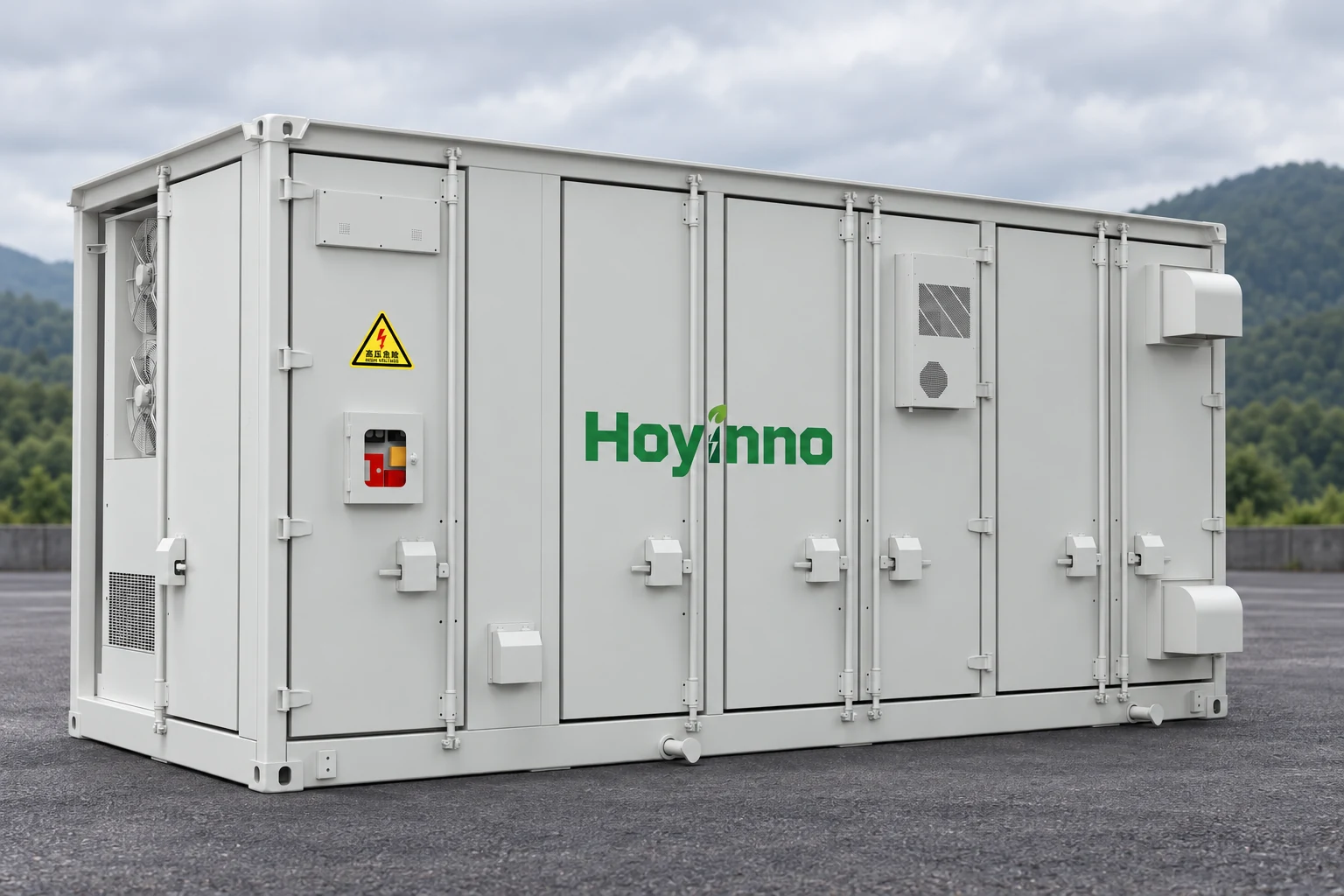
The inspected BESS product catalogue includes cabinet and container formats. The 5.016 MWh container product is one declared equipment example. Its page lists nominal energy and power values, but these do not independently establish usable energy at a project boundary, site acceptance results, or the scope of a delivered installation.
Require the offer to identify the configuration to which its evidence applies: battery arrangement, conversion equipment, software version, thermal system, included auxiliaries, and relevant interfaces. The visible enclosure illustrates product form; it cannot prove the contents of a purchase specification or the performance of a commissioned system.
Define The Measurement Boundary In Plain Language
State whether energy is measured at a DC connection, inverter AC terminals, or the site's agreed connection point. Identify which auxiliary loads and conversion losses fall inside the calculation. Two efficiency figures can differ because their boundaries differ, even when both measurements were performed correctly.
Keep Starting Conditions And Duty Cycles Comparable
A performance result is meaningful only together with the conditions under which it was obtained. State of charge, temperature, prior operation, available grid power, and the requested duty can all affect what a system delivers. Selection should expose these assumptions before they become disputes during handover.
Record The Initial State And Operating Limits
Specify how the starting state is established and recorded, including the permitted operating range and the conditions for returning to a comparable state. A controller's displayed state of charge is an estimate, not a substitute for the agreed test method. The agreed duty profile and acceptance plan should explain how that estimate is used and what uncertainty remains.
Use A Duty Profile That Represents The Intended Service
DOE energy-storage testing material distinguishes baseline measurements from application-oriented duty cycles. That distinction is useful in procurement: a capacity result may establish one characteristic, while a representative sequence reveals whether the system can support the intended pattern of operation. Neither result is a universal pass for every service.
For BESS solutions serving variable loads, a representative profile should include the changes that matter to the requirement. It may need sustained discharge, recovery periods, changing commands, or reserve restrictions. The profile and acceptance limits should be agreed before execution. A convenient steady-state demonstration cannot silently replace a dynamic requirement.

Choose Metrics That Answer The Selection Question
Metrics should connect directly to the promised service and use consistent definitions. Adding more numbers does not improve the comparison if their boundaries or conditions remain unclear. A concise matrix of acceptance conditions is often more useful than a long unqualified specification sheet.
| Metric | Definition To Agree | Selection Risk If Omitted |
|---|---|---|
| Usable delivered energy | Boundary, initial state, end condition, power level, and included loads | Nominal battery energy mistaken for deliverable site energy |
| Sustained power | Duration, environment, operating range, and permitted derating | A short peak treated as a continuous capability |
| Round-trip efficiency | Complete cycle, meter locations, auxiliary treatment, and restoration condition | Unlike accounting boundaries compared as equivalent |
| Command response | Trigger time, measured response, tolerance, and logging resolution | A display update mistaken for physical system response |
| Availability | Observation period, excluded events, service readiness, and downtime classification | An undefined percentage concealing different service obligations |
Avoid Double Counting Energy And Reserve
If an offer promises both routine energy shifting and outage support, check how reserve limits constrain normal operation. The selection model should use the energy actually available to the scheduled duty after the agreed reserve and operating restrictions. A larger nominal number does not resolve a conflicting control policy.
The analysis service description provides a relevant place to frame modelling questions. The required output is a set of explicit assumptions and scenario results, including limitations. It should not be a guaranteed financial outcome inferred from a generic demonstration or an unrelated installation.
Make Data Quality Part Of Acceptance
Agree the source of each measurement, timestamp convention, sampling interval, calibration evidence where relevant, and treatment of missing data. A smooth dashboard curve may be useful for operations but insufficient to assess a rapid transition. The logging system must be capable of resolving the behavior that the acceptance condition describes.
DOE's operational-validation work emphasizes structured data from multiple system scales. The procurement implication is to make evidence interpretable: identify equipment, conditions, units, and time references consistently. This does not mean a particular supplier has passed that initiative or that participation replaces the project's own acceptance requirements.
Include Control Behavior And Interface Failure Cases
The energy management system information introduces control functions, but the offered project needs a specific account of command ownership, operating modes, reserve priorities, and alarm handling. Confirm what happens when two command sources disagree, communication becomes unavailable, or a required input is invalid. These questions should be resolved in a reviewed test plan.
Failure-case assessment must remain within an authorized engineering and commissioning process. It does not require deliberately creating unsafe conditions. Qualified personnel can choose appropriate simulations, staged checks, or other approved methods to demonstrate behavior while preserving protective functions and site permissions.

Separate Factory Evidence From Site Acceptance
Factory and site activities should have distinct purposes and a clear handover between them. Factory checks can establish aspects of assembly and configuration under controlled conditions. Site acceptance addresses the installed system, actual interfaces, and project requirements that could not be demonstrated in the factory environment.
The engineering service scope is relevant to responsibility allocation. Confirm who prepares the test plan, provides instruments, coordinates site access, records exceptions, and approves completion. A delivery schedule should show these dependencies instead of treating acceptance as a signature immediately after unloading.

For BESS solutions, conditional handover should never be a vague promise to resolve everything later. If a limited handover is appropriate under the project agreement, record the permitted scope, remaining restrictions, outstanding items, and decision authority. Required safety and operating permissions must be established through the applicable qualified review, not inferred from a commercial acceptance form.
Preserve The Baseline For Operation And Future Changes
The accepted configuration and results should remain usable after the project team leaves. Deliver organized records that connect the equipment identity, configuration, measurement definitions, executed scenarios, results, exceptions, and approvals. File names alone are not enough if the operator cannot determine which version governs the installed system.
Frequently Asked Questions
Does A Nameplate Capacity Establish Usable Energy?
No. Usable energy depends on the agreed operating range, measurement boundary, duty, conditions, and included loads. A nominal rating is a starting point for configuration selection, not the complete definition of delivered service.
Can Factory Testing Replace All Site Checks?
No. Some equipment and configuration checks can be completed before shipment, but actual site interfaces and installation conditions need appropriate verification. The project plan should define which evidence belongs at each stage.
Is The Highest Efficiency Figure Always The Best Offer?
Only comparable definitions support that conclusion. Confirm meter locations, cycle conditions, power level, auxiliary treatment, and restoration to the agreed end state before comparing percentages.
What Should Happen If Test Data Are Missing?
Record the gap and assess whether the result can still answer the agreed criterion. If it cannot, classify it as inconclusive and define a justified next step. Do not convert an absence of evidence into a passing result.
When Should Acceptance Criteria Be Finalized?
Define essential criteria during selection and resolve project-specific details before execution. Late agreement allows the test to drift toward whatever the equipment happens to demonstrate rather than what the project actually requires.
Selection is strongest when each promise has a defined observation, each observation has interpretable evidence, and each unresolved condition has an owner. That structure turns an equipment offer into a service requirement that can be evaluated and maintained over time.
 Commercial Battery Storage Solutions Can Outgrow An Unchanging Design
  Address: A401, Junxu Junchuang Park, 03A Qingyi Road, Nanhai District, Foshan City, Guangdong Province, China





