



 Home
Home
Commercial Battery Storage Solutions Can Outgrow An Unchanging Design
Commercial battery storage solutions should be selected against both current demand and credible changes in how the site will operate. New equipment or operating hours can change the duty. Planning for those changes requires more than reserving space for another cabinet.
Identify The Change Before Increasing The Capacity
The first decision is whether the future constraint concerns power, energy, timing, or continuity of service. Those constraints can move independently. A larger energy rating does not necessarily solve a higher instantaneous load, and a larger inverter does not supply unlimited operating duration.
Separate A Taller Peak From A Longer Peak
A short, higher demand event may require more discharge power, while a longer event at the same power may require more usable energy. A new process can cause both. The load profile should therefore show when the additional equipment operates, how long its demand persists, and whether other equipment runs at the same time. Monthly consumption alone cannot reveal these relationships.
A simplified example illustrates the distinction. An additional constant 50 kW load running for two hours represents 100 kWh of energy before considering losses or other constraints. If the original system lacks 50 kW of available discharge power at that moment, adding energy alone does not remove that power limit. This arithmetic is a planning illustration, not a cabinet sizing recommendation or a promised operating result.
Distinguish Growth From A Shift In Schedule
A change of schedule can alter storage duty without greatly changing total consumption. Evening production may reduce direct use of daytime solar and increase later discharge needs. A night shift can shorten charging or maintenance windows. Identify planned changes separately from measured history.
NLR's REopt guidance explains the value of interval load data and the difference between normal and critical loads. Reference building profiles can help explore an early concept, but they are not a substitute for the actual site's measurements. The site's system analysis service is a relevant starting point for discussing the input data and assumptions needed for a project-specific evaluation.
Read The Cabinet Specification As One Part Of The System
A catalogue cabinet establishes a product format and a set of declared nominal parameters. It does not establish the delivered performance of a complete installation under every future operating condition. System selection must connect the cabinet to conversion equipment, controls, site connections, and the intended duty.
Keep Nominal Ratings Distinct From Available Service
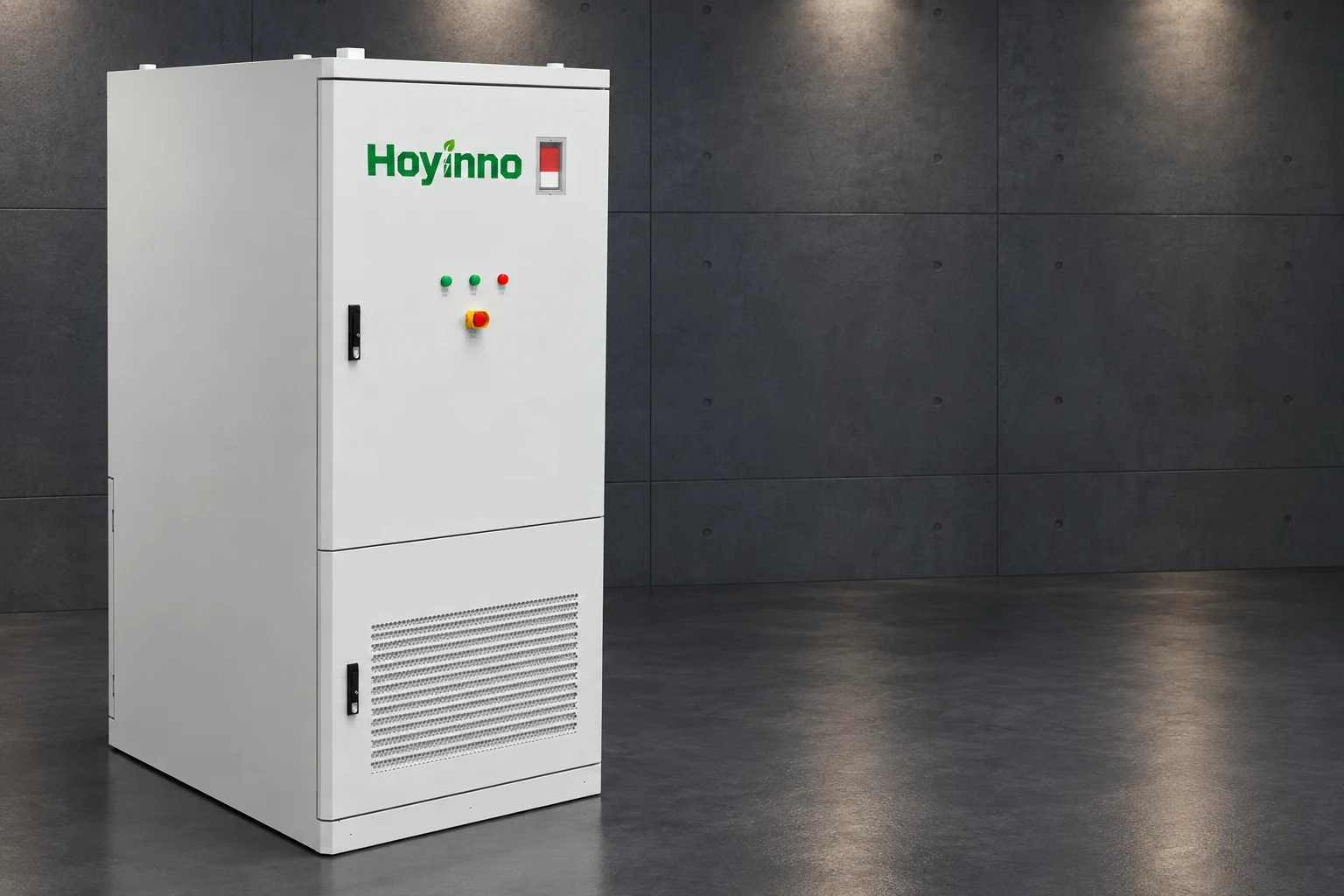
The listed 233 kWh liquid-cooled cabinet combines storage with EMS and PCS functions and lists a nominal 105 kW power rating. These are catalogue declarations, not evidence that any proposed site will receive that output for a particular duration. Usable energy, permitted operating range, auxiliaries, conversion losses, ambient conditions, and operating reserves need definition in the configured proposal.
The product gallery is also shared across related cabinet pages. Appearance alone cannot distinguish a capacity variant or establish its internal configuration. A quotation and technical schedule should identify the exact model and the included functions. Commercial battery storage solutions should be compared on that configured boundary, with missing information recorded as an open question rather than filled in from a similar photograph.
Locate The Limit Outside The Battery
An inverter, feeder, transformer, protection arrangement, connection agreement, or control interface may impose the limit. Extra battery energy cannot remove every constraint. Use the current design to identify spare capability and parts needing further engineering review. A modularity claim alone does not answer those questions.
The BESS product range includes several cabinet and container formats. Comparing them can clarify the scale of available products, but a catalogue progression is not an approved migration path between models. Confirm permitted combinations and the support boundary for the actual configuration before treating a later addition as a routine purchase.
Test Future Scenarios Against The Same Decision Questions
Use a small set of plausible operating scenarios, not a single optimistic forecast. Each scenario should preserve the same measurement boundary and clearly state the changed inputs. This makes it possible to see whether the preferred system remains useful or merely looks attractive under one assumed schedule.
| Potential change | Input to revise | Constraint to reassess | Evidence needed |
|---|---|---|---|
| Additional daytime process | Coincident interval demand | Discharge power and site connection | Equipment schedule and revised demand trace |
| Longer evening operation | Duration and timing of demand | Usable energy and recharge window | Operating calendar and dispatch assumptions |
| More solar generation | Generation timing and export conditions | Charging power, available headroom, controls | Generation study and current connection limits |
| Additional essential loads | Critical-load definition | Reserve energy and supported outage duty | Load schedule and backup operating requirements |
| Another storage cabinet | Equipment and software versions | Electrical and control compatibility | Approved configuration and integration scope |
Preserve The Shape Of Each Scenario
A load profile scaled by one percentage can be a useful sensitivity case, but it should not be mistaken for a detailed forecast. Different changes may occur at different hours or only in certain seasons. Separate the measured baseline, committed equipment additions, and uncertain growth. Document the source and confidence of each assumption so the result can be revised when the operating plan becomes clearer.

Keep The Backup Requirement Visible
If continuity during an outage matters, define which loads must remain supported and for how long under the agreed conditions. Those loads need not equal the whole facility's normal demand. Adding a process may increase commercial consumption without adding to the critical-load requirement, or it may introduce a new essential service. The decision must be explicit because a reserve used for backup can reduce energy available for other dispatch objectives.
Commercial battery storage solutions also need a clear distinction between grid-connected operation and the proposed outage mode. A battery rating alone does not establish islanding capability, transfer behavior, or supported starting loads. Those functions and their validation belong in the configured system proposal, with qualified engineering review for the actual installation.
Check What Expansion Means For Controls And Support
Expansion compatibility includes the way equipment communicates, shares operating limits, and responds when part of the system is unavailable. It should be supported by a defined configuration rather than inferred from matching cabinet colors or the same manufacturer name.
Ask For A Defined Supported Configuration
Record permitted equipment combinations, software versions, interfaces, and the supported arrangement. Identify who confirms compatibility when later equipment differs. A controller change or separately integrated system may be needed; modularity does not establish compatibility with every future equipment generation.
The site's energy management system information provides context for discussing dispatch and monitoring functions. For selection, translate that context into specific questions: how are limits assigned, where is the site measurement taken, and what happens when a communications link or one cabinet is unavailable? The proposal should identify the supported behavior and the evidence required to demonstrate it.

Define The Boundary Between Existing And Added Equipment
Expansion can combine equipment with different service histories, configurations, and support terms. Confirm whether those differences are supported and how combined capability is assessed. Identify who evaluates the arrangement, updates documentation, and supports faults spanning the existing and added equipment.
Reserve More Than An Empty Patch Of Ground
Physical space is only one part of an expansion plan. Access, foundations, cable routes, equipment handling, service arrangements, and the effect of additional equipment on the site design all need review. The correct requirements depend on the configured equipment and local project conditions; a product photograph cannot establish them.
The engineering service description can frame the scope of that review. Ask which drawings, studies, approvals, and commissioning activities are included now and which would be required later. Keep an expansion allowance distinct from installed and verified capability. A route shown on a concept drawing may still require detailed design before it can be used.

Make The Next Selection Review Conditional On Evidence
The strongest comparison identifies what would cause the current choice to be reconsidered. Examples include a confirmed new production shift, a changed critical-load schedule, a revised connection limit, or an unsupported equipment combination. These triggers connect future review to actual operating changes rather than to an arbitrary calendar date.
A simple decision record can state the selected operating scenarios, remaining constraints, supported expansion route, and evidence still required. Keep the assumptions dated and identify who maintains them. The site's operation and maintenance information is relevant to discussing how later performance observations and configuration changes will be documented, without assuming that a particular monitoring or support package is included.
Frequently Asked Questions
Does a modular cabinet guarantee easy expansion?
No. Modularity describes a product approach, while a supported expansion depends on the exact equipment combination, electrical design, controls, site conditions, and integration scope. Ask for the supported arrangement and the conditions under which it applies.
Can monthly bills show how much extra storage is needed?
They provide useful consumption and tariff context but usually do not show the detailed timing of demand. Interval measurements and an operating schedule are needed to distinguish a higher peak from a longer peak and to assess the available charging window.
Should future growth be represented by one percentage?
A single percentage can support an early sensitivity check. It is less suitable when the change involves new equipment, different working hours, or a new critical load. Those changes should be represented explicitly so the analysis preserves their timing and operating purpose.
Can a cabinet image confirm the proposed capacity?
No. Related models can share the same external enclosure or marketing gallery. Confirm the model, configuration, nominal ratings, and usable service conditions in the technical schedule and supporting documents for the actual proposed equipment.
When should the original selection be reviewed?
Review it when measured duty or a confirmed operating plan moves outside the assumptions used for selection. A changed schedule, additional essential load, new connection constraint, or unsupported equipment revision is a concrete reason to revisit the design.
A credible expansion route keeps the present duty, future assumptions, and supported configuration connected. The useful question is whether the complete system can still deliver the required service after the change, and what evidence is needed before that conclusion can be accepted.
 Electrical Storage Solutions Need A Defined Delivered-Energy Boundary
  Address: A401, Junxu Junchuang Park, 03A Qingyi Road, Nanhai District, Foshan City, Guangdong Province, China





