



 Home
Home
Commercial Energy Storage Solutions Need An Agreed Dispatch Priority
Commercial energy storage solutions need an agreed operating priority before equipment size, tariff savings and backup duration can be compared. A site may want lower demand charges, more use of its solar generation and reliable support during outages. Those objectives can compete for the same stored energy. A useful selection process therefore starts by deciding which service takes precedence, when that priority changes and which loads may be interrupted.
The resulting operating policy should guide the equipment proposal. It needs a measurable objective, the data used to assess it, the reserve that must remain available and a clear response when forecasts are wrong.
Choose The Objective That Controls The Operating Schedule
Distinguish A Bill Reduction Target From A Power Limit
A bill reduction project should identify the charge it intends to change. Demand charges, time-based energy charges and other tariff components can respond differently to storage operation. A separate project may instead aim to keep site import below an agreed connection limit. Record the objective in terms that can be checked against the meter or connection requirements.
DOE's guidance on evaluating utility rates emphasizes reviewing the rate structure and facility operating characteristics together. Obtain the applicable tariff, billing interval and recent bills before assigning a savings target. The available benefit depends on actual charges, load timing, system limits and operating cost; it is not guaranteed by a product capacity.
State What The Backup Reserve Must Protect
Backup reserve should be tied to a defined load group and outage objective. List the essential circuits, the power they require, any starting demands and the duration the project intends to support. A reserve expressed only as a percentage is incomplete without knowing the energy available at that point and the loads it serves.
If continuity is the controlling objective, the energy reserved for it may be unavailable for daily tariff optimization. If bill reduction takes precedence, the site must understand the resulting limit on outage support. The selection decision should make that tradeoff explicit rather than promise both outcomes at their independent maximum.
Test Load And Tariff Assumptions At The Right Time Resolution
Build A Data Set That Includes The Difficult Days
Use interval demand data across representative operating periods, including seasonal changes, unusual production schedules and known high-demand events. Align timestamps, time zones and meter boundaries before combining records. A monthly energy total can hide the short peak that controls a demand charge or the evening load that exhausts stored energy.
Record missing intervals and assumptions instead of filling them with an unexplained smooth profile. Ask whether a proposed study models the current facility, a planned expansion or both. The site's analysis service description is a basis for discussing the study scope, not evidence that a particular savings calculation has been completed.
Check The Consequence Of A Missed Peak
A dispatch plan should explain what happens when demand rises earlier or lasts longer than forecast. The battery may reach its power limit, its permitted energy floor or a temperature-related operating limit before the event ends. Ask for sensitivity cases that change peak timing, duration and the available starting charge. Compare the resulting import profile with the actual tariff rules rather than assuming that every reduction has equal billing value.
For commercial energy storage solutions, the study should separate modeled benefit from a contractual performance commitment. Document the data period, weather assumptions, operating restrictions and costs included. NLR's REopt overview describes evaluation of distributed energy options against site objectives; a modeled result still depends on its inputs and is not a substitute for project-specific engineering or commercial terms.
Separate Equipment Format From Dispatch Policy
Cabinet and container formats describe physical system options, not the operating objective. Hoyinno's current 233 kWh cabinet page lists 105 kW rated power and an integrated configuration. The 5.016 MWh container product page presents a larger system family. These published examples establish different scales of offering; they do not show which size fits a particular commercial site or confirm a delivered configuration.
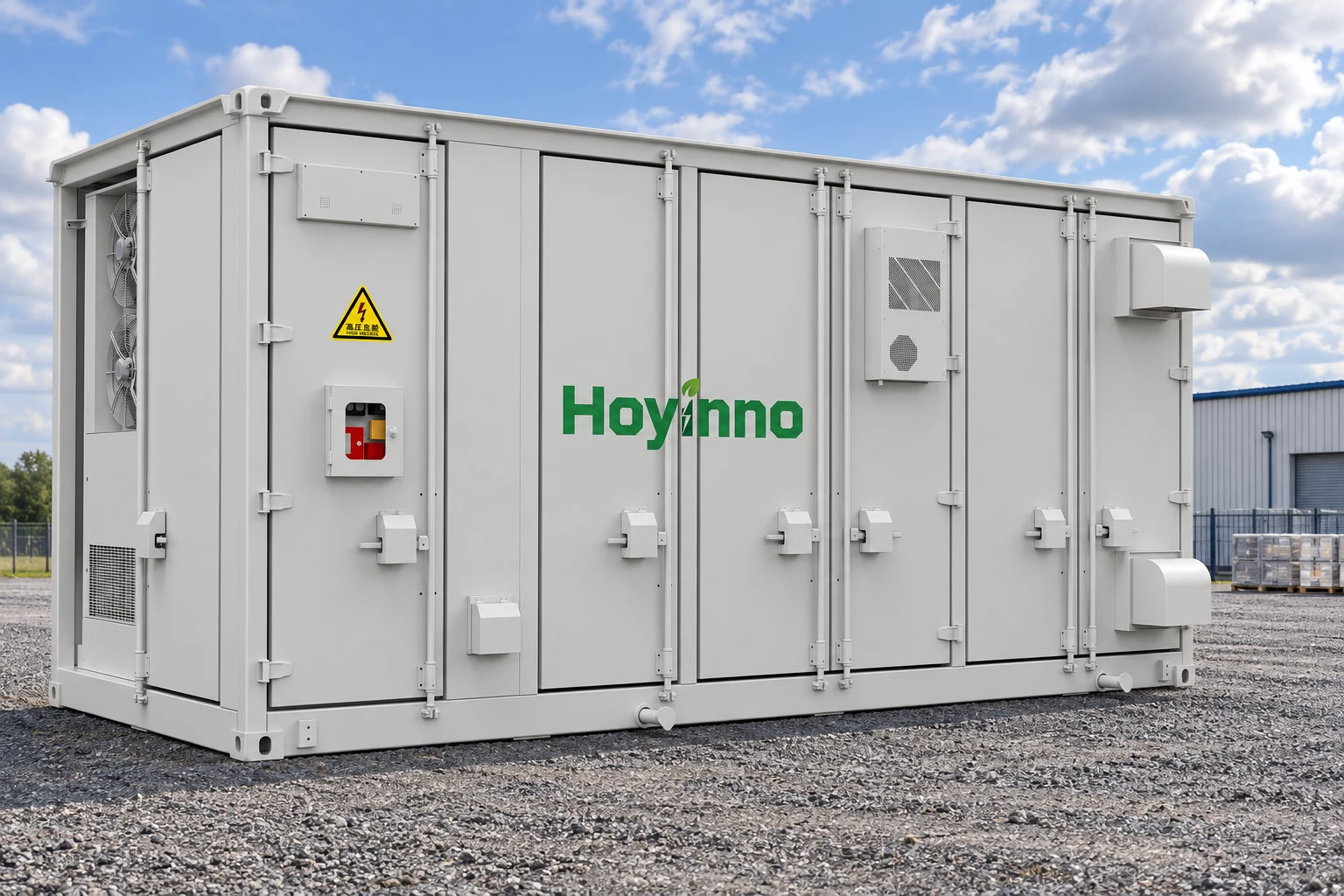
The regenerated scene retains the Hoyinno brand and readable warning label. Minor surface lighting and cabinet proportion differences do not establish dimensions, clearances or installation approval. The original product drawing and project design govern those details.
Compare Power And Usable Energy On The Same Boundary
Power limits how quickly energy can be supplied; usable energy limits how long a given output can continue under the stated conditions. As a simple illustration, 100 kWh delivered at a constant 50 kW would last two hours before allowing for losses or other restrictions. That arithmetic is not a product runtime guarantee. Energy delivered to the load, the permitted operating range, auxiliary consumption and conversion losses all need a defined measurement boundary.
Ask whether quoted values refer to battery DC capacity, converter output or energy delivered at the site connection. Confirm the conditions under which power and energy are available, including temperature, state of charge and aging assumptions. A design should also address installation access, service space, noise, electrical integration and applicable local approvals. Adding capacity does not resolve an unsuitable connection arrangement or an undefined control interface.
Account For Competition Between Solar Surplus And Stored Reserve
A solar-connected site needs both room to accept future generation and enough charge to meet later demand. Holding the battery nearly full for resilience can leave little capacity for midday surplus. Discharging earlier to create room can reduce outage readiness. The appropriate balance depends on the site's priorities, the ability to recharge and the uncertainty in the next operating period.

Define The Reserve Policy Across Different Operating Conditions
Backup reserve need not be treated as an unexplained fixed number. The project can evaluate whether different operating modes are justified by outage risk, forecast generation or a known critical event. Any proposed change must remain within approved operating limits and the agreed service objective. Define who can authorize the mode change, what information supports it and how the system returns to normal operation.
Also check the import or export rules that apply to charging and discharging. A site may have limits on grid charging, export or operation during a grid disturbance. Record those constraints in the operating study and control specification.
| Primary Objective | Input Needed | Control Question | Selection Caution |
|---|---|---|---|
| Reduce billed demand | Interval loads and applicable demand tariff | Which peak should trigger discharge? | A missed interval may reduce expected benefit |
| Shift energy use | Time-based rates and charging windows | When can energy be charged and released? | Losses and operating costs affect value |
| Use more solar generation | Generation, load and export constraints | How much headroom is needed? | Stored reserve can limit surplus absorption |
| Support essential loads | Critical circuits and outage objective | What reserve remains protected? | Backup capability requires system integration |
| Limit site import | Connection limit and load growth | What happens when storage reaches a limit? | A load-management response may still be needed |
Write A Dispatch Sequence That Can Be Reviewed And Tested
Give Conflicting Commands An Explicit Order Of Precedence
Dispatch priority should be stated as a sequence of decisions. Begin with equipment protection and mandatory operating limits, then identify how the agreed commercial objective and protected reserve interact. Define which command wins when an optimization request conflicts with a reserve requirement or site constraint. The detailed control design belongs with qualified system engineers, but the owner must be able to review the intended behavior in plain language.
The energy management system overview provides context for discussing monitoring and control. A project specification should go further: identify the source of meter data, update frequency, communication interfaces, allowed operating modes and response to lost information. Record who may change settings and how revisions are logged.

Include a fallback for unavailable forecasts, failed communication or a meter reading outside the expected range. The appropriate response may differ between grid-connected operation and an approved backup mode. Define how operators are alerted and what evidence shows that normal control has resumed.
Set Acceptance Evidence And Operating Responsibility Before Ordering
Test The Promised Behavior At The Relevant Interface
Acceptance should cover the selected service, not only whether the equipment powers on. Ask for an agreed test plan showing the operating mode, starting conditions, measured signals, acceptance limits and responsible witnesses. A demand-management test and an outage-support test answer different questions. Where a full site condition cannot be reproduced safely, document the alternative evidence and what remains unverified.
Use the engineering service scope to clarify integration responsibilities, including the interface with site switchgear, protection and other generation. Factory inspection may verify supplied equipment, while site acceptance must address the completed installation. Keep those evidence boundaries clear. The factory scene below is illustrative and does not certify a production line, completed test or delivered unit.

Commercial energy storage solutions also need an operating owner after handover. Define monitoring access, alarm escalation, maintenance responsibilities, spare-parts support and the process for revising settings. The published operation and maintenance service description can help frame those questions, but response commitments and exclusions must be confirmed for the project.
Frequently Asked Questions
Can One Battery Reduce Bills And Provide Backup?
It may support both objectives if the complete system and operating policy are designed for them. The same stored energy cannot be fully committed to two conflicting uses at once. State the reserve and priority rules, then assess the resulting performance for each service.
Does A Larger Energy Rating Always Mean A Better Solution?
No. Power, usable energy, connection constraints, control behavior and the load profile all affect suitability. Extra nameplate capacity may be underused or unable to solve a power-limited event. Compare the proposed operating result before comparing capacity alone.
Why Is A Monthly Electricity Bill Insufficient For Sizing?
A bill helps establish charges and historical totals, but may not show the timing and duration of peaks. Interval data is needed to understand when storage must charge and discharge. Missing or estimated data should remain visible in the study assumptions.
Does Solar Compatibility Prove Off-Grid Operation?
No. Independent operation depends on the complete electrical and control design, the required grid-forming capability, protection and approved transfer arrangement. Confirm those functions and their acceptance evidence separately from ordinary solar-connected operation.
What Should Be Compared Before Requesting Final Prices?
Compare the service objective, load and tariff assumptions, usable power and energy boundary, reserve policy, integration scope and acceptance plan.
A defensible selection starts with an operating policy that explains the tradeoffs. Equipment size, controls and acceptance evidence should all follow that policy.
 Battery Storage Solutions Depend On A Clearly Defined Delivery Boundary
  Address: A401, Junxu Junchuang Park, 03A Qingyi Road, Nanhai District, Foshan City, Guangdong Province, China





