



 Home
Home
How Does A Battery Energy Storage System Coordinate Power And Energy?
A battery energy storage system stores energy for later use while coordinating batteries, power conversion and controls to deliver electricity within defined operating limits.
The cabinet is the visible part of a much larger idea. Energy must enter through a suitable electrical path, remain within the battery's permitted conditions and leave at a rate the connected equipment can accept. Understanding those three activities explains why a large energy rating does not automatically mean high output power, long backup time or readiness for every application.
Follow Energy Through A Charge And Discharge Cycle
Charging Changes The Battery's Internal State
A rechargeable battery stores energy through reversible electrochemical processes. During charging, an external electrical source drives those processes in the charging direction. The battery is therefore neither a miniature fuel tank filled with electricity nor a generator with an unlimited fuel supply. Its available capacity and permitted charge rate depend on the particular technology and operating conditions.
In a common AC-connected arrangement, electricity passes through power electronics before reaching the battery as direct current. Other architectures use different coupling arrangements, especially when solar generation is involved. The physical connection diagram matters: a simplified explanation of one arrangement should not be treated as the wiring plan for every installation.
Discharging Requires An Accepted Electrical Path
During discharge, the stored energy supports an electrical current through an external circuit. The converter, switching equipment and protection must provide a compatible path to the intended load or network. A charged battery can still be unavailable if a protective condition, isolation state or control restriction prevents delivery.
Separate The Functions Hidden Behind The Enclosure
A battery energy storage system combines several functions that can be integrated into one cabinet or distributed across multiple assemblies. The boundaries vary by product. A product photograph helps identify an enclosure, but it does not reveal every internal subsystem, external connection or item included in a particular supply package.
| Function | Typical Role | What The Function Does Not Establish Alone |
|---|---|---|
| Battery cells and modules | Store energy through electrochemical processes | The complete installation's usable AC output or backup duration |
| Battery management system | Monitor battery conditions and communicate permitted operating limits | The site's economic dispatch strategy or full electrical protection design |
| Power conversion equipment | Convert electrical power between compatible DC and AC conditions where required | How much energy remains available in the battery |
| Energy management controls | Coordinate operating requests using measurements, schedules and configured priorities | Permission to exceed battery or converter limits |
| Thermal and protective equipment | Help maintain permitted conditions and respond to defined hazards or faults | Suitability for every environment or a particular compliance claim |
A Cabinet Is A Product Boundary, Not A Complete Diagram
Hoyinno's 522 kWh modular cabinet page is one example of the enclosure format. Its published energy figure identifies the marketed product; it should not be substituted for a verified usable AC energy value under a specific operating duty. The configured scope and supporting documentation determine how the cabinet participates in the wider system.
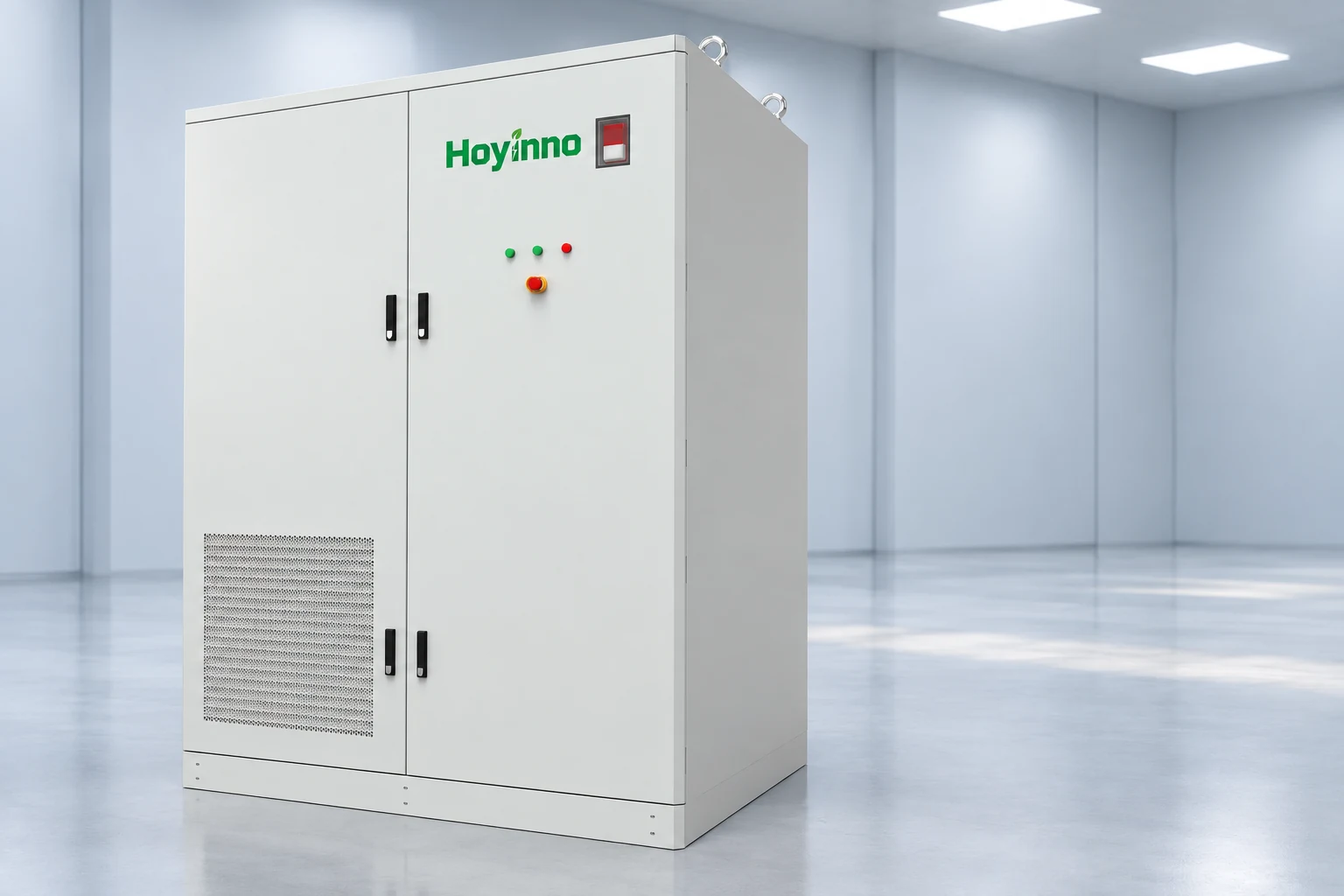
Larger formats, such as the listed 5016 kWh utility-scale product, change the physical scale without removing these functional distinctions. A larger enclosure still needs coordinated energy storage, conversion, control and protection. Product names are a starting point for understanding scope, not a complete operating model.
Read Power And Energy As Different Quantities
Power Describes The Rate Of Delivery
Power, commonly expressed in kilowatts, describes how quickly energy is transferred. It matters when a load changes, a motor starts or an installation must limit its import from the grid. The permitted output may be constrained by the converter, battery conditions, thermal limits or the connection itself. The smallest active constraint can govern the available response.
Energy Describes An Amount Over Time
Energy, commonly expressed in kilowatt-hours, describes an accumulated amount. A simple teaching example is 100 kW sustained for two hours, which corresponds to 200 kWh delivered at the measurement point. This is arithmetic, not a performance claim for a listed product. Real delivery depends on usable energy, losses, reserve settings and operating conditions.
Dividing energy by power gives an idealized duration only when the quantities refer to compatible boundaries. Battery-side nominal capacity divided by AC load power can overstate an achievable result. A duration statement should identify the energy actually available to the load and any assumptions about temperature, aging, auxiliary consumption and changing demand.
Understand Why Timing Changes The Use Of Stored Energy
Storage shifts some energy from one time to another. It does not create additional primary energy. Charging during a period of available generation and discharging later can change the relationship between generation and demand, but the cycle consumes some energy through losses. The value of that shift depends on the site's purpose and operating constraints.

A Dispatch Request Needs A Feasible Energy Budget
A request to reduce grid import during an evening peak must be supported by sufficient charge beforehand. If generation is lower than expected, the controller may need to preserve a reserve or reduce the requested output. The useful question is how the scheduled request is reconciled with the energy actually available, rather than whether the schedule exists.
Different purposes can compete for the same stored energy. Energy reserved for an outage cannot simultaneously be assumed available for every routine discharge. An operating strategy needs priorities for these competing uses. Without those priorities, two individually reasonable performance expectations can describe a combination the installation cannot deliver.
The off-grid solution overview illustrates a different operating context. Independent supply requires suitable design and control capability; a grid-connected battery does not automatically provide it.
Distinguish Battery Limits From Operating Instructions
BMS, PCS And EMS Have Complementary Jobs
The battery management system, or BMS, monitors relevant battery conditions and supports protective limits. The power conversion system, or PCS, manages the electrical conversion within its permitted range. The energy management system, or EMS, coordinates requests according to the intended operation. Names and boundaries vary, but a higher-level request should remain subordinate to applicable equipment limits.
Consider a controller requesting discharge while the battery reports a reduced allowable current. The system should reconcile the request with that limit rather than interpret the schedule as permission to ignore it. Similarly, a full battery may restrict further charging even when generation is available. The visible outcome can be less power than originally requested without indicating that the basic energy calculation was wrong.

Hoyinno's EMS information describes monitoring and coordinated operating functions. These published capabilities provide context for the role of supervisory control. Their availability, configuration and behavior in a particular installation still depend on the supplied system and project implementation.
State Of Charge Is An Estimate With A Boundary
State of charge expresses an estimate of how much charge remains relative to a defined reference. It is useful for supervision, but it is not a direct promise of remaining AC energy or hours of service. The usable window, battery condition, load profile and conversion path all influence what can be delivered from that indicated state.
A display near its lower operating limit may still show some stored energy that the controls intentionally reserve. Conversely, an indicated high charge level cannot overcome a power limitation or an unavailable connection. Reading state of charge alongside operating permissions and measured power gives a more complete picture than interpreting the percentage in isolation.
Account For Conditions That Change Available Output
Temperature, aging and operating history can affect battery behavior. Cooling and other auxiliaries also consume energy. These influences are reasons to define the measurement boundary and test conditions when describing performance. They are not reasons to insert a universal correction factor into every calculation; the appropriate values must come from the actual system and duty.
Measured Performance Needs Comparable Boundaries
Charging energy measured at one point and discharge energy measured at another may include different losses or auxiliary loads. Before comparing results, identify the meters, time window and operating conditions. A consistent boundary makes the result interpretable. An apparently precise efficiency figure can otherwise conceal a comparison between unlike quantities.
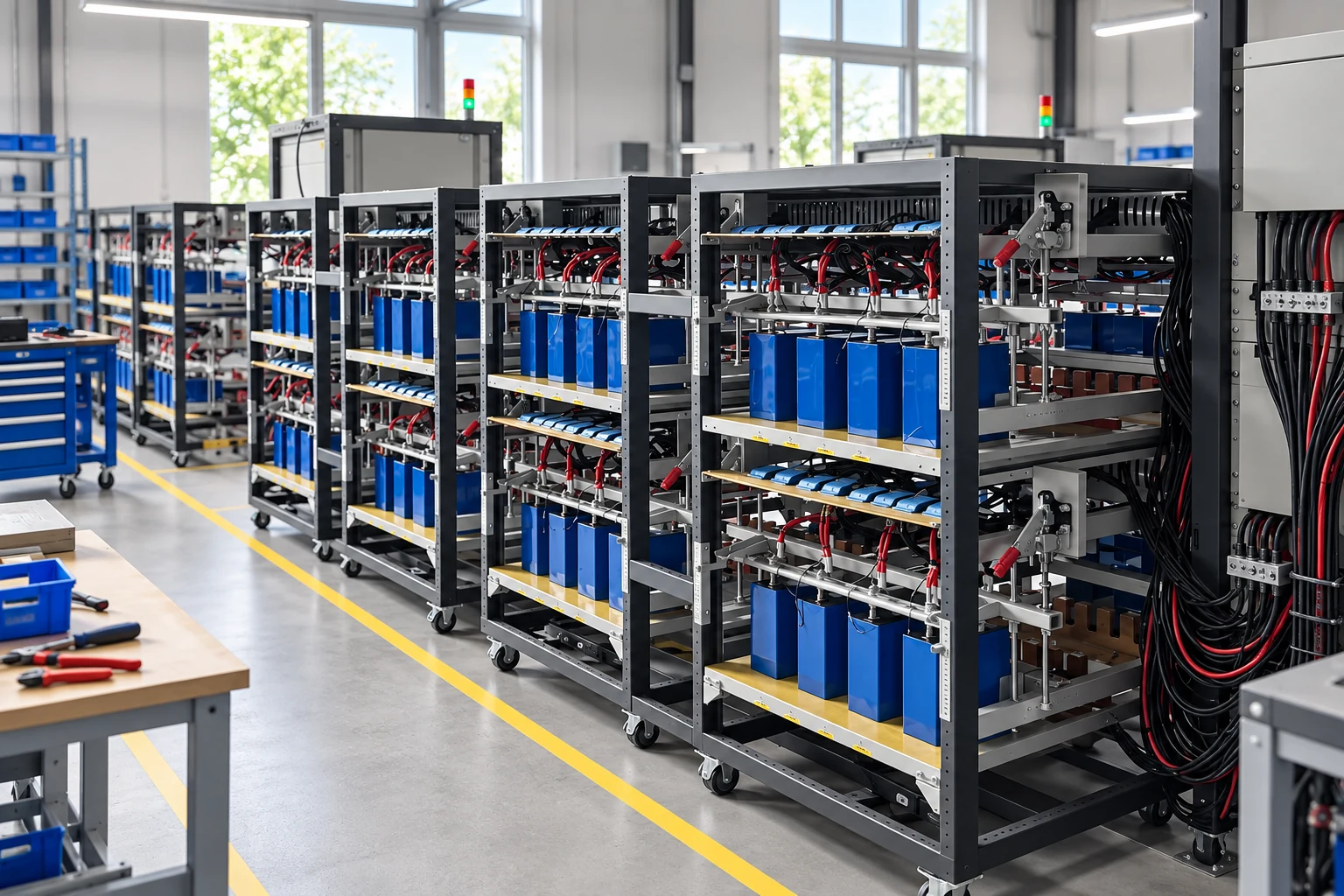
The operations and maintenance page provides service context. Actual procedures must correspond to the supplied equipment and its specific design.
Use The Functional Model To Read A System Description
A clear description should let a reader answer four questions: where energy enters, where it is stored, how it reaches the intended load and which limits govern that transfer. These questions connect the hardware to its behavior without turning an introductory explanation into a quotation checklist. The engineering overview places those functions in a project context.
For a battery energy storage system, neither a cabinet photograph nor one headline rating answers all four. The energy quantity describes an amount; the power quantity describes a rate; the controls coordinate requests; and the protection and operating limits define what is currently permitted. The system's behavior comes from their interaction.
Frequently Asked Questions
Is A Battery The Same Thing As A Complete Storage System?
No. The battery provides the storage function. A complete installation also needs an appropriate electrical path, controls, protection and supporting equipment. The exact items integrated into a cabinet or supplied separately depend on the product and architecture.
Does More Capacity Always Mean More Output Power?
No. Additional energy capacity can extend operating time at a given output, while power may remain limited by the converter, battery conditions or connection. Energy and power must be read as separate specifications with compatible measurement boundaries.
Can Every System Supply Loads During A Grid Outage?
No. Outage operation requires suitable design, switching, protection and control functions. The presence of stored energy alone does not establish an independent supply capability or a seamless transfer behavior.
Why Can Actual Duration Differ From A Simple Calculation?
Nominal energy may differ from usable energy at the load. Reserves, losses, auxiliaries, equipment limits and a changing load can all affect duration. A calculation is meaningful only when those boundaries and assumptions are stated.
Understanding storage begins with the distinction between an amount of energy and the rate at which it can be transferred. Following that energy through the battery, converter and controls explains both what the system can do and why its operating limits matter.
 Solar Battery Storage Works Within A Shared Energy Budget
  Address: A401, Junxu Junchuang Park, 03A Qingyi Road, Nanhai District, Foshan City, Guangdong Province, China





