



 Home
Home
Solar Battery Storage Works Within A Shared Energy Budget
Solar battery storage shifts available solar energy to another time, but daily loads, reserve settings and conversion limits determine how much energy reaches the site.
Follow The Energy Through A Typical Day
A photovoltaic array and a battery perform different jobs. The array produces electricity when sunlight and operating conditions permit. The battery accepts some available energy, holds it within operating limits and later releases part of it. Neither the cabinet size nor the array rating alone describes the energy that reaches a building at a particular hour.
Start With The Loads That Already Use Solar Output
During daylight, some generation may serve equipment immediately. Only the remaining energy is available for charging or export under the chosen controls. A busy production shift may consume nearly all the available output even on a sunny day. A quieter weekend may leave a surplus, although the battery still needs enough empty capacity to receive it.
This is why daily generation totals are only a starting point. Two sites can produce the same total energy but have different charging opportunities because their loads occur at different times. Interval records reveal the overlap. They should use a consistent clock and measurement boundary so that apparent surplus is not an artifact of mismatched data.
Treat A Daily Energy Budget As A Sequence
A useful explanation follows the morning load, midday surplus, evening demand and overnight reserve in order. Each period begins with the energy left by the previous period. An evening discharge cannot be assumed to start from a full battery if the day was cloudy, the daytime load was high or a control rule limited charging.
Solar self-consumption means using solar generation at the site rather than exporting it. Storage can move that use to a later period, but it cannot create the missing generation. A model that resets the battery to full every morning without accounting for the charging source will overstate what the system can provide.
Separate Energy Capacity From Instantaneous Power
Energy capacity describes an amount of stored energy; power describes how quickly energy can be delivered or received. The two limits interact but are not interchangeable. A long, modest evening load and a brief, large equipment start impose different requirements even if their total energy use happens to be similar.
| Quantity | Meaning | Key limit |
|---|---|---|
| Solar surplus | Generation left after direct use | Timing of site loads |
| Stored energy | Energy held within the operating window | Capacity and reserve |
| Output power | Rate of delivery | Converter and battery limits |
| Delivered energy | Energy received by loads | Losses and duration |
Read Usable Capacity Within Its Operating Window
The usable capacity depends on the permitted state-of-charge window, the battery condition and the stated measurement conditions. A reserve setting can make part of that energy unavailable for routine dispatch. Energy delivered at the building also differs from energy measured inside the battery because conversion and auxiliary equipment consume energy along the way.
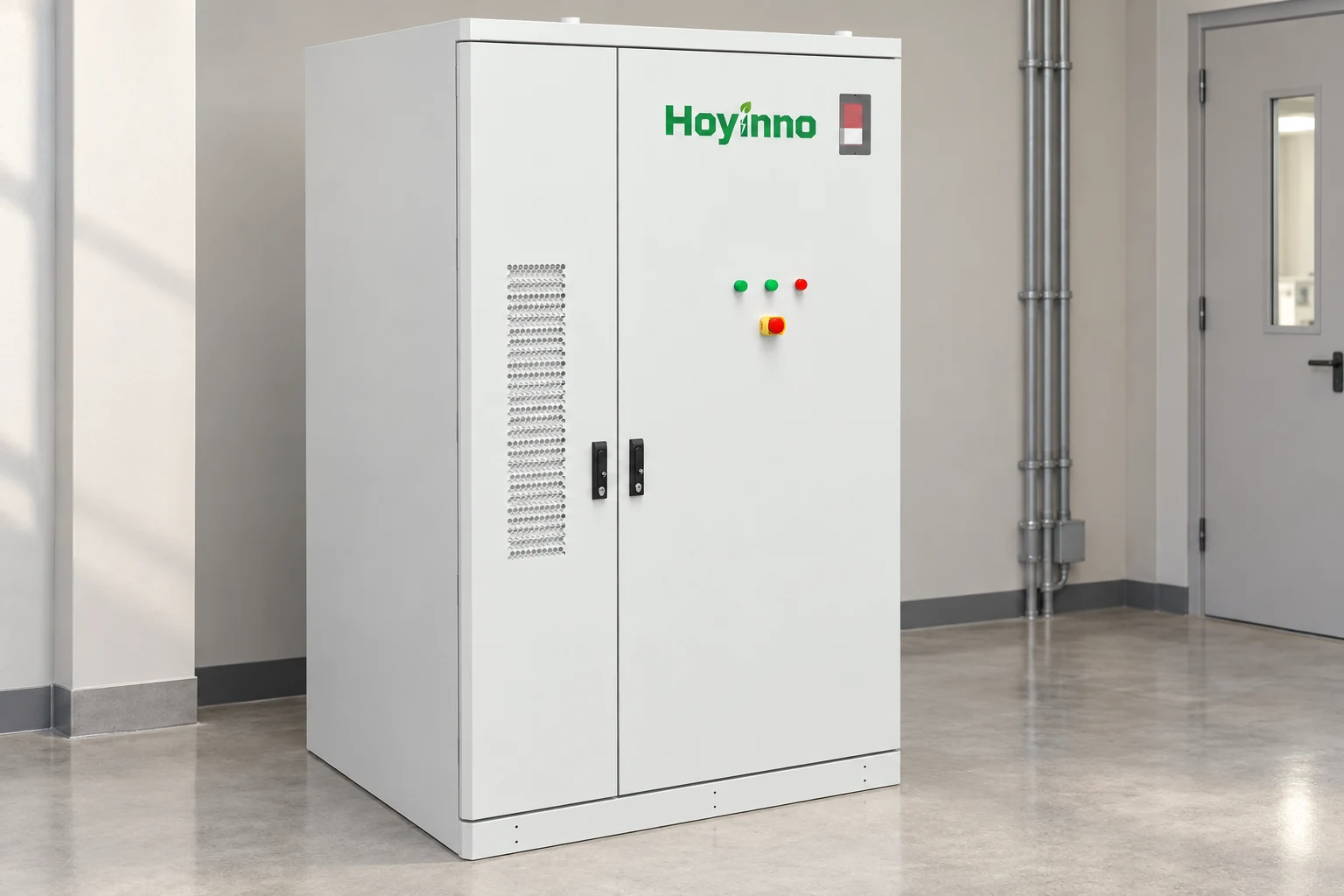
The 522 kWh modular cabinet page describes a particular product format. Its named capacity should be read with the applicable technical documentation. It does not by itself establish the duration of supply for an unspecified load or prove that every unit of the named energy can be delivered at the site meter.
Check Which Component Sets The Power Limit
The converter, battery controls, temperature limits and site connection may each constrain charge or discharge power. The active limit can change with conditions. Dividing a capacity figure by a load gives only a simplified duration estimate; it does not establish that the system can start that load or sustain its required power throughout the proposed period.
The 418 kWh liquid-cooled system is another published enclosure example. Its appearance illustrates a physical product boundary, not a complete installation diagram. A project description must identify the conversion equipment, protection and controls associated with the supplied configuration.
Give Solar Self-Consumption And Backup Separate Rules
A battery may be intended to absorb midday surplus, reduce an evening import or retain energy for a possible outage. These purposes can compete for the same stored energy. A clear operating description states which purpose takes priority when there is not enough energy to satisfy all of them.
Reserve Energy Changes The Routine Dispatch Budget
Keeping a larger reserve can leave less energy available for regular evening discharge. Conversely, using most of the available energy before an outage can leave little backup supply. The reserve should therefore be represented as an explicit control choice, with the load assumptions and expected charging opportunities recorded alongside it.
Critical loads are the circuits that the project intends to support during the defined interruption. They should be identified by actual function and demand rather than assumed to equal the entire site. Some equipment can be delayed or shed; other equipment may require continuous operation, a controlled shutdown or a separate continuity arrangement.
Understand What Changes When The Grid Is Unavailable
A system that operates alongside the grid does not automatically operate independently of it. During an outage, maintaining a local supply involves the appropriate isolation, protection, conversion and control functions. Those capabilities depend on the design and supplied equipment, not simply on the presence of a battery next to solar panels.
Distinguish Energy Availability From Island Operation
A charged battery may contain enough energy for a load while the installation lacks an approved way to energize that load during a grid interruption. Establishing a local voltage and frequency reference, handling load changes and coordinating other sources are separate engineering tasks. A general storage description should not imply that these functions are included unless the configuration confirms them.
The remote-area off-grid overview provides context for systems designed around independent supply. It should not be treated as evidence that any cabinet selected from a product list will provide the same operating mode. The complete project architecture determines how the sources and loads interact.
Make The Control Priorities Visible
Solar battery storage responds to instructions as well as physical conditions. A controller can prioritize reserve, respond to a site demand limit, observe an export restriction or follow an operating schedule. The same equipment can behave differently when these instructions change, so a useful system explanation includes the rules that govern dispatch.
Describe Conflicts In Plain Operational Terms
If midday generation is available while the battery is nearly full, the remaining energy needs another destination or may be curtailed. If the site demand rises while the battery is at its minimum reserve, a controller may preserve that reserve rather than discharge. These are consequences of explicit limits, not necessarily signs of equipment failure.
The energy management system overview introduces the coordination layer. A project-specific description should identify which measurements the controller receives, which devices it can command and how it handles unavailable or stale data. A display showing a target is not proof that every connected device can achieve it.
For solar self-consumption, the relevant control objective may be to store surplus and release it later while observing connection limits. For resilience, retaining energy may take priority. Both objectives can appear in one project, but their order and exceptions must be clear enough that operators can explain an unexpected charge or discharge decision.

Keep Losses And Measurement Boundaries Consistent
Energy entering a storage system is not identical to energy later delivered to the load. Conversion losses, battery losses and auxiliary consumption reduce the amount available. The size of those effects depends on operating conditions and equipment. A single efficiency value cannot explain every partial-load condition, temperature or standby period.
Compare Measurements At The Same Boundary
Generation measured before conversion, charging energy at an alternating-current meter and discharged energy at a building meter describe different boundaries. Comparing them without a diagram can create misleading conclusions. A consistent evaluation records the meter location, direction, interval and included auxiliary loads before interpreting the difference between totals.
The engineering services overview places the battery within a wider project context. For an actual installation, that context should become a documented connection arrangement and operating description. General website information cannot replace the project documents used to identify equipment limits and measurement points.
Read Performance As A Record Of Conditions
A daily operating record should connect generation, load, charging, discharge and reserve changes. It should also note interruptions, unavailable equipment and control changes. Without that context, low discharge may be mistaken for poor performance when there was little surplus to store, or when the reserve rule deliberately prevented discharge.
The operations and maintenance overview gives service context. Actual monitoring and maintenance procedures must match the supplied equipment. Clear records help separate a changed load pattern, an intentional dispatch restriction and a technical fault before a corrective action is chosen.
The energy budget for solar battery storage is straightforward: available generation and imported energy enter a limited system, while loads, losses and reserve commitments draw on that budget. Capacity, power and control choices determine the timing. Understanding these relationships establishes what the equipment description does and does not say about a particular site's energy supply.
Frequently Asked Questions
Does A Larger Battery Always Increase Solar Use?
No. Additional storage needs energy to charge it and a later load that can use the discharge. If the site rarely has surplus generation, or the controller retains most energy as reserve, extra capacity may see little use. The interval relationship between production and demand is more informative than capacity alone.
Can Storage Supply A Building Throughout An Outage?
That depends on the complete system design, the starting energy level and the loads included in the backup boundary. Critical loads must be defined, and the equipment must support the required operating mode. A battery capacity figure alone does not establish uninterrupted supply or a guaranteed duration.
Why Might Charging Stop Before The Battery Is Full?
Available solar surplus may disappear, a charge-power limit may become active, or a controller may apply a schedule or operating restriction. Temperature and equipment status can also affect charging. Interpreting the event requires the relevant measurements and control records rather than a single state-of-charge reading.
Is Daily Solar Generation Enough To Describe The System?
No. The timing of generation and consumption determines when energy is available to charge and when it is needed later. Two days with similar generation totals can produce different dispatch patterns. Consistent interval data also reveals short power demands that a daily total hides.
What Does Usable Capacity Mean In A Project Explanation?
It is the energy available within the stated operating limits and measurement conditions. The portion assigned to routine use may be reduced by a backup reserve. A clear explanation identifies that boundary and distinguishes stored energy from energy ultimately delivered through the conversion equipment to the loads.
 Where Does Solar Energy Battery Storage Connect To The Power Path?
  Address: A401, Junxu Junchuang Park, 03A Qingyi Road, Nanhai District, Foshan City, Guangdong Province, China





