



 Home
Home
Off Grid Solar Suppliers Must Account For The Complete Delivery Scope
Evaluate off grid solar suppliers against a complete delivery scope covering demand assumptions, controls, acceptance testing and service responsibilities.
A list of panels, batteries and inverters does not establish who will make a remote power system work as a whole. The commercial proposal needs to connect the equipment to a defined operating requirement and a responsible team. The strongest comparison is therefore a review of deliverables, assumptions and unresolved interfaces. Cabinet capacity and purchase price become meaningful only after that common boundary is established.
Establish What The Supplier Is Actually Delivering
Begin by distinguishing an equipment shipment from an engineered operating system. A manufacturer, distributor, integrator and installation contractor may each provide a legitimate part of the project. The evaluation must identify which part is offered and which obligations remain with others.
Name The Party Responsible For System Integration
Ask for one accountable organization to coordinate the solar generation, storage, conversion equipment, protection, controls and connected loads. Coordination does not mean every item must come from one factory. It means that interface decisions have an owner and that the owner can demonstrate compatibility for the proposed configuration. A promise that each component meets its own data sheet leaves important system questions unanswered.
Request a project-specific equipment list with model identifiers and controlled document revisions. Compare that list with the quotation and proposed drawings. A change to a component should trigger an assessment of affected interfaces and tests. The current BESS portfolio illustrates different equipment formats; a catalogue entry alone does not define a complete autonomous power package.
Separate Hardware Identity From Operating Capability
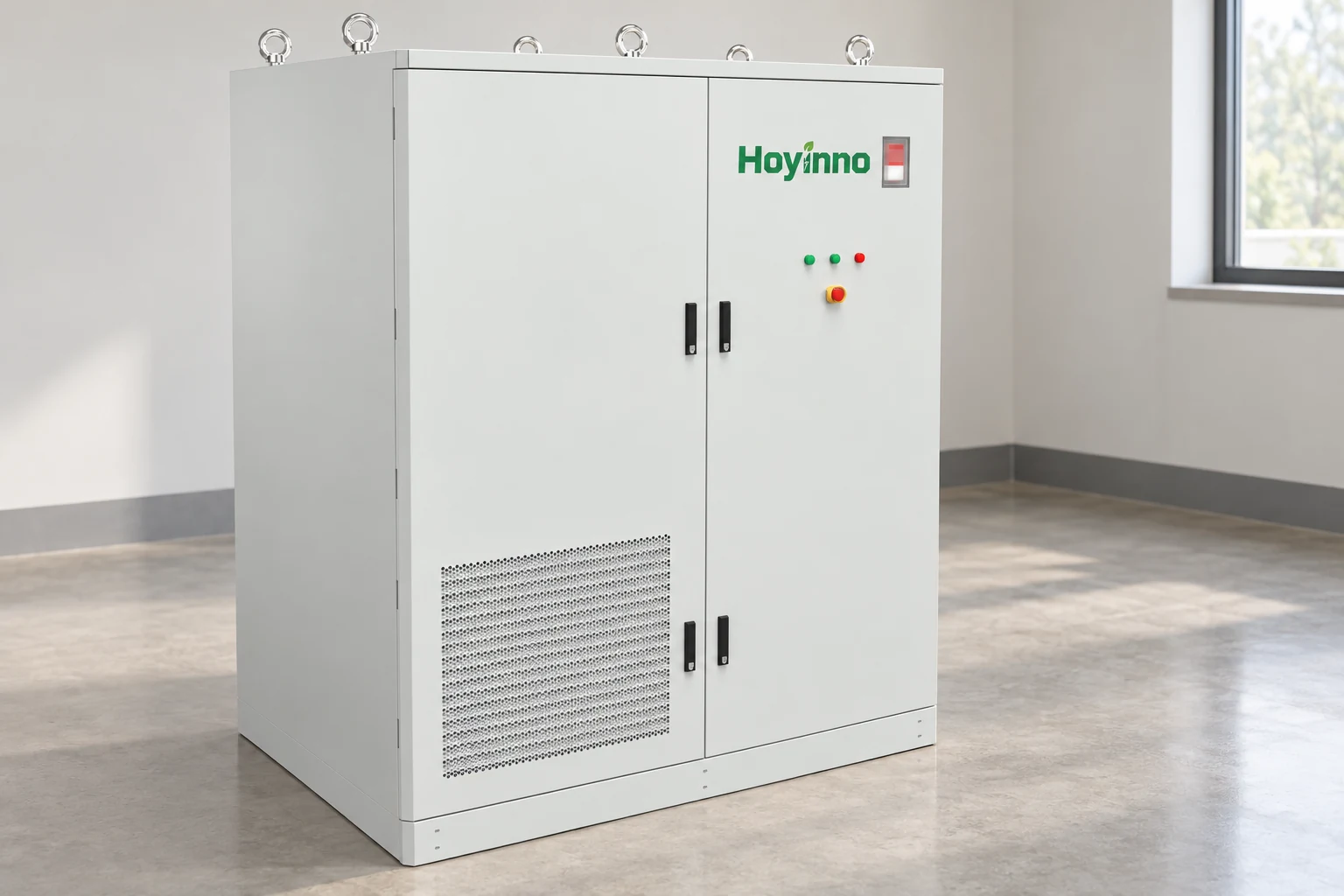
A battery enclosure shows physical equipment, not the operating behavior of the connected system. The proposal must identify the conversion and control configuration needed for the intended independent supply. Confirm start-up, load changes, low-energy operation and recovery as explicit functions. Do not infer these functions from a cabinet photograph, a nominal energy value or a generic description of hybrid operation.
For example, the site presents a 522 kWh storage cabinet and a containerized storage product. These are identified equipment examples, not a recommendation that either size suits a particular remote site. The required usable energy, power capability and control behavior must be checked against the project requirement and the selected configuration.
Make Demand And Resource Assumptions Reviewable
A supplier should explain what information the design uses and where uncertainty remains. A single monthly energy total may hide short demand peaks, starting events and long periods without useful generation. Ask for a load profile and a resource basis that match the decisions being made.
Distinguish Essential Demand From Deferrable Work
List the loads that must continue, the loads that may be interrupted and the activities that can be scheduled. Record operating times and relevant starting behavior with the site team. If reliable measurements are unavailable, mark the estimates and explain how the design will be checked when better data arrives. Uncertainty should be an input to the evaluation, not a fact hidden inside a safety margin.
Review Difficult Periods As Well As Typical Production
Annual energy totals do not describe every period an independent system must serve. Request the seasonal resource assumptions, the sequence of low-generation conditions considered and the recovery strategy afterward. The aim is to understand the proposed service boundary and its limitations. A general renewable-energy illustration or an average sunshine figure cannot establish continuity at a named site.
Department of Energy guidance describes solar generation, storage and other system components as parts that must work together. Its microgrid material also distinguishes independent operation from ordinary grid-connected generation. Those principles support a supplier review focused on system behavior; they do not provide a project-specific sizing result or prove the performance of any offered product.

Allocate Every Interface Before Comparing Prices
The delivery scope should identify documents, physical works, tests and handover obligations. Use the same matrix for each bidder and keep exclusions visible. This prevents a component-only offer from appearing directly comparable with a proposal that includes substantial engineering and field work.
Give Each Exclusion A Named Owner
For every excluded item, record who will provide it, what information they need and when it must be ready. Examples include site preparation, transport access, local installation, communications and required approvals. These are topics to allocate with qualified project specialists, not a universal construction checklist. The final allocation should match the location, system configuration and contract.
| Project Boundary | Supplier Evidence | Decision Before Award |
|---|---|---|
| Design basis | Demand and resource assumptions with stated uncertainty | Which inputs are accepted, measured or still provisional? |
| Equipment integration | Configuration, interface list and controlled drawings | Who owns compatibility and configuration changes? |
| Factory release | Agreed test procedure, records and exception list | Which results permit shipment? |
| Site acceptance | Commissioning plan and operating demonstrations | Who witnesses, records and closes outstanding items? |
| Service handover | Training, access, spares and escalation arrangements | Who can restore service when remote support is insufficient? |
Hoyinno's service overview can provide topics for this discussion, but each advertised activity requires confirmation for the actual project. The reviewed engineering page currently presents analysis-oriented material. Its navigation label should not be treated as proof that a particular drawing package or field engineering service is included in a quotation.
Turn Performance Promises Into Witnessable Tests
Acceptance testing should be agreed before equipment is shipped or installed. Define the behavior to be demonstrated, the starting conditions, the measurements and the rule for handling an exception. A supplier's standard test may be useful, but its scope must be compared with the project's actual operating requirement.
Keep Factory Release And Site Acceptance Distinct
Factory checks establish specified aspects of the equipment before shipment. Site acceptance addresses the installed configuration and its interaction with the local loads and other project elements. A successful factory record cannot automatically close site-specific questions. Conversely, a field demonstration should not replace missing equipment identification or release records.
Ask off grid solar suppliers for a test matrix that links each claimed function to its evidence. Candidate topics include controlled start-up, representative load changes, communication loss handling and recovery from an agreed low-energy condition. Qualified personnel must define safe procedures appropriate to the actual design. The procurement requirement is a clear demonstration and record, not an improvised live electrical experiment.

The record should preserve configuration versions, test conditions, observations and unresolved issues. Define who may accept a deviation and which changes require a repeated test. This makes acceptance testing a controlled decision rather than a collection of photographs taken when the equipment appeared to be operating.
Evaluate Service Against The Site's Real Constraints
Describe The Escalation Path Beyond A Remote Login
Ask what information the support team needs, how an incident is opened and who takes responsibility when remote action is insufficient. Clarify authorized access and the process for approving configuration changes. Keep a record of changes and ensure that the operating team can identify the current configuration. Avoid making the ability to restore service depend on an undocumented personal account.
The published operation and maintenance services describe monitoring, inspections and repair-related activities. Confirm which are included, which require a separate agreement and which depend on local partners. Response targets, travel arrangements and spare availability should be written commitments if they are material to the project; do not infer them from a general service statement.

Compare The Cost Of An Equivalent Obligation
Normalize quotations after the technical and service boundaries have been resolved. Show equipment, engineering, tests, logistics, site work, training and ongoing support separately where practical. Record assumptions for items that remain provisional. A headline price should never silently absorb an unresolved design or access question.
A site inspection and a review of the offered analysis services may help resolve assumptions before award. Confirm the specific deliverable first. A general resource or financial analysis is different from a signed design responsibility, an installed system guarantee or an acceptance result.
Keep Open Conditions Visible At The Award Decision
Use a short decision record that separates confirmed evidence from outstanding conditions. It should identify the selected configuration, accepted demand basis, unresolved exclusions and the person authorized to close each item. A technically promising proposal can remain conditional without being described as fully approved.
- Agree the operating requirement and the information used to define it.
- Reconcile equipment identities, interfaces and responsibilities across the proposal.
- Approve the required factory and site evidence before shipment decisions.
- Confirm the support path and the documents needed by the operating team.
- Record remaining conditions and their effect on authorization to proceed.
Frequently Asked Questions
Can A Battery Cabinet Alone Establish Off-Grid Capability?
No. The complete conversion, control, protection and load arrangement determines operating behavior. Confirm the proposed configuration and its evidence rather than treating an enclosure or nominal energy rating as proof of an autonomous system.
Should Every Component Come From One Manufacturer?
Not necessarily. Multiple manufacturers may be appropriate when integration responsibility, compatibility and change control are clear. The unresolved risk is a gap between suppliers in which no organization owns the system-level requirement.
What Makes Two Quotations Comparable?
They must address the same operating requirement, input assumptions, equipment boundary, evidence and service obligations. Differences can remain, but they need to be visible and priced consistently. Comparing only panel power or battery energy leaves much of the delivery obligation outside the comparison.
What Evidence Should Be Requested First?
Ask off grid solar suppliers for a concise basis of design, a responsibility matrix and an outline of factory and site tests. Those documents reveal major gaps before detailed commercial negotiations and help identify which additional measurements or specialist reviews are needed.
Submit the site demand record and a draft responsibility matrix through Hoyinno's project consultation page, requesting a marked-up response that identifies included work, exclusions and the evidence proposed for acceptance.
 How Does A Battery Energy Storage System Coordinate Power And Energy?
  Address: A401, Junxu Junchuang Park, 03A Qingyi Road, Nanhai District, Foshan City, Guangdong Province, China





