



 Home
Home
How Should An Off Grid Solar Power Setup Progress From Load Survey To Commissioning?
An off grid solar power setup becomes dependable when measured loads, solar yield, battery autonomy, controls, protection, and commissioning are treated as one project sequence. The practical starting point is evidence about the site and its operating duties, not a shopping list assembled from unrelated component ratings.
Start By Defining The Service The System Must Deliver
A useful setup brief defines what electricity must accomplish during normal days, poor-solar periods, maintenance, and faults. It separates essential services from deferrable loads, names permitted interruptions, and prevents an annual energy total from being mistaken for a peak-demand profile.
Measure Demand As A Timeline, Not A Single Number
A load profile survey should record power over time, identify starting currents and overlapping loads, and explain seasonal or production-driven changes. Hourly or finer data is more useful than a monthly bill because the inverter must meet short peaks while the battery covers energy over longer intervals. A structured system analysis labels missing measurements and tests assumptions through sensitivity cases instead of presenting them as facts.
Convert Reliability Expectations Into Operating States
“Reliable” needs a testable meaning. The brief should define normal solar operation, battery-supported night operation, low-state-of-charge behavior, backup-generator operation if one exists, planned maintenance, and safe shutdown. Each state needs a permitted load, a control priority, and a recovery rule. The battery autonomy target is then tied to critical services and expected low-solar conditions, rather than copied from a generic number of hours.
Build A Site Data Package Before Choosing Equipment
Site evidence controls the feasible layout and operating envelope. Record solar resource, shading, temperature, humidity, dust, wind, altitude, drainage, access, clearances, cable routes, grounding, communications, and local requirements. A consultancy review can separate items that need measurement from authoritative datasets and provisional assumptions.
Separate Resource Uncertainty From Design Margin
Solar production changes with season, weather, temperature, soiling, orientation, and equipment losses. The model should preserve those causes instead of hiding them inside one oversized safety factor. A conservative resource case, a typical case, and a demanding load case reveal different risks. This method makes it possible to see whether the proposed margin protects a real uncertainty or simply adds cost without resolving a defined failure mode.
Keep Power, Energy, And Solar Yield As Separate Quantities
Power answers how much demand can be served at one moment; energy answers how long that service can continue; solar yield describes how much renewable energy can be collected over a period. Confusing them produces familiar errors: enough battery energy but insufficient discharge power, enough inverter power but too little overnight energy, or a large array that cannot recover the battery during the worst relevant season.
Translate Evidence Into One Coordinated Architecture
A complete architecture connects the photovoltaic array, conversion equipment, battery, distribution, protection, controls, meters, communications, optional backup, and loads. The test is whether their voltage ranges, power limits, commands, protection zones, and failure responses are compatible.
Define Interfaces Before Freezing Model Numbers
An interface schedule should state the electrical rating, communication protocol, control owner, measurement point, protection responsibility, and acceptance method for each connection. It also identifies who supplies transformers, switchgear, cable terminations, network equipment, auxiliary power, and emergency-stop circuits. This prevents scope gaps from appearing only after equipment reaches the site.
The same schedule should map operating commands. A site-level energy management system may coordinate dispatch priorities, alarms, modes, and remote visibility, while device controllers enforce their own safe limits. The design must state which layer has authority in each state and what happens when communications are unavailable.
| Project Gate | Minimum Evidence | Decision Enabled | Common Failure If Skipped |
|---|---|---|---|
| Service definition | Critical loads, operating hours, interruption limits, growth | Reliability boundary | Every load is treated as equally essential |
| Site assessment | Resource, shading, climate, access, layout, cable routes | Feasible equipment envelope | Thermal, civil, or access limits appear late |
| System model | Power balance, energy balance, losses, dispatch, sensitivity cases | Coordinated capacity | One component rating is mistaken for system performance |
| Detailed design | Single-line diagram, interfaces, protection, controls, communications | Procurement-ready scope | Responsibility gaps and incompatible connections |
| Commissioning | Approved procedures, instruments, pass criteria, records | Operational acceptance | Equipment is energized without proving system behavior |
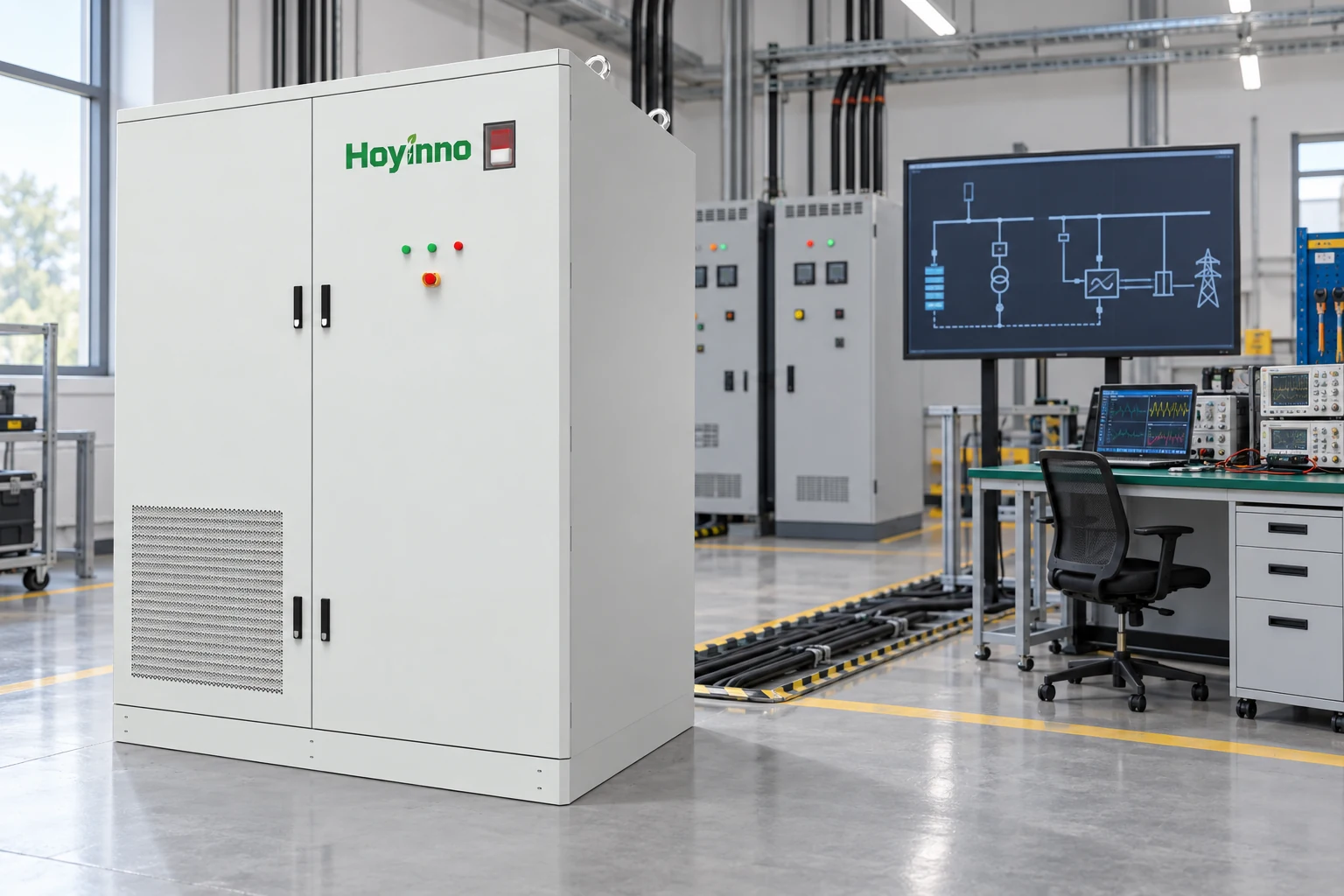
The 522 kWh cabinet page describes integrated battery management, power conversion, fire protection, distribution, solar regulation, PV MPPT, and thermal management. These confirmed functions are useful context, but suitability still depends on the project's verified load, voltage, environment, duty cycle, and controls.
Size Solar And Storage Through Iteration
Sizing should be iterative. Test the array, battery, conversion capacity, control policy, and backup strategy against the same load and resource series, then review unmet load, curtailed solar, state of charge, temperature assumptions, and recovery after low-solar periods.
Test PV Array Sizing Against Recovery Duties
PV array sizing must cover more than average daily consumption. The array must serve daytime demand, absorb conversion losses, recharge the battery after night operation, and recover from demanding weather without repeatedly pushing the system into emergency behavior. Oversizing can create curtailment and equipment costs, while undersizing can leave the battery chronically undercharged.
Useful simulations show monthly energy balance, hourly peaks, clipping, curtailment, and battery recovery time. They also test realistic soiling and temperature losses. The result is a range of viable capacities with explicit tradeoffs, not a single number detached from assumptions. That range can then be reviewed through the site's engineering process.
Check Battery Duty Against Power And Lifetime Constraints
The battery must satisfy both instantaneous power and usable energy duties while staying inside defined operating limits. A second battery autonomy target check should ask whether the critical-load definition, reserve policy, allowable depth of discharge, conversion losses, temperature, and ageing assumptions are all consistent. If any input changes, autonomy and recovery calculations should be rerun.
Design For Protection, Access, And Maintainability
An off-grid plant must detect faults, isolate hazardous sections, and recover without a utility network. Protection studies should address inverter fault-current behavior, selectivity, grounding, surge protection, emergency shutdown, auxiliary supplies, and control or communications loss. Applicable codes remain project-specific and must be confirmed locally.
Make Physical Service Conditions Part Of The Electrical Design
Equipment spacing, ventilation paths, drainage, fire separation, lifting access, maintenance aisles, cable segregation, and replacement routes affect whether the installed system can be operated safely. A maintainable design lets technicians reach filters, terminals, disconnects, sensors, and modules without dismantling unrelated equipment. It also identifies isolation points and lockout steps in drawings and operating procedures.
Remote supervision cannot replace planned inspection and competent local response. Define alarm ownership, escalation times, spares, software access, data retention, and routine checks. Hoyinno's technology support and operation and maintenance service illustrate relevant categories; exact responsibilities still require a written scope.
Install, Commission, And Hand Over In Controlled Stages
Installation should follow approved drawings, inspection points, and change control. Civil works, mounting, grounding, cable routing, terminations, communications, protection settings, firmware, and control parameters require verification before energization. Deviations should be assessed and documented.
Use Acceptance Tests To Prove The Intended Operating States
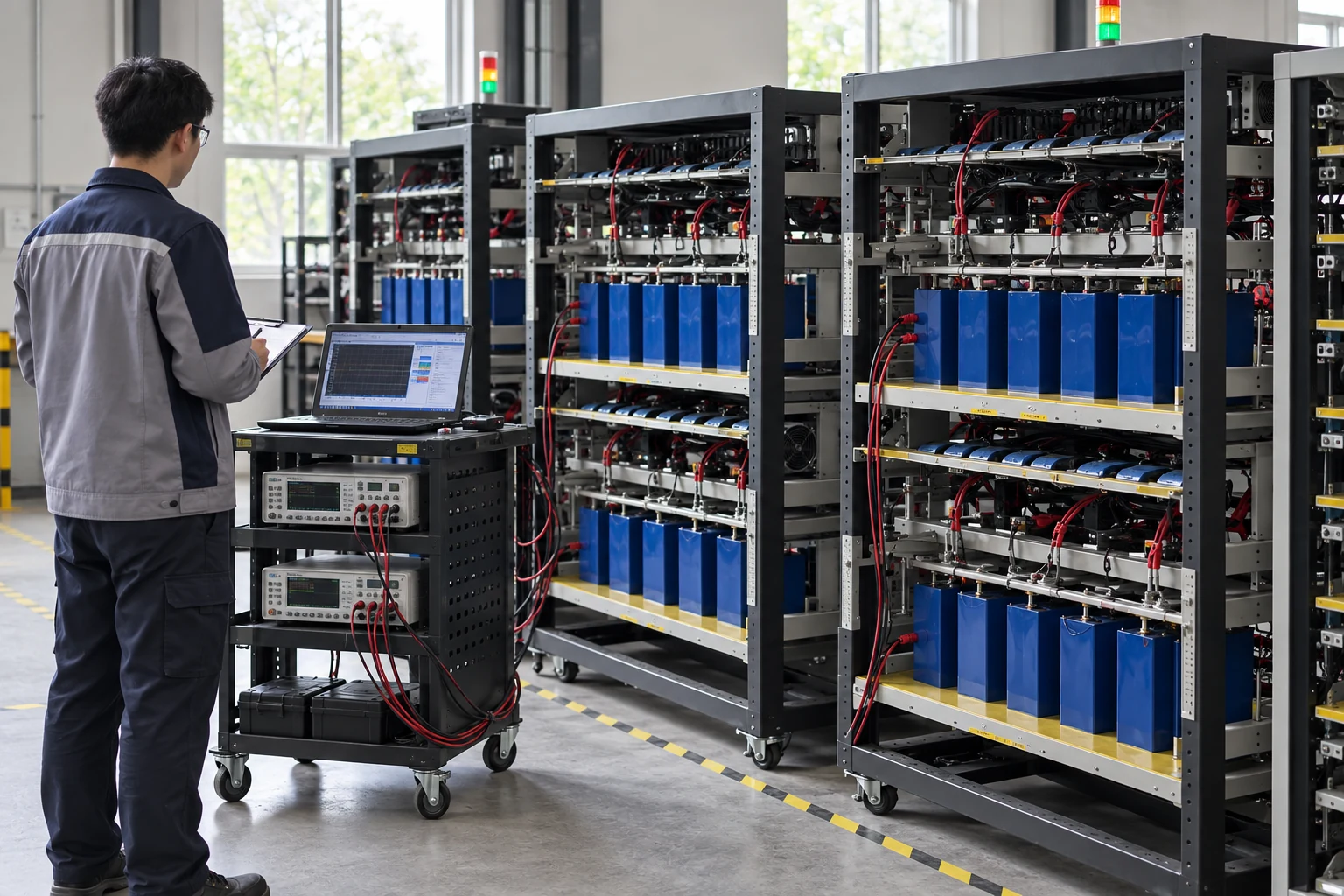
A commissioning test plan should connect every test to a design requirement and define the procedure, instrument, prerequisite, expected result, tolerance, witness, and record. Start with inspection and continuity checks, then prove individual devices, communications, interlocks, protection, controlled energization, dispatch modes, alarms, shutdown, restart, and loss-of-communication behavior.
The off grid solar power setup should also be tested as a coordinated system. Demonstrations can include step changes in load, transitions between solar and battery operation, reserve limits, load shedding, restoration, backup coordination where applicable, and safe response to simulated faults. Tests must be planned within safe operating limits; a commissioning program is evidence gathering, not destructive experimentation.

Handover should include approved drawings, settings, software ownership, equipment records, test results, baseline measurements, alarms, maintenance intervals, spares, warranty conditions, training, and escalation contacts. The final commissioning test plan and signed results become the reference for later review.
Frequently Asked Questions
What Should Be Measured First At An Off-Grid Site?
Begin with loads and their timing, then record solar access, shading, environment, layout, cable routes, communications, and operating constraints. Historical consumption is useful, but it should be checked against equipment schedules, peak events, seasonal change, and planned growth.
Can Daily Energy Consumption Alone Size The System?
No. Daily kilowatt-hours do not show peaks, motor starts, overlapping equipment, inverter duty, or demand timing relative to solar production. A sound design tests both power and energy timelines against seasonal resource data, conversion losses, reserves, and recovery requirements.
How Is Battery Capacity Different From Inverter Capacity?
Battery energy capacity describes stored energy within usable limits, while inverter power describes conversion capacity at a moment. Both must match the load, and allowable battery discharge power must support inverter duty. Model-specific limits and environmental derating require supplier evidence.
When Should Equipment Models Be Selected?
Shortlist models after the service boundary, site data, architecture, power and energy model, interfaces, and applicable requirements define an equipment envelope. Final selection checks verified datasheets, compatibility, thermal and protection duties, controls, documents, support, and lifecycle conditions.
What Proves That The Setup Is Ready For Handover?
Readiness requires more than energization. The system should pass approved inspection and functional tests, demonstrate intended operating and fault responses, close critical exceptions, retain traceable results, and provide accurate as-built documents, settings, training, maintenance information, and escalation procedures.
An off grid solar power setup forms an evidence chain: measured needs define the model, the model defines the architecture and equipment envelope, interfaces guide installation, and acceptance tests prove intended behavior. Any remaining assumption should stay visible until measurements or approved evidence resolve it.
 Solar PV Off Grid Works Through A Timed Balance Of Generation, Storage, And Loads
  Address: A401, Junxu Junchuang Park, 03A Qingyi Road, Nanhai District, Foshan City, Guangdong Province, China





