



 Home
Home
Solar Array Battery Storage Turns Surplus Into A Scheduled Energy Reserve
Solar array battery storage shifts available solar electricity to a later period, within the battery's charge limits, operating reserve and connection constraints.
An array rating describes generation under specified conditions; a battery rating describes a different part of the system. Neither alone establishes what will be available after sunset. Follow the timing of surplus, the limits on charging and the later service before comparing equipment sizes.
Locate Surplus At A Defined Electrical Boundary
Generation Above Demand Is Only A Starting Estimate
Surplus is the part of generation left after the loads and other destinations assigned to that boundary have been accounted for. In a simple behind-the-meter arrangement, the same interval may include array output, building consumption, battery charging and grid exchange. Compare these quantities on a consistent AC or DC basis. Subtracting a DC array estimate from an AC load meter without conversion adjustments can create a surplus that is not physically available.
Uncollected Generation Is Not Always Recoverable
Power restricted by a connection limit and potential DC production clipped by an inverter are different opportunities. Their recovery depends on topology, available converters, charging permissions and battery headroom. An AC-connected battery cannot automatically access energy that never passes through the PV inverter. Similarly, a battery at its upper operating limit cannot accept more energy merely because the array could generate it.
The energy management system overview provides a useful control-system context. For an actual project, the relevant evidence is the approved control description and the location of measurement and command interfaces. A website description does not establish the settings, response time or permissions of a delivered configuration.
Separate Charge Power From Energy Headroom
A Short Peak May Exceed The Charging Path
Charging power is a rate, usually expressed in kW or MW. Energy is accumulated over time and is expressed in kWh or MWh. A large battery can still miss a brief solar peak if the permitted charge power is too low. Conversely, a high-power converter does not ensure that the battery has sufficient remaining space to store a long period of surplus. Both limits must be evaluated at the same time.
Consider a deliberately simplified example: a constant 100 kW surplus lasting two hours represents 200 kWh at the stated measurement boundary. If the charging path accepts only 60 kW throughout that interval, no more than 120 kWh reaches that path before losses. If available headroom is smaller, the accepted amount is lower again. These numbers explain the relationship; they are not specifications or a production forecast for any pictured product.
State Of Charge Describes An Operating Position
State of charge indicates where the battery sits within its charge range. Operational limits may retain reserve at the bottom, limit charging at the top, and change with temperature or battery condition. The nameplate energy figure should therefore be distinguished from usable energy within the permitted range. The latter also needs a defined test condition and delivery boundary before it can support an operating estimate.
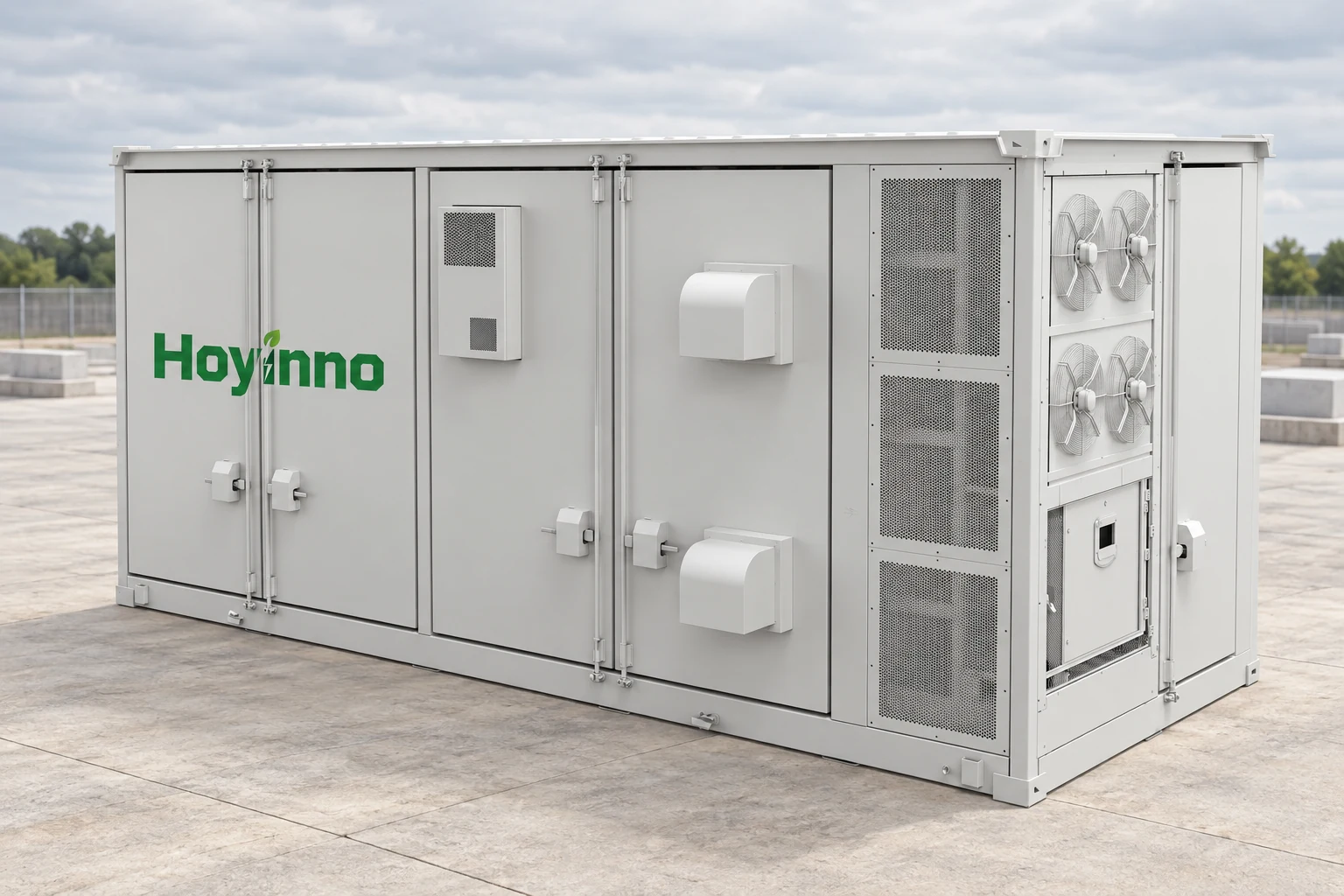
Hoyinno's industrial container storage page is one example of the enclosure family shown below. Its exterior cannot reveal the available charge headroom, the installed converter rating or the current control settings. Those details require the configuration documents and operating records for the actual equipment.
Account For The Connection And Control Priorities
An export limit restricts power leaving the agreed connection point. It does not, by itself, define how much power the battery may absorb. Site demand, PV curtailment, converter limits and battery availability interact with that boundary. A control description should explain which action takes precedence when more than one restriction becomes active.
Distinguish An Instruction From Its Achieved Response
A charging request is a target. The achieved response depends on available equipment and its active constraints. A battery management system may reduce permissible charge power; a converter may reach its rating; a communication problem may interrupt commands. Records should retain the requested value, actual response, operating mode and relevant limit flags. An unexplained difference should not immediately be attributed to a lack of solar generation.
The power conversion and control catalogue describes a separate equipment category from the battery enclosures. This distinction is useful when reading a system diagram: storage medium, converter and supervisory control perform different functions even when a supplied package integrates them. Confirm the actual scope rather than inferring it from a category name.
| Observed condition | Possible limiting factor | Useful evidence |
|---|---|---|
| Surplus remains while charging is capped | Permitted charge power or converter capability | Requested and actual power with active limit flags |
| Charging stops despite sunshine | Upper charge limit, schedule or equipment state | State of charge, operating mode and event record |
| Export remains close to a boundary | Connection control or curtailment priority | Connection-point measurement and approved sequence |
| Evening energy is below the daily charge total | Losses, reserve, auxiliary demand or a different boundary | Aligned charge and delivery meters with stated scope |
| Results change between similar days | Different initial condition, load timing or availability | Comparable interval records and starting conditions |
Follow The Charging Window Across A Real Day
The charging window is the period in which solar energy is available and charging is permitted. It is narrower than the period between sunrise and sunset, and it may consist of several separate intervals. Simultaneous demand, cloud cover, operational restrictions and the battery's starting condition all influence its shape. A daily total cannot describe these timing relationships by itself.
Use Aligned Intervals Instead Of Unmatched Totals
Place generation, load, grid exchange and battery power on the same time axis. Check the time zone, clock alignment and interval length before drawing conclusions. If an array record uses hourly averages while a demand record uses short peaks, the comparison can hide both charging constraints and brief reversals. Choose an interval suitable for the operating question, and keep the original records so the aggregation remains auditable.
Test Ordinary Variability Before Exceptional Events
A clear day, a cloudy day and a low-demand day can produce quite different charging patterns. Seasonal changes may alter both solar availability and the hours when electricity is needed. Start with representative records for those conditions. Then examine exceptional events separately, such as equipment unavailability or a prolonged interruption. This prevents a single attractive day from standing in for an annual operating assessment.
For remote applications, the remote-area power context illustrates why demand continuity and alternative supply need explicit treatment. A charging window that works during normal grid operation does not establish that a system can sustain an isolated load through poor weather. That requires a separate energy balance and the appropriate operating capability.

Translate Stored Energy Into A Later Service
Solar array battery storage can shift energy only when later discharge is technically available and permitted. Energy accepted during charging will not all appear at the final load because conversion and auxiliary use consume some of it. Reserve policies can also leave part of the stored energy unavailable for routine dispatch. State the service and its measurement boundary before estimating duration.
Define The Delivery Period And Reserve Together
Supporting an evening load, limiting a brief demand peak and holding emergency reserve are different objectives. A schedule that uses most of the battery for one purpose may reduce its readiness for another. The operating agreement should make that tradeoff explicit. Usable energy at the battery terminals also differs from energy delivered after downstream conversion and auxiliary consumption.
Backup operation needs capabilities beyond storing daytime electricity. Isolation, protection, grid-forming behavior where required, starting conditions and load management must be engineered for the intended mode. The engineering service description provides a place to identify the relevant project questions. Neither a charged battery nor an illustrative system picture proves that outage operation has been designed or tested.
Build An Explanation From The Operating Record
- Mark the generation, load, battery and grid measurement points on the system diagram.
- Align timestamps and record the battery's initial state and active operating mode.
- Identify the charging window and check both power limits and remaining headroom.
- Track accepted energy separately from losses, auxiliary consumption and retained reserve.
- Compare later delivery against its stated boundary, schedule and load conditions.
Retain records for unavailable equipment and incomplete data. A gap should remain a gap rather than being filled with assumed normal behavior. If a meter is replaced or a control setting changes, record the date and scope of the change before comparing results across periods. The operations and maintenance service context is relevant to this ongoing recordkeeping responsibility.

The most useful conclusion about solar array battery storage connects three things: the timing of available surplus, the constraints on accepting it, and the later service for which it is reserved. Once those are defined, the next technical step is to compare an aligned operating record with the approved system description. This keeps both the useful energy and the limits of the evidence visible.
Frequently Asked Questions
Does A Larger Array Always Fill The Battery Faster?
No. A larger array may increase available generation, but simultaneous demand, conversion limits, charging permissions and remaining headroom can still restrict charging. Compare actual power at the relevant boundary with the battery's allowed response during the same interval.
Why Can Charging Stop Before The Battery Is Fully Rated?
The nominal rating is not a requirement to charge to the physical maximum. An upper operating limit, a reserve strategy, temperature conditions or an equipment state can restrict charging. The control record and configuration explain which limit applies; an exterior photograph cannot.
Can All Curtailed Solar Electricity Be Stored?
No. The curtailed energy must be accessible through the installed topology, the battery must have headroom, and the permitted charging path must be available. An export restriction and inverter clipping occur at different boundaries and may require different technical treatment.
Is A Daily Charge Total Enough To Estimate Evening Supply?
No. The estimate also needs usable energy at the delivery boundary, retained reserve, auxiliary demand, conversion losses and the later load profile. A consistent measurement scope is necessary before subtracting totals or estimating how long a load can be served.
Does Solar Charging Prove That Backup Will Work?
No. Backup depends on an engineered operating mode with suitable isolation, protection, controls and load arrangements. Successful daytime charging establishes only one part of that sequence. Evidence for outage operation must address the actual design and its commissioning conditions.
 Which Coupling Route Fits PV Panel Battery Storage In An Existing Plant?
  Address: A401, Junxu Junchuang Park, 03A Qingyi Road, Nanhai District, Foshan City, Guangdong Province, China





