



 Home
Home
Which Coupling Route Fits PV Panel Battery Storage In An Existing Plant?
PV panel battery storage can be added through different coupling routes, and the suitable route depends on existing conversion equipment, operating objectives and the connection boundary.
An existing solar installation creates both an opportunity and a constraint. Some equipment may be worth retaining, while other components may limit the proposed storage function. The first decision is therefore not simply how much battery energy to buy, but where the new equipment joins the plant and which devices control each power path.
Start With The Existing Plant And The Required Function
Build An Equipment Baseline Before Comparing Architectures
Collect the as-built single-line diagram, inverter model and firmware information, array configuration, protection arrangement and metering locations. Identify undocumented modifications before treating the drawings as authoritative. A proposal based on the original design may miss a later inverter replacement or a different point of connection.
The existing inverter is a central part of this review, but its rated power is not the whole answer. The engineering team needs its permitted operating modes, relevant interfaces and support conditions. The engineering service scope can frame the information request without implying that every installed model is compatible.
State The Objective In Operational Terms
Charging from surplus solar, limiting an agreed import peak and supporting selected loads during an outage are different objectives. Define the priority when they compete for the same battery capacity. A reserve held for an interruption may reduce the energy available for routine shifting, even though the nameplate capacity has not changed.
Understand What AC And DC Coupling Mean At The Boundary
AC Coupling Connects Through The Alternating-Current Side
In a common AC-coupled arrangement, the solar inverter and battery conversion equipment connect on the AC side. This can allow the existing solar inverter to remain in place, subject to the equipment and connection design. It does not mean that any battery inverter can be added without reviewing protection, controls and operating permissions.
The main benefit to investigate is the ability to retain useful solar equipment while adding a separately controlled storage branch. The corresponding question is how the devices coordinate. Meter placement, command priorities and the behavior of the solar inverter when the grid is unavailable need to be established for the actual system.
DC Coupling Shares A Direct-Current-Side Conversion Arrangement
DC coupling commonly links solar and battery equipment through a compatible hybrid conversion architecture. It may suit a new design or a planned inverter replacement, but the actual hardware determines which DC connections and controls are supported. A battery cabinet cannot be connected to an arbitrary solar input merely because both involve DC power.
Review the complete approved configuration, including battery voltage range, conversion equipment, communications and the solar array's electrical characteristics. If the existing inverter is not designed for the proposed route, retaining it may not be feasible. Confirm that conclusion from manufacturer information rather than from a generic architecture diagram.
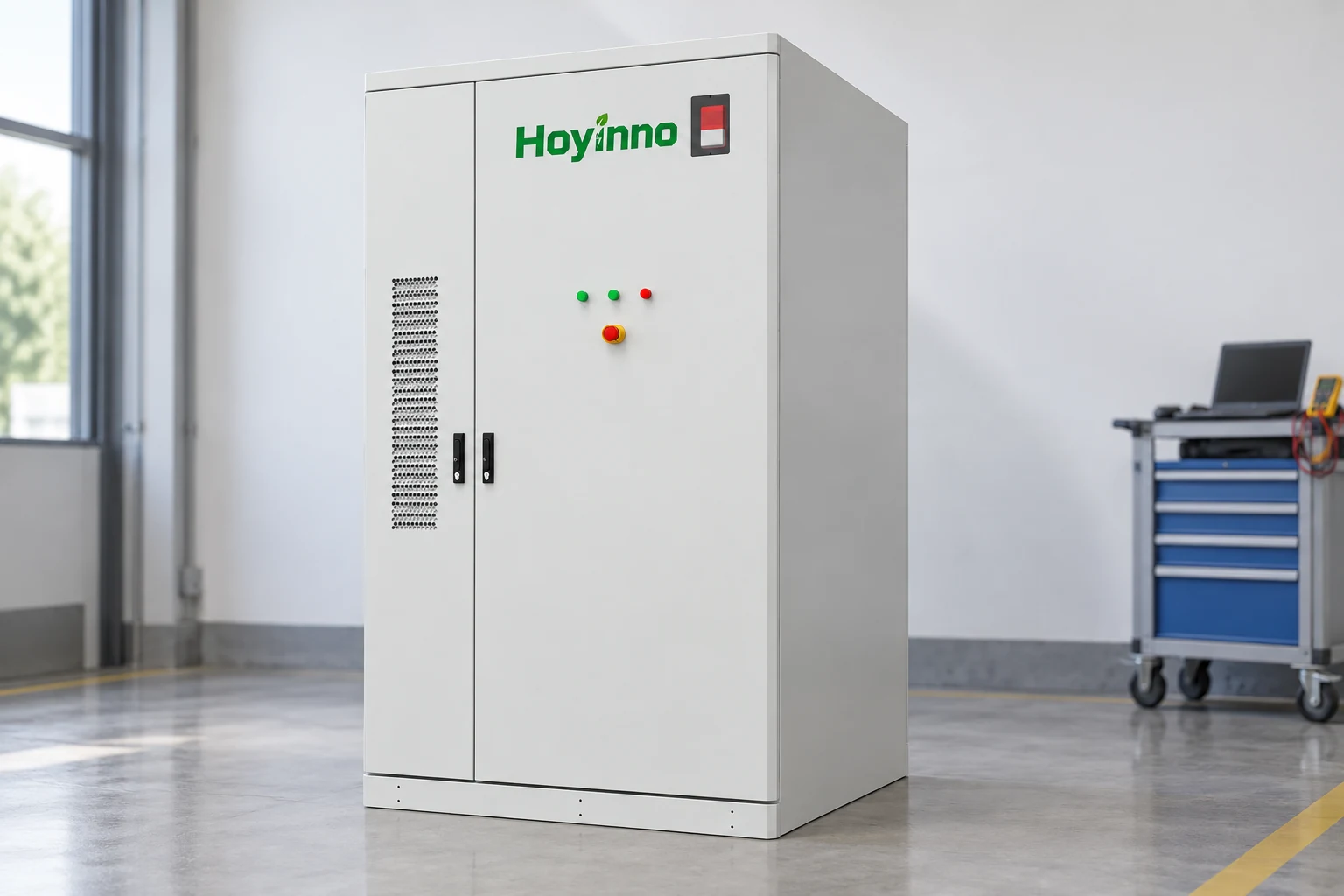
The published 418 kWh liquid-cooled cabinet example provides a specific hardware identity for discussion. Its enclosure appearance and nominal energy do not establish the compatible power converter, solar coupling route or backup function. Those belong in the system configuration and engineering evidence.
Compare The Two Routes Against The Same Plant Requirements
| Decision Area | AC-Side Route | DC-Side Route |
|---|---|---|
| Existing solar equipment | May retain the current solar inverter if the design permits | May require a compatible hybrid conversion arrangement or replacement |
| Control boundary | Coordination between solar and battery conversion branches | Coordination within the supported hybrid configuration |
| Design evidence | AC connection, protection, metering and device interaction | Supported DC ranges, array inputs, battery interface and conversion limits |
| Construction planning | Assess added equipment space and AC integration work | Assess equipment replacement and any array-side reconfiguration |
| Outage behavior | Requires a specifically supported islanded arrangement | Requires the actual hybrid system's supported backup configuration |
This comparison describes common architectural questions, not universal capabilities. Different suppliers package power conversion, controls and battery modules differently. Ask each proposal to name the supplied components and the interfaces that remain the responsibility of the installer or another vendor.
The battery storage product range should be screened after the boundary is understood. Start with the function and compatible configuration, then compare equipment that can provide it. Selecting a cabinet first and asking the plant to fit around it can leave essential interfaces unresolved.
Check The Connection And Control Responsibilities
Place Meters Where They Observe The Intended Quantity
An import-limiting function needs to observe the relevant import boundary. A solar generation meter measures something different from a whole-site meter, especially when other loads or generators sit between them. The proposal should show each measurement location and explain how its reading is used by the controller.
For AC coupling, ask which device sends a power request and which device applies the final limit. For DC coupling, ask how the hybrid controller prioritizes solar input, battery charging and load supply within its supported configuration. In both cases, identify what happens when a measurement or communication link becomes unavailable.
The energy management system information is a useful starting point for the control discussion. A communications protocol name alone does not prove that the required commands, status signals and fault responses are implemented between the specific devices.
Assign Protection And Connection Review To The Responsible Engineer
The connection design needs an assessment of equipment ratings, protection coordination and applicable utility or site requirements. The project team should establish who prepares that assessment, who approves it and which assumptions require confirmation. Generic cabinet imagery cannot support an electrical protection decision.
Separate normal grid-connected operation from operation during a grid interruption. Solar generation may stop when its normal grid reference disappears unless the installed system explicitly supports another operating arrangement. The presence of solar panels and a charged battery is therefore insufficient to promise continued power to a load.
Test The Charging Window Against The Load Pattern
A battery can only shift energy that is available to charge it under the operating rules. Compare the timing of solar production, the site's concurrent demand and the permitted charging sources. A large daily solar total can coexist with little midday surplus if the plant consumes most of the generation as it occurs.
Use time-aligned data at a suitable interval and document any missing periods. Distinguish measured records from estimates, and assess whether the chosen period represents seasonal operation. A single clear day or a marketing yield figure is an incomplete basis for specifying repeatable storage behavior.
PV panel battery storage also needs a discharge opportunity that matches the objective. If the load falls before the intended discharge period, some reserved energy may remain unused. If the power demand exceeds the supported converter output, adding nominal energy alone does not resolve the power constraint.

Plan Integration Tests Around The Chosen Architecture
Confirm Normal Operation And Defined Exceptions
The acceptance plan should connect each required function to an observable test and a responsible reviewer. For example, a charging objective needs evidence that the correct source, command and limit were applied under the test conditions. Record the configuration version so that the result remains meaningful after later changes.
Review supported exception cases with the equipment providers before commissioning. These may include unavailable measurements, communications loss or a device entering a protective state. The test plan should define safe conditions and authorized personnel; it should not improvise hazardous switching to demonstrate a marketing claim.
Where backup is required, specify the supported loads, transfer arrangement, available starting condition and return-to-grid process. A test of routine energy shifting does not establish those functions. The off-grid application context can inform the questions, while the actual project still needs its own approved configuration.
Make The Handover Useful To The Operator
Provide the final diagrams, equipment list, configuration record, alarm meanings and escalation contacts in a form the operator can use. Identify which settings are permitted to change locally and which require engineering approval. The handover should reflect the installed arrangement, not an earlier proposal that changed during procurement.
Maintenance access and replacement strategy also differ between architectures. A retained solar inverter and a new battery conversion branch may have separate service responsibilities. A hybrid arrangement may concentrate more functions in one device. Discuss these dependencies through the operation and maintenance service scope before finalizing the equipment boundary.

Choose The Route With The Clearest Supported Integration
AC coupling deserves close examination when useful solar equipment can be retained and a separately controlled storage branch suits the plant. DC coupling deserves examination when a compatible hybrid arrangement fits the project, especially alongside planned equipment renewal. Neither route is automatically the correct answer for every existing installation.
A decision on PV panel battery storage is ready to move into detailed design when the plant baseline, intended duty and proposed configuration agree. The preferred route is the one whose equipment, controls and responsibilities can be demonstrated for that site, with construction and operating constraints accounted for.
Frequently Asked Questions
Can The Existing Inverter Always Remain In An AC-Coupled Project?
No. Retention depends on its supported operation and the overall design. Confirm the specific model, controls, protection requirements and intended grid-connected or backup behavior before assuming it can stay.
Does DC Coupling Always Mean Higher Overall Efficiency?
Not as a universal conclusion. Assess the actual power paths, equipment data and operating duty. A comparison should also account for replacement needs and whether the plant can use the energy in the intended time window.
Does A Battery Cabinet Include Every Component Needed For Solar Integration?
The supplied scope varies. Identify the power conversion, protection, controls and installation items included in the actual offer. A nominal energy figure or product photograph does not define the complete system boundary.
Will Solar Continue Operating During A Grid Outage?
Only if the installed arrangement supports the required mode. Review the solar inverter, grid-forming or hybrid functions, protection and transfer design. Grid-connected energy shifting alone does not establish backup operation.
What Information Should Be Collected Before Requesting A Retrofit Proposal?
Begin with as-built diagrams, inverter details, time-aligned generation and load data, the required function and available shutdown windows. Mark uncertain information clearly so that the engineering review can resolve it.
 Solar Array Battery Storage Turns Surplus Into A Scheduled Energy Reserve
  Address: A401, Junxu Junchuang Park, 03A Qingyi Road, Nanhai District, Foshan City, Guangdong Province, China





