



 Home
Home
What Evidence Separates Off Grid Solar Companies Before Project Award?
Off grid solar companies should be compared by the evidence they can produce for one defined project, not by broad claims about capacity or experience. For an EPC project manager, procurement lead, energy manager, electrical engineer, or investor working in Southeast Asia, Africa, or the Middle East, the useful question is whether a bidder can translate an hourly load profile, climate exposure, logistics constraints, and operating responsibilities into a traceable design. This decision guide, current as of September 14, 2026, does not rank suppliers. It applies the same evidence criteria to every candidate so that a shortlist can survive technical, commercial, and site review.
Define The Bid Boundary Before Comparing Names
Separate System Integrator And Equipment Roles
Ask each bidder to mark its role against every subsystem: designer, manufacturer, packager, reseller, installer, commissioning party, or warranty coordinator. The distinction matters because an attractive cabinet does not prove responsibility for protection coordination, generator dispatch, load shedding, or site acceptance. A useful responsibility matrix names the accountable party, required input, approval point, and deliverable for each interface. Compare that matrix with the proposed architecture on Hoyinno's remote-area off-grid solution page and with the available battery energy storage system families, while treating all page descriptions as starting information that still requires project-specific confirmation.
Freeze Assumptions That Drive Price
Record the load growth allowance, required autonomy, photovoltaic yield basis, ambient temperature range, altitude, dust or salt exposure, grid or generator availability, usable battery window, degradation basis, and operating reserve. If one assumption changes, require the bidder to show which equipment sizes, guarantees, and prices change with it. This is basic solar supplier due diligence: the comparison sheet must keep engineering assumptions beside commercial figures instead of hiding them in separate attachments.

Request Evidence For The Engineering Chain
Trace Load Data To Energy And Power
Request the raw interval data or the documented estimate that created the hourly load profile. Then follow the calculation into coincident peak demand, starting currents, daily energy, seasonal variation, autonomy, and reserve. Battery energy and inverter power are different decisions: energy supports duration, while power determines the ability to serve simultaneous and transient loads. A strong bid shows both, identifies conversion losses and auxiliary consumption, and provides sensitivity cases rather than one unexplained headline value.
Inspect Model Outputs And Review Records
Ask for an energy balance, one-line diagram, equipment schedule, protection philosophy, control narrative, communication architecture, and design review register. The objective is not to collect paper for its own sake. It is to see whether inputs, calculations, selections, and approvals form a chain that another engineer can audit. Useful microgrid project evidence includes revision numbers, named assumptions, reviewer comments, and the disposition of open issues. Screenshots without input files or version context are weak evidence.
| Decision Area | Evidence To Request | Buyer Check |
|---|---|---|
| Load and generation | Interval profile, yield basis, loss table, sensitivity cases | Inputs match the named site and operating season |
| Storage sizing | Energy, power, reserve, usable window, degradation assumptions | Guarantees use the same operating conditions |
| Electrical design | One-line, fault study, protection settings, cable schedule | Interfaces and approval owner are identified |
| Controls | Operating modes, alarms, fail states, communications list | Loss of a sensor or link has a defined response |
| Delivery | Inspection plan, packing list, route survey, site test plan | Milestones connect to acceptance evidence |
Test Integration Depth, Safety, And Climate Fit
Off-grid performance depends on interactions among generation, storage, conversion, loads, protection, and controls. A catalogue match is therefore not enough. IEC 62933-5-2:2020 covers safety requirements for grid-integrated electrochemical energy storage systems, including system-level considerations. The applicable code set will depend on jurisdiction and project design, so the buyer should ask the engineer of record and local authority to confirm the final requirements.
Verify Control And Protection Behavior
Require a mode table covering normal solar operation, low state of charge, sudden load increase, generator start and stop, communication loss, inverter fault, emergency stop, and black start where relevant. Each row should state the trigger, commanded response, protection action, alarm, recovery path, and responsible controller. Evidence of battery integration capability is strongest when the bidder can demonstrate tested interfaces between the battery management system, power conversion system, energy management system, generator controller, and site supervisory layer.
Translate Environment Into Design Actions
Southeast Asian humidity, African heat or dust, and Middle Eastern temperature and sand exposure cannot be handled by a country label alone. The bidder should work from measured or specified site conditions: maximum and minimum temperature, humidity, altitude, corrosive atmosphere, flood risk, wind, seismic category, solar exposure, access, and maintenance conditions. Ask how those values affect enclosure protection, cooling derating, filtration, coatings, cable entries, spacing, fire strategy, and service intervals. Record any value that remains to be confirmed as an open item rather than an assumed compliance claim.

Verify Manufacturing And Delivery Controls
Project risk continues after design approval. The procurement package should connect drawings and bills of material to inspection, packing, shipment, installation, and acceptance. A supplier may have strong products yet still be a poor match if documentation control, change handling, export packing, or field support is unclear. Review relevant project examples on the site's case section, and compare the stated delivery boundary with its engineering service overview, but ask for a reference whose climate, system boundary, and operating duty genuinely resemble the current project.
Make The Inspection Plan Measurable
The inspection and test plan should identify incoming checks, assembly inspections, torque records, wiring verification, insulation tests, functional tests, alarm checks, communication tests, factory acceptance criteria, witness points, and document release. Define the sample or serial-number scope for every record. A generic quality certificate does not show that the delivered units were built and tested against the approved project configuration. Ask who signs each record and how nonconformities are closed.
Connect Logistics To Site Readiness
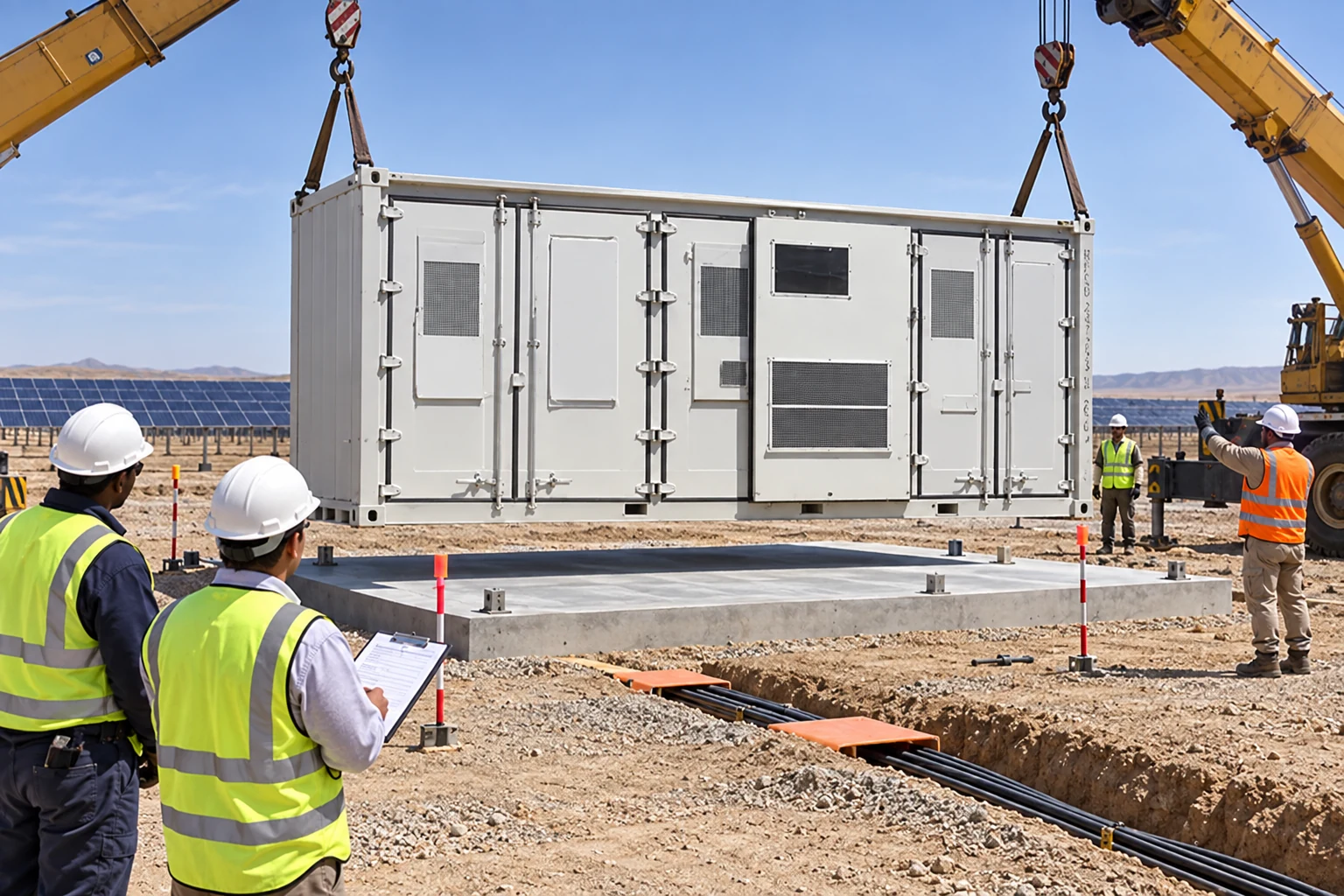
Request weights, dimensions, lifting points, centre of gravity, packaging method, storage limits, hazardous-goods documentation where applicable, route constraints, unloading plan, and preservation instructions. Align shipment dates with foundations, cable routes, communications, generation equipment, and temporary power. A late interface can delay commissioning even when the storage equipment arrives on time. The buyer should include a document index and a hold-point release process in the purchase order.

Make Commissioning An Acceptance Gate
Define Records, Training, And Handover
Handover evidence should include approved as-built drawings, settings files, equipment lists, serial numbers, software and firmware versions, test records, open-item status, operating procedures, emergency contacts, maintenance plan, recommended spares, warranty conditions, and training attendance. The operator should know what can be reset locally, what requires remote support, and what must trigger a shutdown. Buyers can review Hoyinno's energy management system overview for the types of monitoring functions described by the site, then require the actual project point list and permissions.
Measure Support Against Operating Consequences
Set response targets according to the consequence of lost power, not a generic service promise. Define fault severity, response time, remote diagnostic access, spare availability, escalation path, time-zone coverage, travel assumptions, and exclusions. For remote projects, also verify who owns communications links and how logs are retrieved when connectivity is intermittent. Ask for a warranty claim workflow and sample service report before award.
Align Commercial Terms With Evidence
Control Changes And Performance Guarantees
For off grid solar companies, connect every guarantee to defined conditions, measurement points, tolerances, and test methods. State how changes to load, climate, dispatch, or auxiliary systems affect the guarantee. Establish a deviation register, engineering change notice process, approval authority, and price or schedule impact method. This prevents informal substitutions from separating delivered equipment from the design that was evaluated. It also gives investors a clearer view of residual technical and commercial risk.
Build An Awardable Shortlist
Score off grid solar companies against mandatory gates first: scope completeness, traceable sizing, safety and code plan, interface ownership, testability, climate response, delivery controls, and service coverage. Then apply weighted criteria agreed before proposals are opened. Keep “not provided” separate from “noncompliant,” and give every bidder the same clarification deadline. The result is a defensible shortlist rather than a popularity contest.
Frequently Asked Questions
Should buyers rank suppliers before issuing a technical scope?
No. A ranking made before the system boundary and evidence requirements are fixed can reward proposals that omit difficult interfaces. Define the common scope, mandatory gates, and scoring method first, then compare complete submissions as of the stated review date.
Which document should be requested first?
Start with a responsibility and assumptions matrix linked to the hourly load profile. It quickly reveals whether the bidder understands the project boundary and provides the foundation for checking sizing, controls, price, and guarantees.
Does a battery certificate prove the whole off-grid system is safe?
No. Component evidence is important, but system safety also depends on integration, installation, protection, control behavior, environment, commissioning, and local requirements. Confirm the applicable codes with qualified project professionals and authorities.
How can a buyer compare project references fairly?
Use the same filters: climate, power and energy scale, generation mix, control scope, logistics, commissioning responsibility, operating history, and client contact availability. A close technical match is more informative than a larger but unrelated project.
What should trigger a clarification rather than immediate rejection?
A missing document may justify a time-bound clarification if the rule is applied equally. A direct conflict with a mandatory safety, scope, or performance requirement should follow the procurement plan's noncompliance process instead of being quietly reinterpreted.
If your team is preparing an off-grid solar shortlist, send the site load profile, climate data, single-line concept, delivery location, and required operating modes through Hoyinno's contact channel. Review the company's about page and technology-support scope, then request a project-specific responsibility matrix, assumptions register, and evidence index before treating any proposal as award-ready.
 Off Grid Energy Solutions Differ By Load Priority, Autonomy, And Recovery Path
  Address: A401, Junxu Junchuang Park, 03A Qingyi Road, Nanhai District, Foshan City, Guangdong Province, China





