



 Home
Home
Why Must Off Grid Energy Be Designed Around An Hourly Load Profile?
Off grid energy works reliably only when hourly demand, renewable supply, storage limits, control states, and recovery reserves are evaluated together. Average daily consumption is useful for an early estimate, but it cannot show a motor start, an evening peak, a cloudy sequence, or the order in which essential services should recover after a shutdown.
An Hourly Model Turns an Energy Idea Into an Operating System
An isolated power system must maintain voltage and frequency while supplying every permitted load without continuous support from a utility grid. Its generation, battery energy storage system, power conversion, protection, and controls therefore act as one coordinated system. The hourly model is the common time base that lets those parts be tested against demand rather than selected as unrelated catalogue items.
Separate instantaneous power from energy over time
Power describes what the system must deliver at a moment; energy describes how long it must continue. A pump may add a short starting surge that shapes inverter and protection choices while contributing little to daily energy. Refrigeration may have a moderate rating but run for many hours. Recording only kilowatt-hours hides both effects. A useful critical load profile includes interval demand, peak coincidence, starting current, power factor, duty cycles, and the maximum interruption each service can tolerate.
Record operating sequence instead of assuming every load is simultaneous
Many loads can be scheduled, staggered, or temporarily curtailed. Water treatment can operate during strong solar production; cold storage may need continuous temperature control; workshop equipment may be blocked during a low-reserve state. The design should distinguish non-negotiable, shiftable, and discretionary demand, then record permitted start sequences. This reduces unnecessary capacity without hiding the operating rules needed to make the smaller system dependable.
| Input | What it reveals | What an average misses | Design response |
|---|---|---|---|
| Interval demand | Coincident peaks and daily timing | Evening peaks behind the same daily total | Size conversion equipment and dispatch states |
| Load priority | Consequences of interruption | Which services must survive a shortage | Create staged shedding and restoration |
| Starting behavior | Short power and reactive demand | Motor, compressor, or transformer inrush | Check surge capability and protection |
| Resource sequence | Hours of weak renewable input | Multi-day or seasonal deficits | Test storage, backup, and curtailment |
| Recovery reserve | Energy retained after a disturbance | The risk of restarting with an empty battery | Set reserve bands and recovery logic |
The Architecture Must Close the Power Balance in Every Allowed State
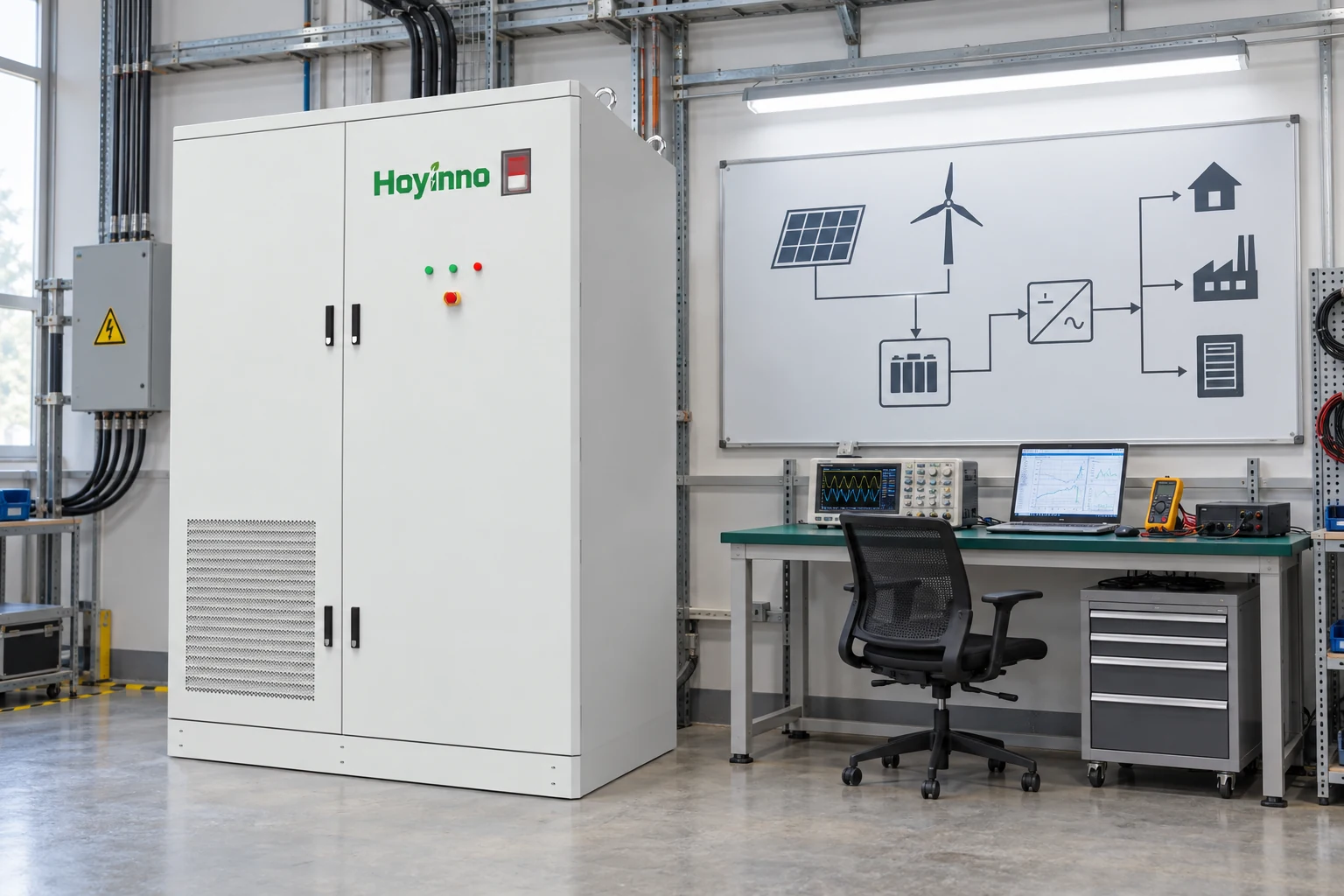
A block diagram for off grid energy should show sources, storage, AC and DC buses, converters, switchgear, meters, controllable loads, and the authority that issues commands. Larger projects may use a containerized storage architecture where its site interfaces and operating limits fit the approved design.
Generation, storage, and conversion perform different jobs
Solar and wind follow the available resource, a generator offers dispatchable energy subject to fuel and maintenance, and storage moves energy between hours while responding quickly to imbalance. Power conversion establishes or follows the electrical reference and respects current, voltage, thermal, and state-of-charge limits. A conversion and control design must state which device forms the grid, which devices follow it, and how authority transfers during a fault or maintenance isolation.
Control logic converts physical capacity into dependable service
The microgrid controller should act on measured conditions, not optimistic assumptions. It may curtail renewable generation when batteries are full, start backup generation before reserve is exhausted, shed lower-priority loads during a deficit, and restore them only after stable recovery. The controller also needs safe behavior for stale measurements, communications loss, unavailable equipment, conflicting commands, and manual overrides. Those transitions belong in an operating-state matrix before software acceptance.
Storage Sizing Is a Sequence Problem, Not a Single Autonomy Number
Multiplying average load by a chosen number of hours is only a rough energy estimate. Detailed battery autonomy must account for usable state-of-charge limits, conversion losses, auxiliary demand, temperature, ageing allowance, charge power, discharge power, and the timing of renewable recovery. The same nominal battery can produce different service outcomes under different hourly sequences.
Define the event window and the end condition
An autonomy requirement should name the demand that must be served, the assumed resource condition, the availability of backup generation, and the reserve required at the end. For example, surviving one night is different from surviving a multi-day low-sun event while retaining enough energy for a controlled restart. If the event has no boundary, the storage target becomes either arbitrary or impossibly conservative.
Use time-aligned resource data and a conservative design season
Monthly average irradiation cannot reveal the exact hours when generation and demand diverge. The model should use a resource record with a suitable interval, document gaps and uncertainty, and test the season most likely to constrain service. Temperature, dust, shading, curtailment, array orientation, conversion efficiency, and planned maintenance reduce delivered energy. Field resource assessment should be connected to the same timeline as demand.

Future demand should be tested as scenarios rather than hidden inside one precise forecast. A modular system approach may support phased growth, but space, switchboard capacity, controls, and protection must still be planned.
Controls and Protection Must Be Checked Under Changing Fault Conditions
Islanded systems can operate in several source combinations: inverter only, generator plus inverter, multiple converters, or a reduced arrangement during maintenance. Available fault current and its direction may change between those states. Protection therefore cannot be copied from a conventional grid-connected installation without a study of the permitted operating modes.
Write a state matrix before finalizing setpoints
The matrix should cover normal renewable supply, charging, night operation, low reserve, backup start, failed start, load shedding, maintenance isolation, emergency stop, black start, and restoration. Each row needs entry conditions, command authority, equipment status, permitted loads, alarm behavior, and exit criteria. It becomes a shared reference for the owner, designer, supplier, programmer, and commissioning team instead of leaving important behavior inside undocumented code.
Coordinate protection for inverter and generator modes
Inverter-limited current may be lower and shorter than generator fault current. Earthing, neutral switching, transformer inrush, breaker curves, residual-current protection, directional elements, and anti-islanding behavior must be checked for the actual topology. Settings should also protect personnel during service. A selective trip should isolate the faulty section without unnecessarily removing the whole critical bus, while a severe condition should produce a safe shutdown and a controlled recovery path.
Commissioning Proves the Timeline That the Design Model Predicts
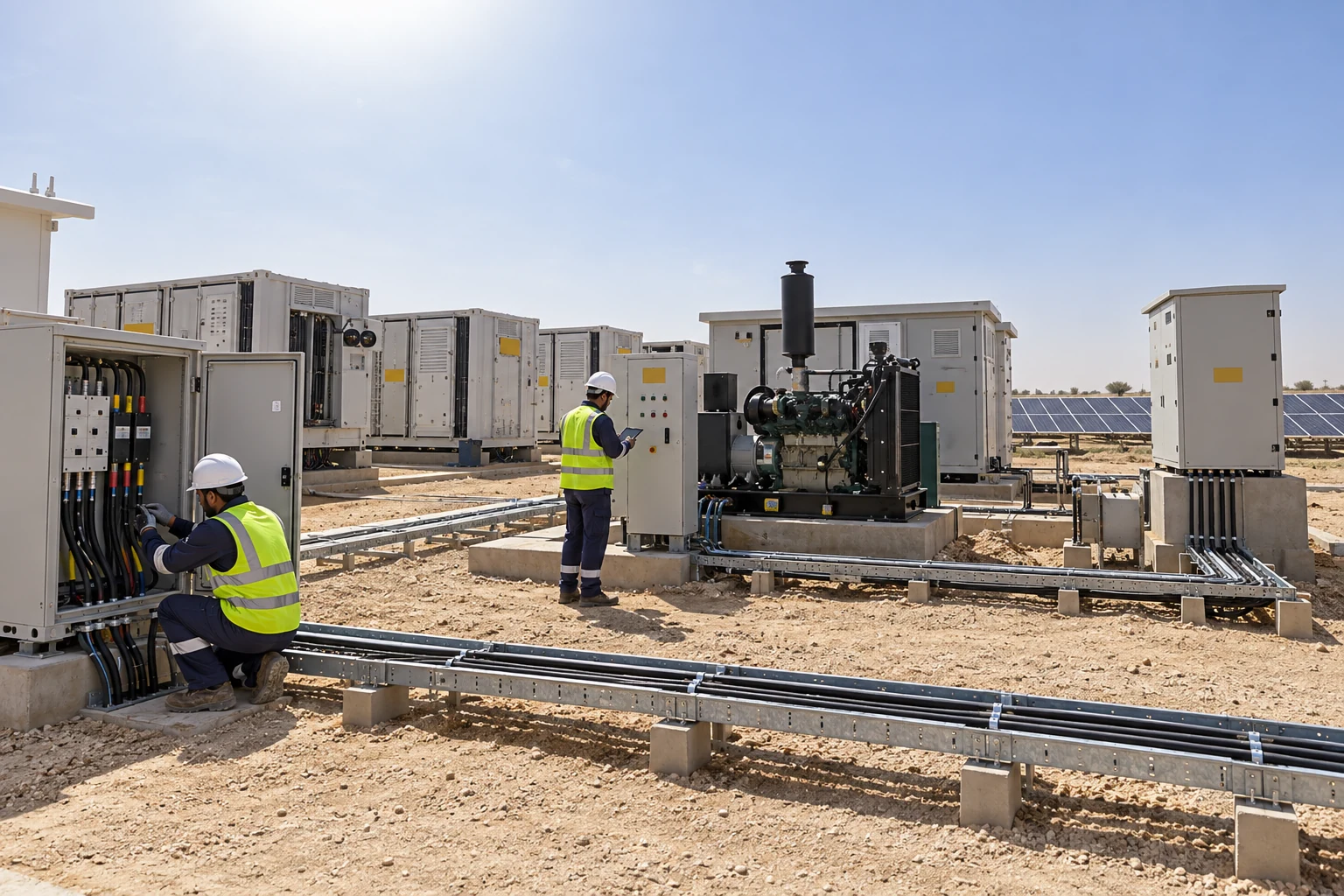
Factory tests can confirm equipment functions, but site acceptance must prove the connected system. The sequence should progress from visual inspection, insulation, polarity, sensor scaling, and communications to individual source operation, staged loads, protection trips, transfer behavior, reserve control, and restoration. Every result should identify the expected behavior, actual observation, approved setting, exception, and corrective action.
Test credible failures rather than only normal operation
Useful tests include a lost meter, frozen data, communications interruption, unavailable storage string, inverter trip, failed generator start, emergency stop, and complete shutdown followed by black start. These events expose common dependencies that a normal demonstration can miss. Test boundaries and safety controls must come from the approved project procedure; unplanned fault injection is not a substitute for a controlled acceptance program.
Carry the model into operations and maintenance
After handover, the operating team should compare measured demand, renewable yield, reserve, temperature, alarms, and dispatch behavior with the design cases. Unexpected change in one variable may reflect load growth, fouling, sensor drift, battery imbalance, a new operating schedule, or a control-setting change. An operations and maintenance plan should define review intervals, configuration control, spares, local responsibilities, and escalation without replacing site safety procedures.

Frequently Asked Questions
Why is daily energy consumption not enough for sizing?
Two sites can use the same daily energy while having very different peaks, starting currents, night demand, and load priorities. Daily consumption cannot show when the battery is charging or discharging, whether conversion equipment can start a motor, or whether reserve is adequate before sunrise. It is an initial check, not a complete sizing basis.
How should battery autonomy be stated?
State the loads to be served, resource condition, usable state-of-charge window, conversion losses, temperature basis, ageing allowance, availability of backup generation, event duration, and required end reserve. A number of hours without those conditions cannot be compared reliably between proposals.
Does every isolated system need a microgrid controller?
Not every small system needs a separate high-level controller, but every system needs defined control authority. Simple equipment may coordinate through embedded controls when the permitted states are limited. Larger multi-source systems usually need clearer supervisory logic, communications, priorities, fail-safe behavior, and configuration control.
Can a generator solve every long-duration shortage?
No. A generator is useful only when it can start, accept the intended load, obtain suitable fuel, operate within its maintenance limits, and coordinate with storage and protection. Remote fuel delivery, minimum loading, noise, emissions, starting-battery condition, and service access introduce risks that must be modelled rather than ignored.
Which documents matter most at handover?
Important records include the approved design basis, single-line diagrams, protection study and settings, operating-state matrix, alarm list, communications map, commissioning results, final configuration backups, safety procedures, maintenance schedule, spare-parts plan, and training records. A same-site technical FAQ can identify useful discussion points, while the exact handover set still depends on project scope and applicable local requirements.
The Hourly Timeline Is the Common Language of a Reliable Design
When off grid energy is tested hour by hour, equipment capacity becomes connected to a service outcome. The model reveals when a peak occurs, which loads may move, how renewable supply changes, when storage reaches a limit, why backup starts, and what reserve remains for recovery. It also gives commissioning and operations teams a reference against which real behavior can be checked.
The sound next step is technical rather than promotional: freeze the measured load hierarchy, align it with a defensible resource record, define credible disturbances, and compare permitted operating states. Every unknown should remain visible for confirmation. That evidence trail supports better architecture, safer protection, clearer acceptance, and maintenance decisions that preserve service over time.
 What Evidence Separates Off Grid Solar Companies Before Project Award?
  Address: A401, Junxu Junchuang Park, 03A Qingyi Road, Nanhai District, Foshan City, Guangdong Province, China





