



 Home
Home
Which Off Grid Solutions Match Critical Loads, Climate, And Fuel Risk?
The right off grid solutions begin with a service target, then match generation, storage, controls, and backup to the site's load, climate, and logistics. A design is not defined by the number of solar modules or batteries. It is defined by the loads that must remain available, the disturbances the site must survive, and the operating evidence that proves those outcomes.
Start With The Service Target, Not The Technology Label
Build a critical load profile before discussing capacity
A critical load profile records power demand by interval and separates loads by consequence. Tier 1 might include medical refrigeration, safety lighting, control systems, communications, and essential pumps. Tier 2 may include productive equipment that can be shifted within the day. Tier 3 includes comfort or discretionary demand that can be curtailed. Peak kilowatts, daily kilowatt-hours, starting current, power factor, operating sequence, and permissible interruption time belong in the same record.
Define the failure boundary and recovery sequence
Reliability is not a single percentage. A project should state the maximum acceptable interruption for each load tier, the longest design weather event, the permitted generator runtime, the minimum reserve after a fault, and the recovery order after a shutdown. These requirements reveal whether a simple solar-battery system is enough or whether a controllable battery energy storage system, a dispatchable generator, or multiple generation sources are necessary.
Compare Four Practical Architecture Families
No family is universally superior. Practical off grid solutions should be compared on identical dimensions and treated as project-specific engineering decisions.
| Architecture family | Strongest fit | Main design pressure | Evidence to request |
|---|---|---|---|
| Solar plus battery | Predictable loads, good solar resource, strict noise or fuel limits | Seasonal energy deficit and long low-sun events | Interval load data, resource record, autonomy simulation, curtailment estimate |
| Solar, battery, and generator hybrid | High consequence of lost load or manageable fuel access | Dispatch logic, minimum generator loading, maintenance and fuel quality | Annual dispatch simulation, start tests, fuel plan, operating-state matrix |
| Multi-resource microgrid | Large or diverse sites using solar, wind, hydro, generator, or multiple feeders | Protection selectivity, communications, synchronization, control authority | Single-line diagram, short-circuit study, control narrative, staged test plan |
| Demand-managed modular system | Expandable compounds where flexible loads can follow available energy | Load controls, user acceptance, modular interfaces, forecast accuracy | Priority schedule, expansion envelope, override rules, performance dashboard |
Use solar plus battery when energy can follow a bounded duty cycle
This family is attractive where quiet operation, low routine fuel use, and simple logistics matter. Its limitation is not night-time alone; it is the longest credible mismatch between renewable production and essential demand. The battery autonomy model should simulate hourly or finer demand, conversion losses, state-of-charge limits, temperature effects, degradation allowance, and the solar resource for the design season. Annual energy balance cannot prove that the system survives several poor days.
Add dispatchable generation when the consequence of shortage is high
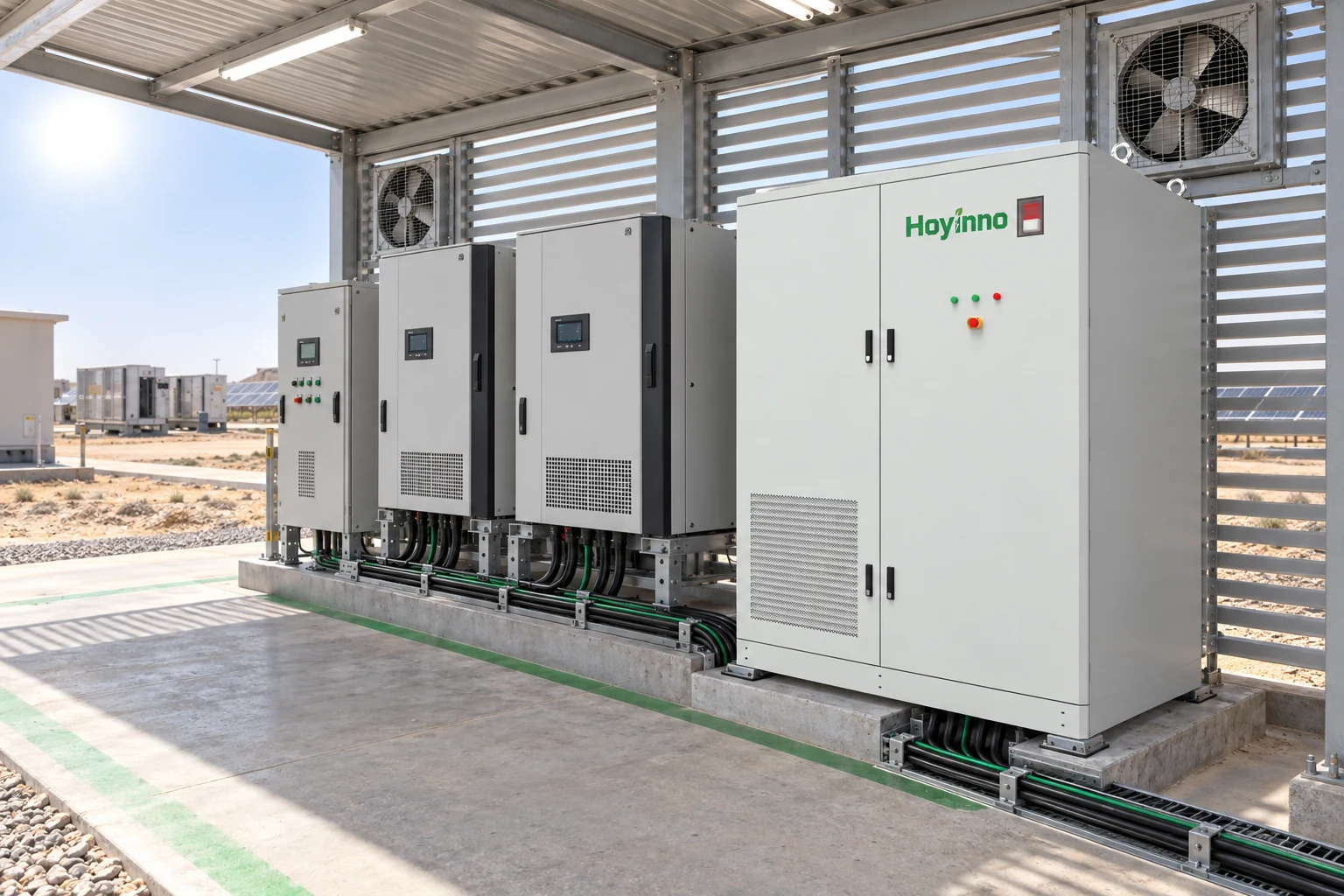
A generator can reduce the battery and array capacity required for rare weather events, but it introduces maintenance, noise, emissions, starting reliability, and fuel logistics risk. The strongest hybrid microgrid design does not merely connect a generator. It specifies who may start it, what state of charge triggers it, how long it should run, which load step is acceptable, how it synchronizes, and what happens if the start attempt fails.
Match Architecture To Climate, Logistics, And Local Skills
Treat heat, humidity, dust, salt, and altitude as operating inputs
Environmental conditions affect every subsystem. High temperature may reduce battery and inverter power or accelerate ageing. Humidity and salt increase corrosion risk. Fine dust can restrict heat exchangers, contaminate switchgear, and raise maintenance frequency. Altitude can reduce cooling performance and dielectric margin. Flood level, cyclone exposure, seismic conditions, wildlife, and access security can determine enclosure location before equipment ratings are discussed.
Design for the people, tools, and spares actually available
A remote installation may have excellent remote support but intermittent communications, or capable local operators but limited diagnostic tools. The architecture should separate actions that are safe locally from changes that require specialist authority. Alarms need clear priorities, offline records, and time synchronization. Essential spares should reflect failure probability, replacement lead time, storage conditions, and the skill required for installation.

Controls And Protection Separate A System From A Collection Of Assets
Write the operating-state matrix before programming controls
The control narrative should cover normal renewable supply, battery charging, night operation, low reserve, generator start, generator failure, load shedding, maintenance isolation, emergency stop, black start, and restoration. Each state needs entry conditions, command authority, permitted loads, protection settings, alarm behavior, and exit criteria. This becomes the shared language for the owner, EPC team, equipment suppliers, and commissioning technicians.
Verify protection in every allowed source combination
Fault current can change substantially between inverter-only, generator-supported, and multi-source modes. Directional power flow, earthing, neutral switching, transformer inrush, breaker coordination, anti-islanding, and personnel safety require project-specific study. A protective device that clears a fault with a generator online may respond differently when only power electronics are energizing the bus.
Compare Lifecycle Exposure, Not Only Installed Cost
Capital price is visible, but the largest decision differences often sit in replacement timing, fuel delivery, lost-load consequence, technician travel, cooling energy, curtailment, spares, software support, and expansion work. A credible comparison uses the same study period, discount assumptions, demand scenario, resource record, degradation model, and service target for every architecture. It also separates costs that are confirmed from values that still need quotations.
Scenario analysis is more honest than one precise forecast. At minimum, evaluate expected conditions, poor renewable resource, higher load growth, delayed fuel delivery, major component outage, and communications loss. The best economic result is not always the lowest expected cost; it may be the option with acceptable cost under the widest range of credible conditions. Independent energy analysis can help make assumptions and uncertainty visible.
Reserve interfaces for phased growth without buying idle hardware blindly
Projects frequently add pumps, production lines, housing, telecom equipment, or EV charging after commissioning. Expansion planning should reserve physical space, switchboard capacity, communications addresses, protection zones, and controller licenses where appropriate. However, installing excessive battery capacity years early can create unused degradation and cooling burden. A modular plan should state the maximum validated expansion block and the studies or firmware changes needed before connection.
Commission The Architecture As One Operating System
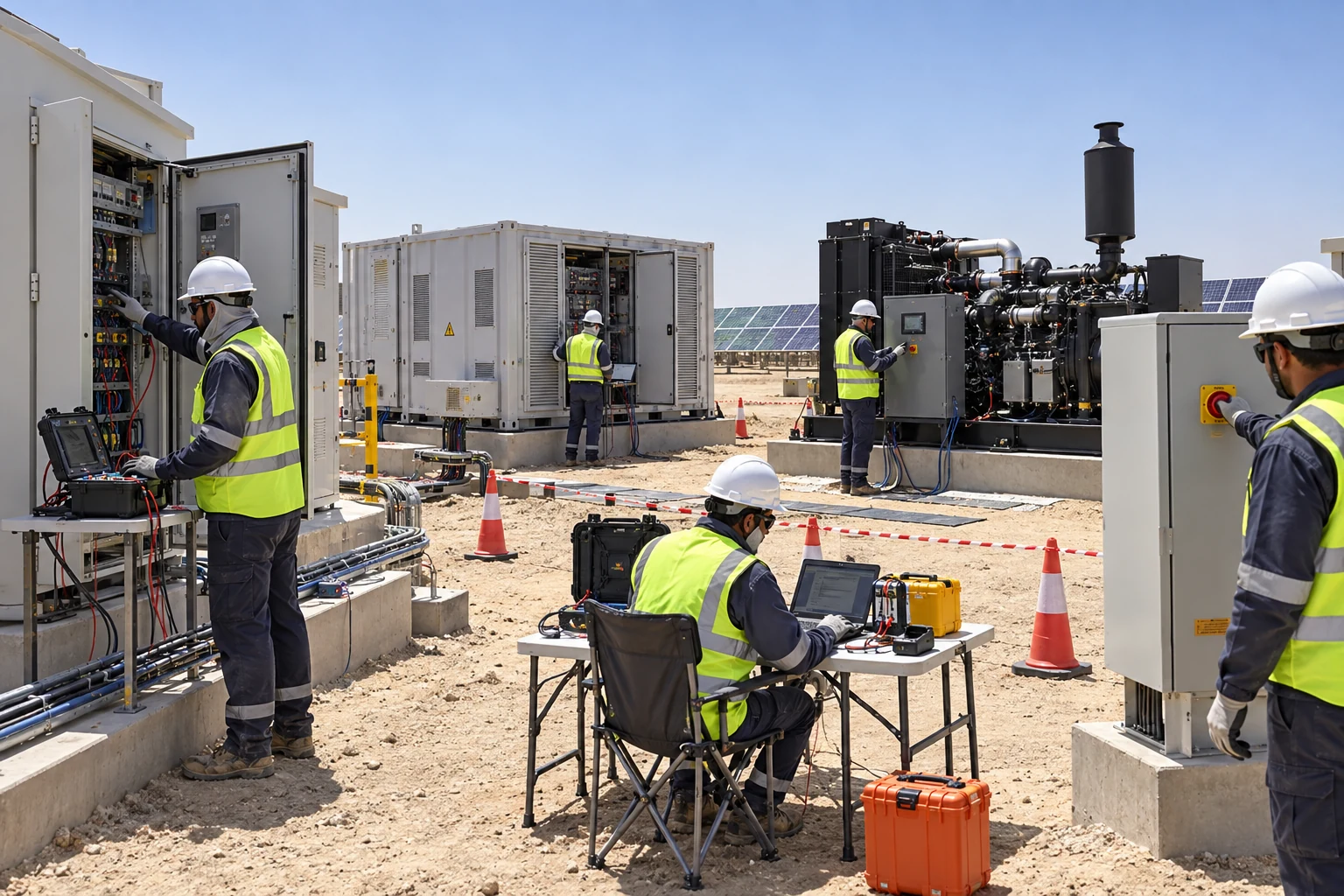
Factory tests can verify devices, but site acceptance must prove interfaces. The commissioning plan should progress from inspection and insulation checks to communications, sensor polarity, command authority, individual sources, storage limits, staged loads, protection trips, generator transfer, load shedding, black start, and restoration. Test records need timestamps, expected results, actual results, exceptions, corrective actions, and final approved settings.
Tests should include credible failures: loss of a meter, frozen data, communications interruption, failed generator start, unavailable battery string, inverter trip, emergency stop, and restoration after complete shutdown. This is where hidden common dependencies appear. A formal technical support arrangement should define escalation paths and configuration control without replacing local safety procedures.
Use outcome-based acceptance criteria
Acceptance should connect back to the original service target. Suitable criteria may include uninterrupted operation of Tier 1 loads during a defined transition, stable voltage and frequency during a specified load step, correct shedding order at low reserve, successful generator start within an agreed window, and complete recovery without unsafe manual intervention. Exact limits must come from the project's design documents and equipment capabilities.
Frequently Asked Questions
Is solar plus battery always the lowest-cost option?
No. It can be attractive where solar resource is good and fuel delivery is costly, but the result depends on the service target, seasonal resource, load shape, financing, replacement assumptions, and value of lost load. A hybrid option may reduce capital exposure for rare events, while a fuel-free option may reduce operating exposure. Both must be compared on identical assumptions.
How many hours of battery autonomy are enough?
There is no universal number. Autonomy should follow the critical load profile, resource variability, generator policy, recovery target, temperature, usable state-of-charge window, and allowable shortage. A battery autonomy model should test whole event sequences rather than multiplying average load by an arbitrary number of hours.
When does a generator improve reliability?
It improves reliability when it starts predictably, has suitable loading and maintenance conditions, receives acceptable fuel, and is coordinated with storage and protection. If supply routes, fuel quality, or starting batteries are unreliable, the generator introduces its own failure modes. Fuel logistics risk belongs in the reliability model.
Can one controller coordinate equipment from different suppliers?
Potentially, but compatibility must be verified at the required level. A shared protocol name does not guarantee identical data points, control timing, alarm semantics, fail-safe behavior, or cybersecurity support. The integration test should cover normal commands, invalid data, communications loss, time synchronization, and recovery.
What information should an EPC team prepare before an inquiry?
Prepare interval load data, load priorities, single-line drawings, site and environmental conditions, renewable-resource evidence, fuel constraints, required autonomy, permissible interruption, expansion plans, local standards, communications needs, and acceptance criteria. A concise project consultation is more productive when unknowns are marked for confirmation instead of replaced with assumptions.
Choose The Architecture That Protects The Required Service
The strongest off grid solutions are those whose assumptions can be tested. The decision record should show how the selected architecture serves priority loads, handles the design climate, manages reserve, survives credible failures, fits local operating capacity, and remains maintainable through its study life. Product capacity is necessary, but coordinated behavior is what keeps a remote site operating.
A practical next step is to freeze the service target and compare two or three architectures against the same data. That comparison should expose uncertainty, document information still to be confirmed, and carry the preferred option into protection study, controls design, procurement, commissioning, and operations and maintenance planning. The result is an engineering basis that can be reviewed and improved, not a promise built on a brochure.
 Why Must Off Grid Energy Be Designed Around An Hourly Load Profile?
  Address: A401, Junxu Junchuang Park, 03A Qingyi Road, Nanhai District, Foshan City, Guangdong Province, China





