



 Home
Home
What Must Off Grid Power Storage Control Before Capacity Can Help?
Off grid power storage only becomes useful when its controls can hold voltage, frequency, protection, and load priority inside defined boundaries. Capacity answers how much energy may be available; it does not decide which device establishes the electrical reference, how a motor start is managed, when a feeder is shed, or what happens after a communications failure. Those decisions determine whether stored energy becomes reliable service.
That distinction is especially important for remote industry, islanded facilities, and weak-grid projects. A battery may show a healthy state of charge while the site still cannot energize a bus, accept a generator, clear a fault selectively, or reconnect priority loads. Early design should therefore define a control architecture and prove its behavior before buyers treat kilowatt-hours as the leading comparison.
Begin With The Electrical Reference
An islanded power system needs a source that establishes voltage and frequency. In many modern designs, a grid-forming inverter performs that duty while other converters, generators, and renewable sources synchronize to it. The specification should identify the reference-setting device in every operating state, including normal island operation, restart, maintenance, and a failed communications link.
Assign One Authority For Each Operating State
Control conflicts arise when two devices try to regulate the same quantity without a defined hierarchy, or when every device waits for someone else to establish the bus. A responsibility table should name who forms the grid, who follows it, who issues active- and reactive-power commands, and who owns the transition. The table must cover generator start, renewable curtailment, battery limits, maintenance bypass, and return from a trip.
Define The Acceptable Envelope
Nominal voltage and frequency are not enough. Buyers need steady-state ranges, rate-of-change limits, transient recovery times, imbalance assumptions, harmonic boundaries, and the load steps used for testing. These values should connect to actual equipment tolerances. A stable waveform outside a critical load's allowable envelope is not an acceptable result.
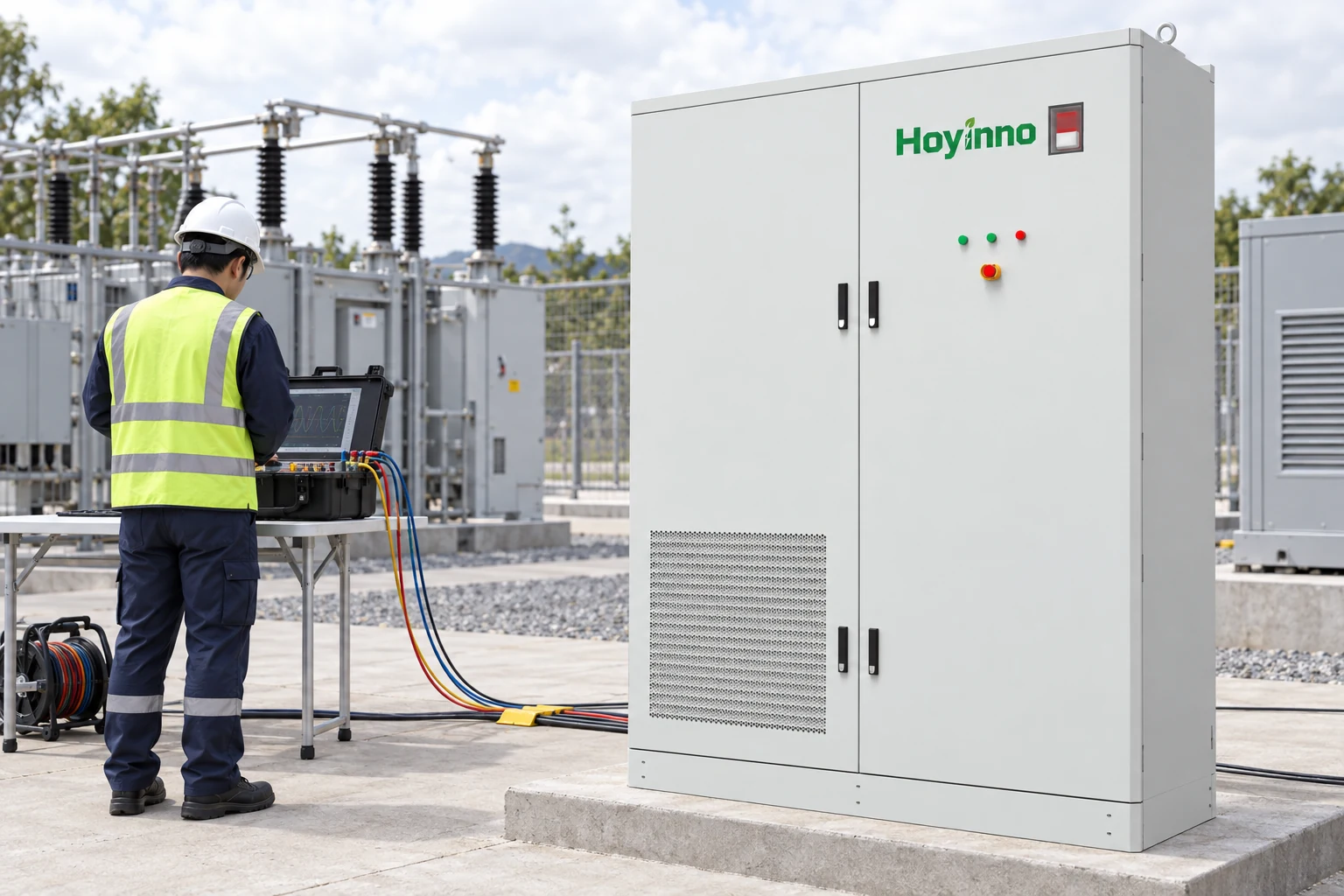
Separate Energy, Power, And Control Headroom
Off grid power storage must satisfy three related but different constraints. Energy supports loads over time. Power covers instantaneous demand, charging, and short-duration events. Control headroom gives the system room to respond before it reaches a hard limit. A design can pass the first calculation and fail the other two during a motor start, cloud transient, generator synchronization, or abrupt feeder return.
Reserve More Than A State-Of-Charge Number
A reserve policy should state which loads it protects, which event it covers, and which device may release it. It should also include converter power margin, reactive support, thermal derating, and auxiliary demand. If the battery reaches a current or temperature limit while attempting to stabilize the bus, nominal stored energy cannot compensate for the missing response capability.
Model Events In Time Order
Chronological simulation exposes interactions hidden by daily totals. It can show a morning demand step before solar production, a generator minimum-run constraint, an afternoon charging limit, and an evening critical peak. The model should report bus behavior, source commands, curtailed energy, unserved load, reserve, and limiting components at each important transition.
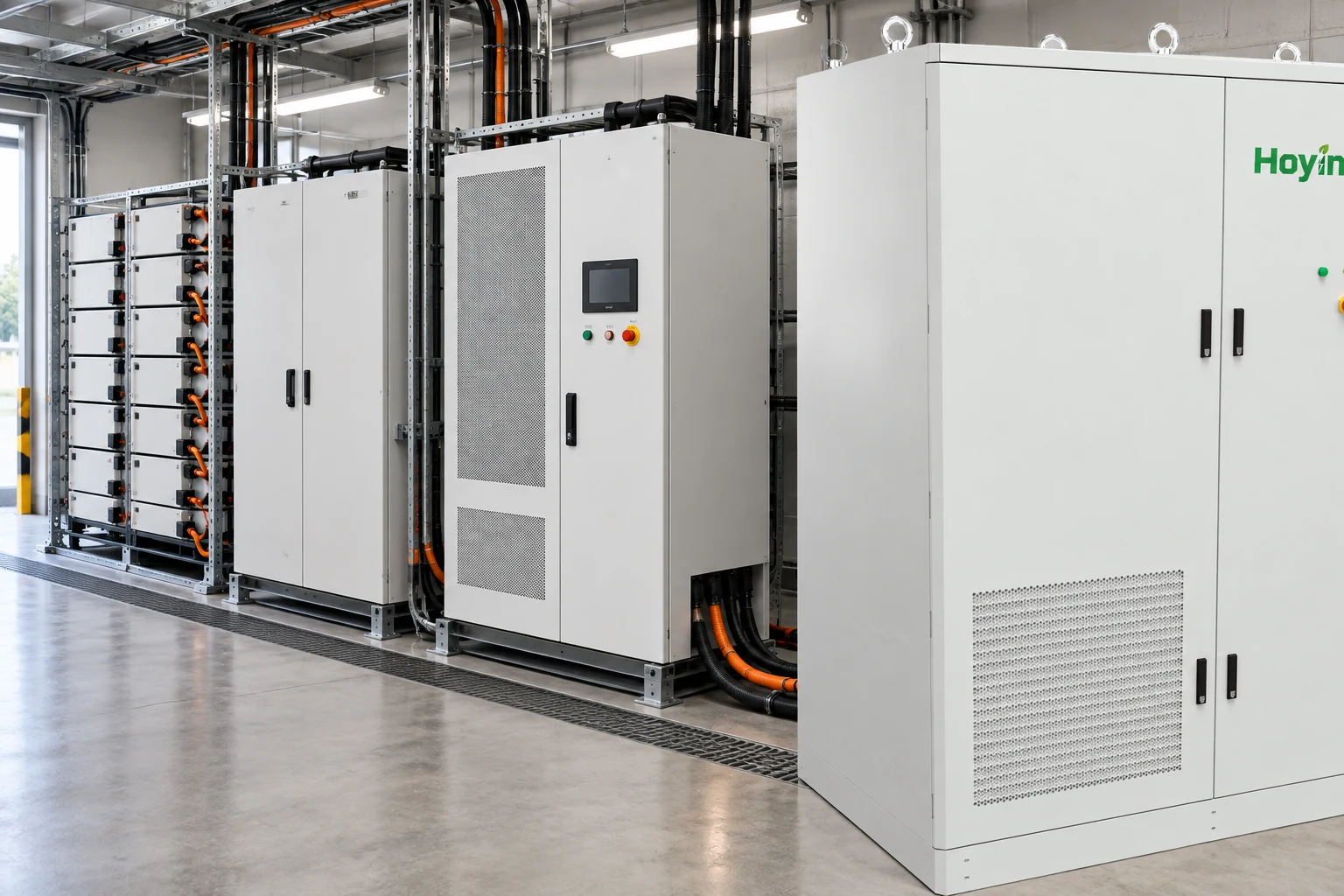
Make Protection Follow The Operating Mode
Fault current in an inverter-led island may be lower and more tightly controlled than in a utility-fed system. Protection settings copied from a strong grid can therefore operate too slowly, fail to discriminate, or disconnect more of the site than necessary. The design must coordinate breakers, inverter limits, grounding, isolation, and restart logic across every credible source combination.
Test Boundaries, Not Only Individual Devices
A useful protection coordination study follows the fault from detection through isolation and service restoration. It should explain what the inverter does during the event, which protective device operates first, what remains energized, and how the isolated section is returned. The same logic must be checked when a generator is online, because available fault current and clearing behavior can change.
Write Fail-Safe Communications Behavior
The loss of a meter, network switch, time source, or supervisory controller should lead to a defined local state. Each asset needs a timeout, fallback setpoint, permitted duration, alarm route, and recovery rule. “Last command held” may be appropriate for one signal and unsafe for another. This is a design decision, not a commissioning improvisation.
| Control Boundary | Decision To Freeze | Evidence To Request | Risk If Missing |
|---|---|---|---|
| Electrical reference | Which device forms voltage and frequency in each state? | State diagram, setpoints, transition tests | No source takes authority, or sources compete |
| Power margin | How much response remains near charge, thermal, and current limits? | Power-duration envelope and derating curves | Stored energy exists but cannot stabilize the bus |
| Protection | Which device isolates each fault under each source combination? | Coordination study and witnessed injection or functional test | Slow clearing or unnecessary site-wide outage |
| Load priority | Which feeders stay, shed, and return? | Priority matrix, thresholds, timers, pickup limits | Controls consume reserve on noncritical demand |
| Communications | What local state follows a missing command or measurement? | Timeout table and fail-safe demonstration | Stale data drives unsafe or unstable action |
| Acceptance | Which events must pass before handover? | Approved script, synchronized trends, exception log | Components pass while the integrated plant remains unproven |
Coordinate Loads And Sources Through One Sequence
The site's power conversion and control layer connects battery limits, inverter modes, generation forecasts, generator availability, and feeder priorities. An energy management system may supervise those decisions, but the procurement document still needs to define what remains local, what depends on communications, and which commands can override equipment protection. The same questions apply when the enclosure format changes to a containerized energy storage system.
Use A Load Priority Matrix
Every material load should have a priority, start characteristic, minimum run time, restart delay, and permissible interruption. Critical does not always mean continuously connected: some essential loads can be sequenced, while a small control or cooling load may be indispensable. The matrix converts general claims about reliability into executable rules that operations teams can review.
Prevent Control Hunting
Poorly coordinated thresholds can repeatedly start a generator, shed and restore a feeder, or switch between charge and discharge. Deadbands, minimum dwell times, rate limits, forecast confidence, and manual-override rules reduce this hunting. Engineers should test values near the boundary, because a sequence that works at the center of its range may oscillate when measurements contain noise or delay.
The same-site EMS overview provides context for supervisory monitoring and dispatch. Project acceptance, however, should be based on the actual signal list, control ownership, network architecture, software version, and witnessed behavior supplied for the site.
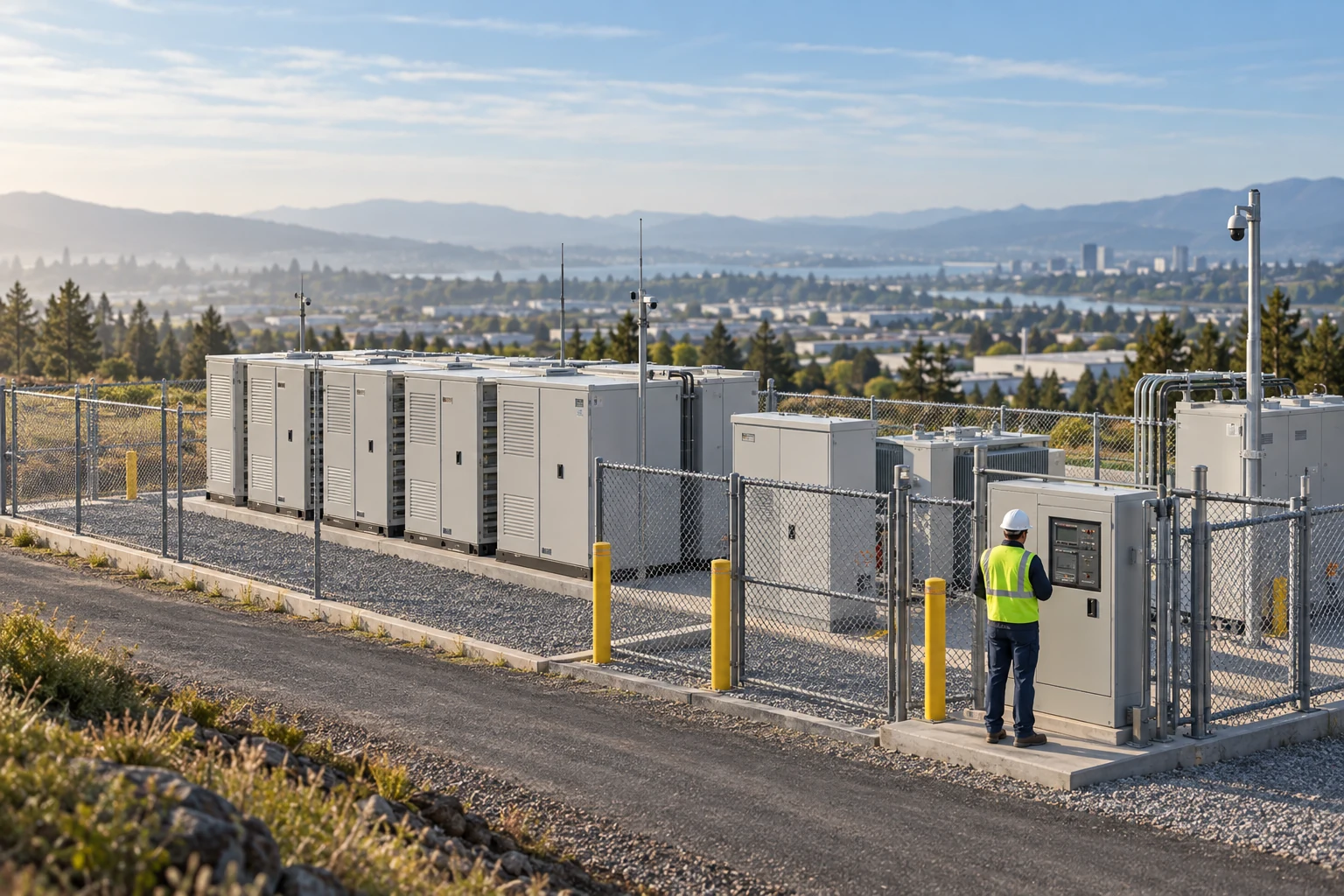
Turn Monitoring Into Operational Evidence
Frequency control cannot be judged from a single dashboard value. Useful records include voltage, frequency, battery power, state of charge, converter mode, available renewable power, generator state, served load, curtailed load, temperatures, alarms, and commands on a common time base. Event resolution should be fine enough to explain the transitions being accepted.
Preserve Data When The Network Does Not
Remote sites should buffer important measurements locally and forward them after connectivity returns. Alarm priorities, retention periods, user permissions, clock synchronization, and export formats belong in the design. Without these details, an operator may see that a trip occurred but lack the sequence needed to identify whether the initiating condition was a load, source, network, protection, or control problem.
For applications where access and communications affect recovery, the remote-area off-grid solution context is relevant. The operating plan should still identify local competence, safe isolation points, essential spares, escalation ownership, and the maximum time the plant may remain in a fallback mode.

Specify A Control-First Acceptance Test
A product page such as the 522 kWh modular energy storage cabinet can establish same-site equipment context, but it cannot replace a site-specific controls specification. The broader modular energy storage system category likewise provides configuration context rather than project acceptance. Buyers should apply one agreed sequence to the proposed battery, converter, generation, switchgear, protection, communications, and loads.
The test should begin from defined initial conditions and use approved pass limits. It should include cold start, a large load step, renewable reduction, generator start and synchronization where applicable, feeder shedding, controlled reconnection, a communications loss, a representative protection event, and recovery to normal operation. Each stage needs timestamps, expected commands, actual measurements, and named responsibility for correcting deviations.
- Freeze the one-line diagram, control ownership, operating states, and load priorities.
- Provide chronological load and generation data plus converter and battery limits.
- Approve protection settings, communications timeouts, and fallback setpoints.
- Run factory integration tests with the intended signal list and software versions.
- Repeat the critical sequence on site using synchronized measurements.
- Retain the accepted settings, trends, exceptions, corrections, and operator instructions.
Frequently Asked Questions
Why Can A Large Battery Still Fail To Support An Islanded Site?
The limiting issue may be converter power, voltage or frequency authority, thermal derating, protection behavior, auxiliary consumption, or an undefined load sequence rather than stored energy. A complete design checks the time-ordered electrical and control response, not only nameplate capacity.
Who Should Own The Master Control Logic?
Ownership depends on the project architecture, but it must be explicit. One party should maintain the state diagram, command hierarchy, signal list, interfaces, software versions, change control, and integrated test. Component suppliers still remain responsible for their local protections and declared limits.
What Should Happen If The Supervisory Controller Fails?
Each device should enter a documented local state after a defined timeout. Critical service, battery protection, safe generator behavior, and load shedding should not depend on an indefinite stale command. The fallback state and the path back to supervisory control should both be tested.
Which Records Should Remain After Handover?
Keep the approved one-line diagram, responsibility matrix, state diagram, signal list, settings, firmware and software versions, protection study, test scripts, synchronized trends, alarm definitions, deviations, corrective actions, backups, and operator procedures. These records establish a baseline for maintenance and future expansion.
In short, off grid power storage should be evaluated as an electrical control system with energy behind it. When authority, margins, protection, priorities, fallback states, monitoring, and acceptance evidence are defined first, capacity becomes meaningful—and operations teams know exactly what service the stored energy is expected to protect.
 How Does Off Grid Storage Work Across Seconds, Hours, And Days?
  Address: A401, Junxu Junchuang Park, 03A Qingyi Road, Nanhai District, Foshan City, Guangdong Province, China





