



 Home
Home
What Sets The Operating Limits Of Power Storage Systems?
The output of power storage systems depends on battery condition, conversion hardware, controls and the connection, so the available power can change during operation.
An enclosure rating is only the start of understanding this behavior. A battery may contain energy while its controls temporarily restrict discharge, or accept less charging power than a connected solar array could supply. Engineers reviewing power storage systems need to distinguish those situations before interpreting a shortfall as a fault. This guide explains the operating envelope without assigning one manufacturer's limits to another product.
The Operating Envelope Changes With Conditions
Power describes a rate; energy describes an amount
A power limit constrains how quickly electricity can enter or leave the equipment. Stored energy indicates an amount available under stated conditions. The U.S. Department of Energy's storage overview distinguishes these quantities and explains that conversion involves losses. A large energy rating therefore does not establish the power that a system can supply at a particular instant. Likewise, high conversion power does not establish how long the battery can sustain it.
Consider an illustrative load needing a steady output through an interruption. The battery must hold enough usable energy, but the converter must also support the instantaneous load. Either boundary may become restrictive first. These are separate checks, even where a product brochure presents them together.
Published values usually have associated conditions such as temperature, voltage range or permitted duration. Those conditions belong with the figure when it enters a design calculation. Comparing a short overload rating with another unit's continuous rating can create a misleading impression of capacity. The operating envelope should identify which output is continuous and which is allowed only for a limited period under defined conditions.
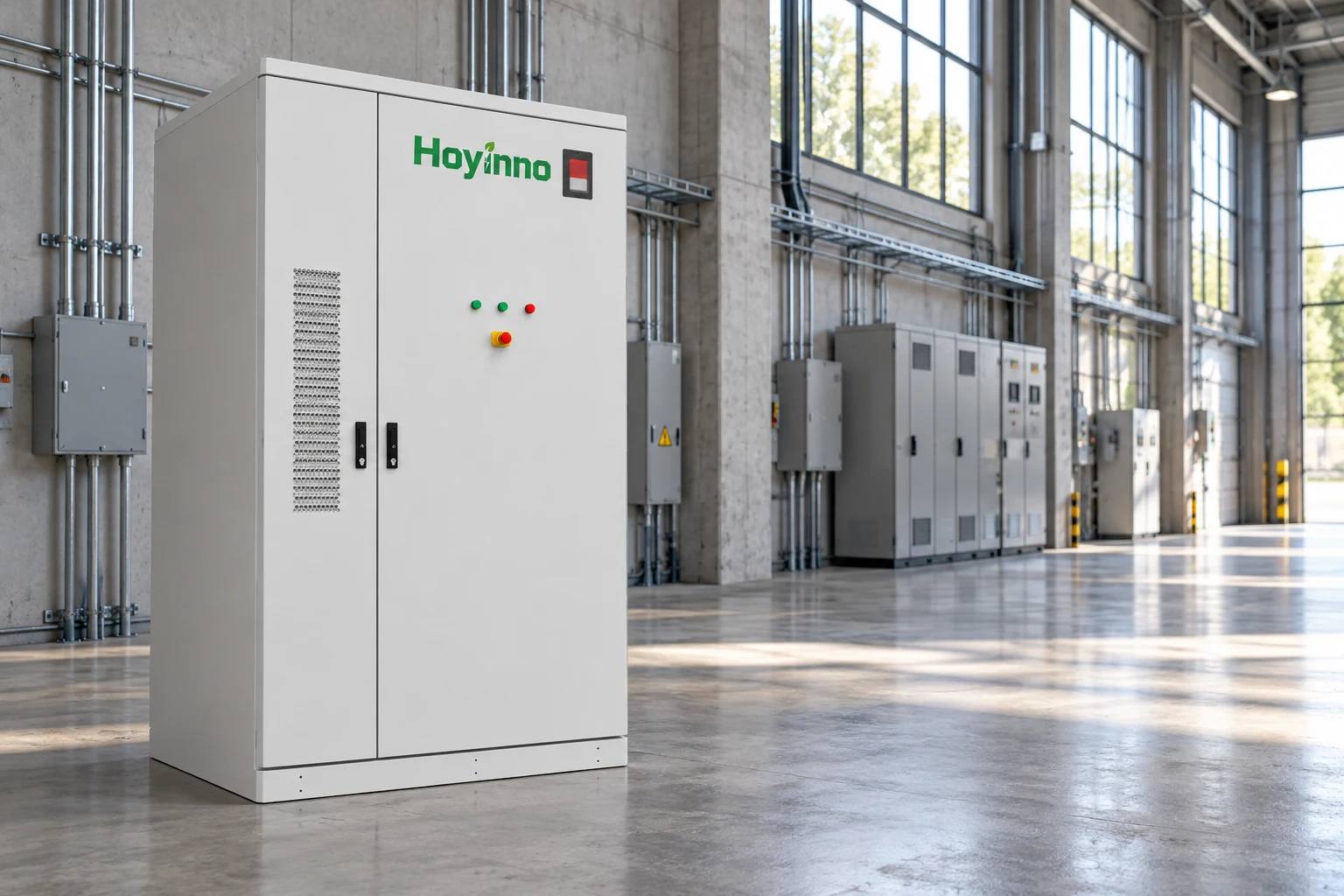
The cabinet illustration shows equipment form only. Its doors, enclosure size and indicators do not establish a site's output, internal configuration or installation approval.
The Battery Determines What Is Available
State of charge is an estimate with operating consequences
State of charge describes estimated remaining charge relative to the battery's defined reference. It is useful for scheduling, but it is not a direct guarantee of deliverable AC energy. The approved usable window, battery condition and conversion losses still matter. A reserve policy may deliberately leave energy unused for routine dispatch so that a different service can use it later. A displayed percentage should therefore be read together with the active operating mode.
Cell conditions can restrict the whole battery
The battery management system observes relevant battery conditions and communicates permitted operation. A boundary reached by a monitored cell can reduce the allowed charge or discharge even when the average pack value appears ordinary. This is why a power limit may change before a user expects it from the headline state of charge. The applicable manufacturer's documentation determines the actual thresholds, actions and recovery conditions.
Conversion Hardware Adds Another Boundary
DC availability does not equal AC delivery
A battery can permit discharge while a converter reaches its own current, thermal or output boundary. The power conversion and control layer translates between battery-side and load-side conditions. Its efficiency, supported voltage range and operating mode affect the result. The operating envelope is the combination of compatible limits across the equipment, not whichever individual component has the highest published rating.
Continuous output and short events need different treatment
A brief load event can place a different demand on conversion hardware from a steady operating period. Motor starts, switching events and other changes may need evaluation using the selected equipment's documented response. A continuous power limit alone cannot describe all transient behavior. The project engineer must also determine whether the proposed operating mode supports the required load characteristics and transition behavior.
The Connection Can Restrict Otherwise Available Output
Site limits operate outside the battery cabinet
A connection may impose an import or export constraint independent of available battery energy. Other equipment sharing that connection also affects the remaining headroom. The active power limit at the connection can therefore be lower than the storage equipment's capability. This distinction matters when an operator sees unused battery capacity while the site is already close to an agreed connection boundary.
The engineering scope should describe the point of connection and the measurement used for control. A limit applied to a facility meter is different from a limit applied only to the storage converter. Shared loads, generation and metering arrangements determine how those values relate during operation.
Connected and isolated operation are separate cases
An installation designed for grid-connected dispatch does not automatically provide an isolated supply during an interruption. The required switching, control behavior and load support depend on the approved design. Reviewing an off-grid energy system means examining a different operating case, not simply assuming that a charged battery continues supplying every load when the external network disappears.
Network imagery represents connection context only. It does not identify the voltage, approval status or connection arrangement of any project discussed here.
Controls Translate Available Capability Into Actual Dispatch
An operating target is different from permission to operate
The energy management system may request a particular output, while equipment protections and communicated limits determine whether that request is permissible. A scheduling target cannot make unavailable capability appear. Hoyinno's EMS overview describes monitoring and control across storage and connected assets. The practical question is how the selected configuration reconciles a requested action with its current operating envelope.
For example, a schedule might request discharge while a reserve rule preserves energy for another purpose. Alternatively, a charging request might be limited by available generation or battery permissions. Understanding the controlling reason avoids treating every difference between requested and actual output as the same problem.
Limits need a clear priority and an observable reason
Multiple constraints may apply simultaneously. Operators benefit from knowing which one currently determines output and whether it is a temporary condition, a configured policy or an equipment alarm. The system's documentation should explain the priority among these conditions and the information made available to the operator. An unexplained reduction is harder to interpret than a recorded reason tied to a specific monitored value.
Any change to a protection setting belongs within the manufacturer's approved procedures and the project's engineering responsibilities. A user should not raise a threshold merely because it prevents a desired dispatch. The useful first step is to understand the active condition, its data source and its intended purpose.
Read Operating Information As A Connected Set
The table separates common boundaries by the question they answer. It is an interpretation aid, not a specification or a substitute for the selected equipment's manuals. Values should be compared at the same measurement point and under the same operating condition.
| Boundary | What it explains | Information to read with it |
|---|---|---|
| Battery charge window | Which portion of stored charge is available | State of charge, reserve policy and battery permissions |
| Battery current permission | How quickly the battery may charge or discharge now | Cell condition, temperature and communicated limits |
| Converter output | What the conversion stage can deliver | Continuous rating, transient capability and measurement point |
| Connection constraint | How much the site may import or export | Shared demand, generation and connection metering |
| Dispatch policy | Why the controller requests a particular action | Schedule, service priority and operating mode |
Time alignment makes comparisons meaningful
A battery value recorded at one moment and an AC output recorded later may describe different conditions. Trend interpretation needs aligned timestamps, compatible units and a clear sign convention. Charging and discharging should be distinguishable. Otherwise, an apparent mismatch may come from comparing incompatible observations rather than an actual restriction in the equipment.
A useful operating record connects requested output, actual output and the active limiting condition. It also identifies the operating mode and relevant alarms. This allows a reviewer to distinguish a scheduled reserve from a thermal restriction or connection constraint. The operation and maintenance context matters because equipment condition and recorded history help interpret how the operating envelope changes over time.
The engineering illustration depicts review activity. The screens are illustrative and do not present calculated performance, a verified site model or a commissioning result.

How To Interpret A System Description
Read the description of power storage systems as a set of connected statements: what is stored, how quickly it can move, where the quantity is measured and which conditions can restrict it. A useful explanation keeps those statements together instead of allowing a single large number to stand for every capability.
A storage solution also has an intended service. Shifting energy, supporting a load and coordinating generation can involve different priorities. Understanding that service explains why a controller may retain charge or limit output even when another action appears physically possible. The operating envelope describes allowable behavior; the service strategy decides which allowable behavior is useful.
The central distinction is between stored energy, available capability and requested dispatch. State of charge contributes to the first two, while conversion, connection conditions and controls shape the final result. Reading all three together provides a clearer explanation of normal system behavior and of the questions that require project-specific engineering.
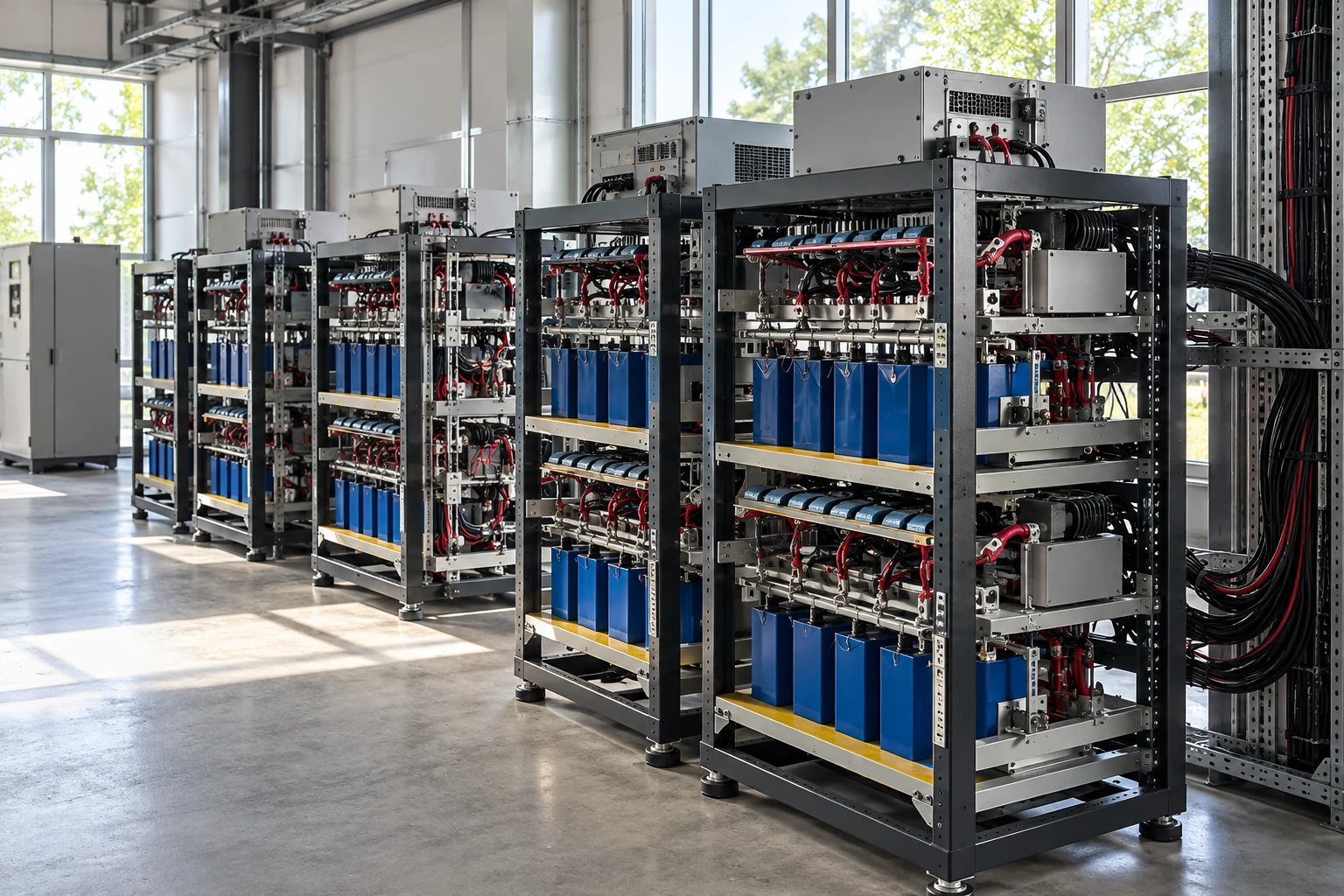
The equipment racks below illustrate electrical integration context; their appearance does not establish the internal arrangement of any delivered cabinet.
Frequently Asked Questions
Why can a charged battery have limited output?
The converter, battery permissions, connection or active operating policy may be restrictive. Remaining charge is only one condition. The active limit and operating mode help explain why the system supplies less than the requested amount.
Does a larger energy rating mean higher power?
No. Energy describes an amount, while power describes a rate. A design needs compatible values for both, together with the conditions under which they apply. Neither figure alone describes all operating capability.
Can charging and discharging have different limits?
Yes. The selected battery and control documentation may define different permissions for each direction. Temperature, cell conditions and operating policy can affect them differently. Use the actual equipment's values rather than a generic threshold.
Does an EMS override a battery protection?
A dispatch request must remain within the applicable equipment permissions and approved design. Monitoring and scheduling do not remove physical or protective boundaries. Unexpected restrictions require diagnosis through the documented process.
Does grid-connected storage automatically provide backup?
No. Backup capability depends on the approved system arrangement, controls, switching and supported loads. A grid-connected rating or a high state of charge does not, by itself, establish operation during a network interruption.
 Solar Panels And Battery Storage Need A Seasonal Energy Check
  Address: A401, Junxu Junchuang Park, 03A Qingyi Road, Nanhai District, Foshan City, Guangdong Province, China





