



 Home
Home
Which Building Blocks Let Off Grid Power Operate Reliably?
Off grid power works reliably only when demand, generation, storage, conversion, controls, protection, and operating procedures are designed as one system. A collection of individually capable devices is not enough. The parts must share a common design basis, respond correctly to disturbances, and remain serviceable in the actual climate and logistics environment.
Define the Electrical Service Before Choosing Equipment
Set a Clear System Boundary
The first building block is a precise boundary. List each source, storage asset, generator, controllable load, distribution board, and responsibility point. Define what must keep running during normal service, low-renewable periods, maintenance, and a credible outage. This prevents proposals that appear comparable while solving different problems.
A useful design basis states the loads to be served, the duration of service, the environmental conditions, the allowed interruptions, the reserve policy, and the evidence required at handover.
Build the Load Profile From Evidence
Separate Power From Energy
Load profile analysis should distinguish instantaneous power from energy over time. Power, measured in kW, determines whether converters can start motors, ride through step changes, and carry simultaneous peaks. Energy, measured in kWh, determines how long the system can serve loads between charging opportunities. Adding daily kWh values alone can hide a five-second inrush that trips an inverter. Designing only for the peak can create an oversized and costly battery without addressing the real autonomy case.
Collect interval data and reconcile it with schedules, nameplates, operator interviews, and planned expansion. Divide loads into critical, deferrable, and interruptible groups so that an energy management system receives explicit priorities rather than shedding loads arbitrarily.
Model Weather, Growth, and Battery Autonomy Planning
Battery autonomy planning defines which loads run, for how many hours, at stated charge limits, temperature, efficiency, reserve, and end-of-life capacity. The answer cannot be copied from another site. Solar-heavy systems need chronological, seasonal modeling that includes losses and the energy required to recover after a low-generation event.
Assign Generation, Conversion, and Storage Distinct Roles
Give Every Source an Operating Purpose
Solar PV is often the lowest-complexity primary source during daylight, but wind, hydro, biomass, or a generator may add seasonal or dispatchable value where site conditions support them. Each source needs a stated role: base energy, peak support, reserve charging, black start, or emergency service. The concept should also define whether sources connect on an AC bus, a DC bus, or a hybrid arrangement, because that choice affects losses, controls, protection, expansion, and failure isolation.
Use Storage for Defined Services
A battery energy storage system can absorb renewable surplus, form or support the local grid, cover evening loads, smooth source transitions, and hold operating reserve. These services compete for the same power and energy capacity, so the design must define priority. If half of the usable energy is reserved for contingencies, it cannot simultaneously be counted as daily cycling capacity.
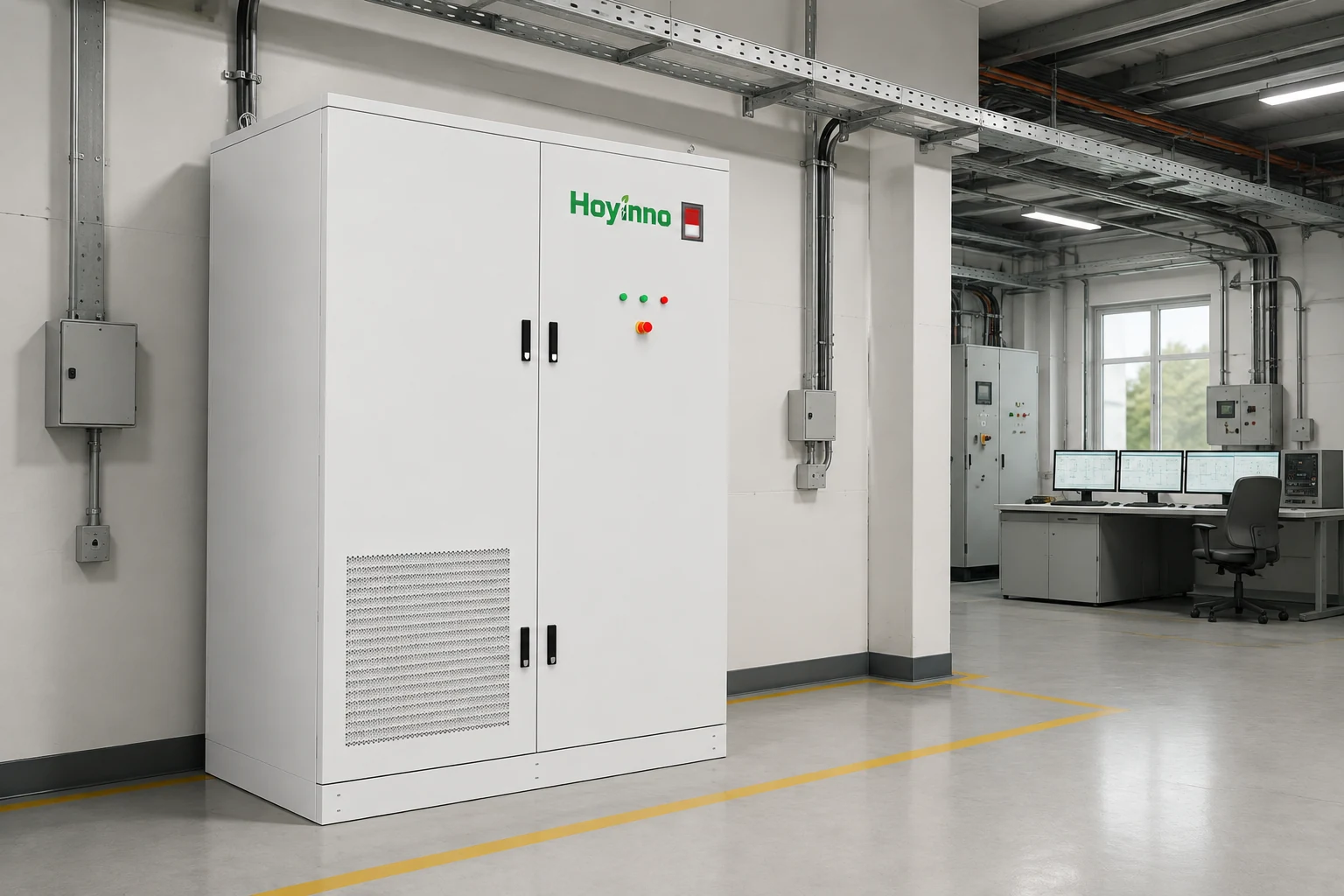
Storage selection should evaluate usable energy, continuous and short-duration power, state-of-charge limits, thermal management, enclosure protection, monitoring, and replacement access. Product data must apply to the exact model. A modular energy storage cabinet can provide a project reference point, but suitability still depends on verified specifications and the complete design basis.
| Building block | Primary design question | Evidence to request |
|---|---|---|
| Load | Which loads must run, and when? | Interval data, schedules, inrush values, criticality list |
| Generation | What energy is available by season? | Resource data, array model, derating assumptions |
| Storage | What power, usable energy, and reserve are required? | Duty-cycle model, limits, thermal and lifecycle data |
| Conversion | Who forms the grid and handles step loads? | Operating curves, overload behavior, control modes |
| Controls | How are sources, loads, and reserves coordinated? | State diagrams, setpoints, alarms, communications map |
| Protection | How are faults detected and isolated? | Protection study, selectivity review, earthing design |
| Operations | How will the site detect and recover from problems? | Procedures, spares plan, training and acceptance records |
Make Grid Formation, Controls, and Protection Work Together
Identify the Grid-Forming Inverter
In an islanded network, at least one capable source must establish voltage and frequency. A grid-forming inverter can perform this role when specified and configured for the relevant load steps, motor starts, source transitions, and fault behavior. Other devices may follow that reference. The design should state which asset forms the grid in every mode, what happens during transfer, and how the system restarts after a complete shutdown.
This is a control responsibility, not a label that can be assumed from inverter power rating. Request operating-mode descriptions, transition logic, overload curves, black-start sequence, and evidence of compatible communication. If a generator is included, the backup generator strategy should define synchronization, minimum loading, start triggers, warm-up, cooldown, and the conditions under which storage may charge from it.
Translate the Operating Philosophy Into Control States
Controls should follow a written sequence covering renewable operation, storage support, reserve conservation, load shedding, generator assist, maintenance, fault isolation, and black start. Each state needs entry and exit conditions, priorities, alarms, and safe fallback behavior so software review and commissioning remain objective.
Coordinate Protection for Converter-Dominated Faults
Conventional overcurrent assumptions may not transfer directly to a converter-dominated network, where fault current can be limited and brief. Protection settings, earthing, residual-current detection, isolation, surge protection, DC protection, and selective tripping should be engineered as a coordinated system. The aim is to isolate the smallest affected section while keeping healthy critical loads energized where the design permits.
Design for Climate, Maintenance, and Logistics
Apply Environmental Limits to the Actual Site
Temperature, humidity, salt, dust, altitude, flooding risk, and solar exposure can reduce available power or component life. Use exact limits and derating curves for the proposed model. Verify enclosure rating, corrosion protection, cooling, drainage, cable entry, and service clearances; nominal laboratory capacity may not be available on the hottest project day.
For containerized or modular systems, layout also affects maintainability and emergency access. The containerized energy storage system approach and the modular energy storage system approach create different transport, foundation, expansion, and service considerations. Neither is automatically superior; the site and duty cycle determine the better boundary.
Plan Spares and Recovery Before Handover
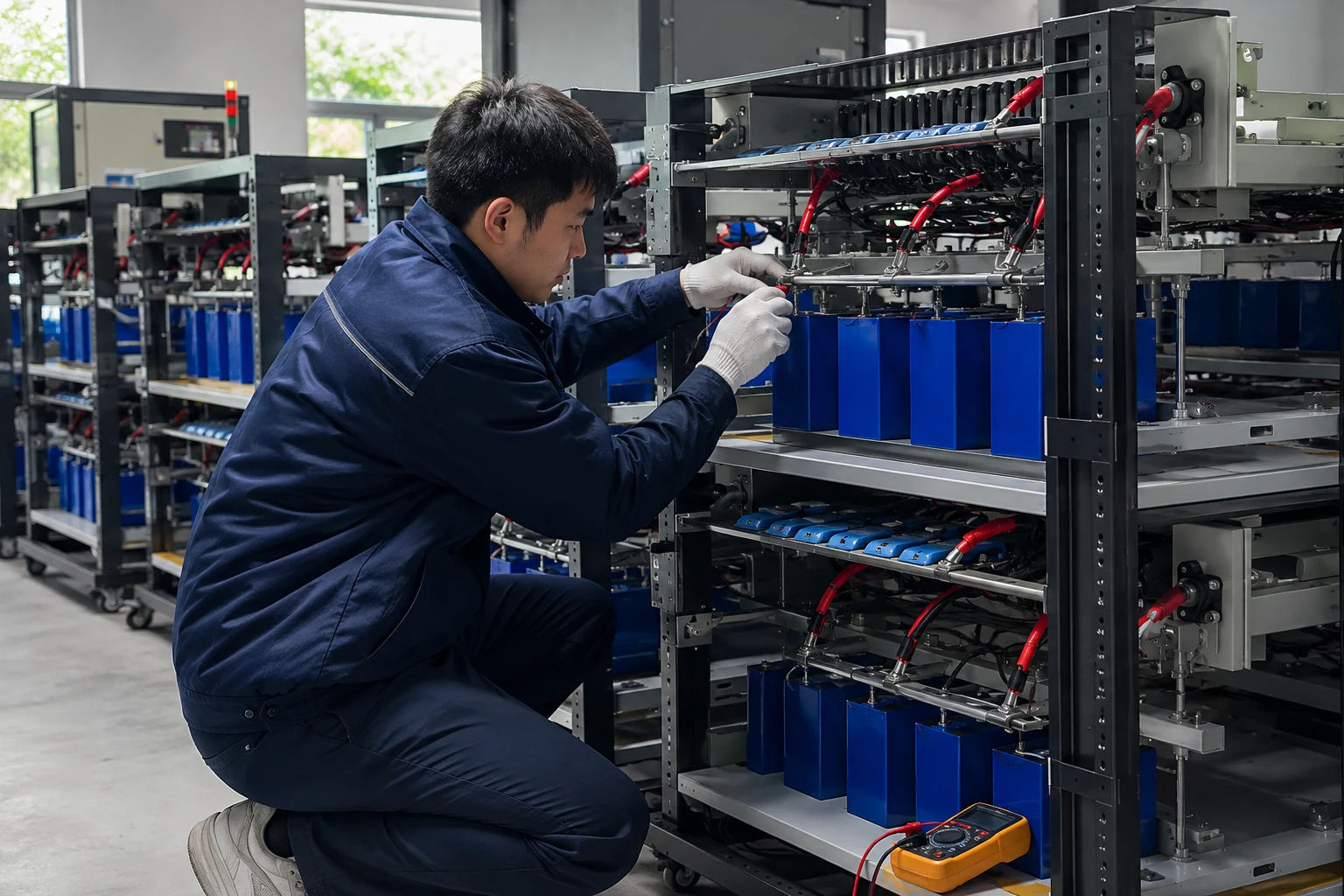
Reliability includes the time needed to diagnose and restore service. Identify critical spares, local stock, transport lead times, lifting requirements, firmware compatibility, specialist tools, and the level of work that trained site staff may perform. The replacement plan should cover not only battery modules but also fans, filters, sensors, contactors, communication devices, control power supplies, and protection components.
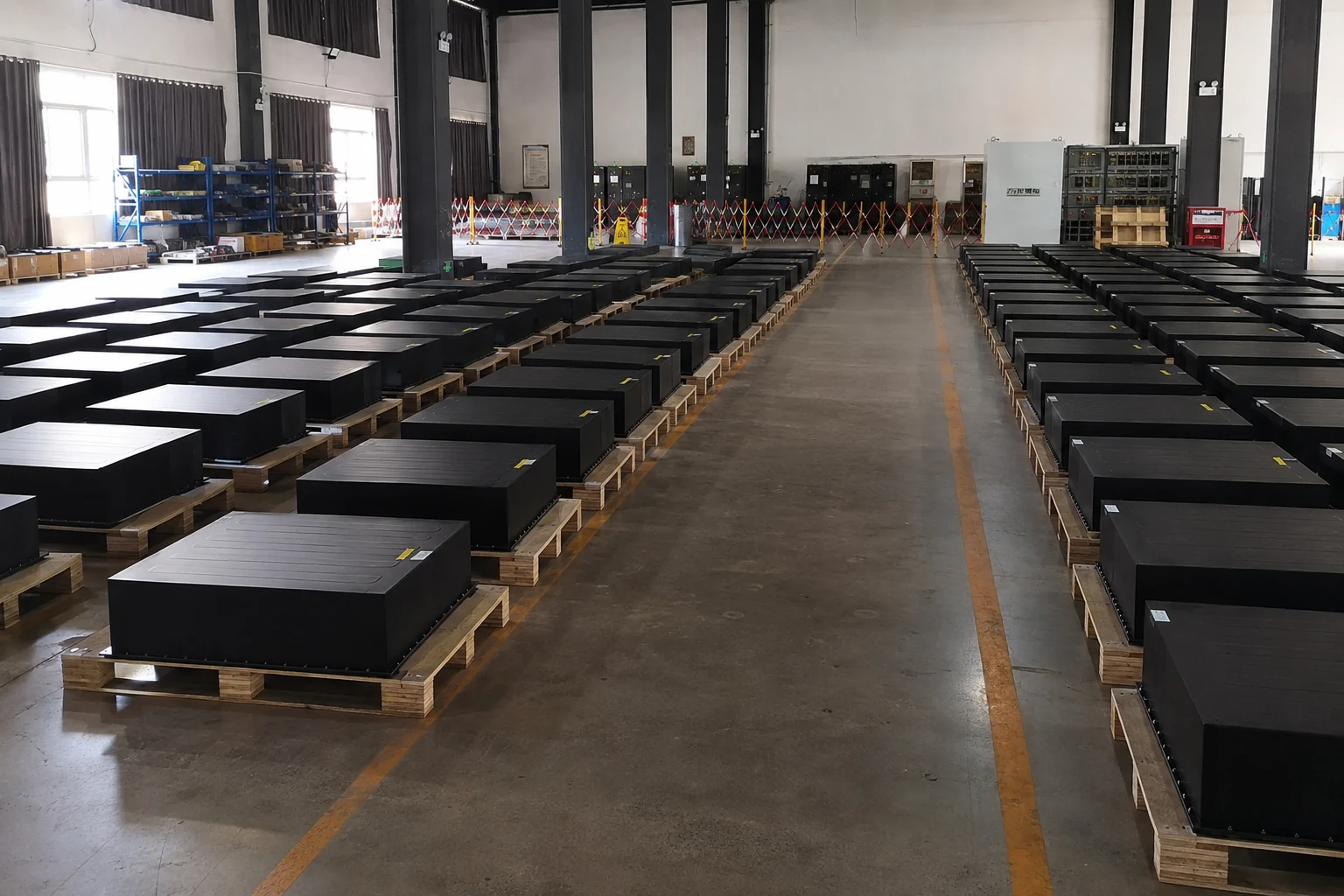
A warehouse full of modules is useful only when serialization, storage conditions, inspection status, and compatibility are controlled. Procurement documents should ask how parts are identified, tested, packed, and supported. A supplier's company and production context and the broader Hoyinno energy storage portfolio can help frame due diligence, but project evidence must still match the quoted equipment.
Commission the System Against Measurable Acceptance Criteria
Test Modes, Transitions, and Failures
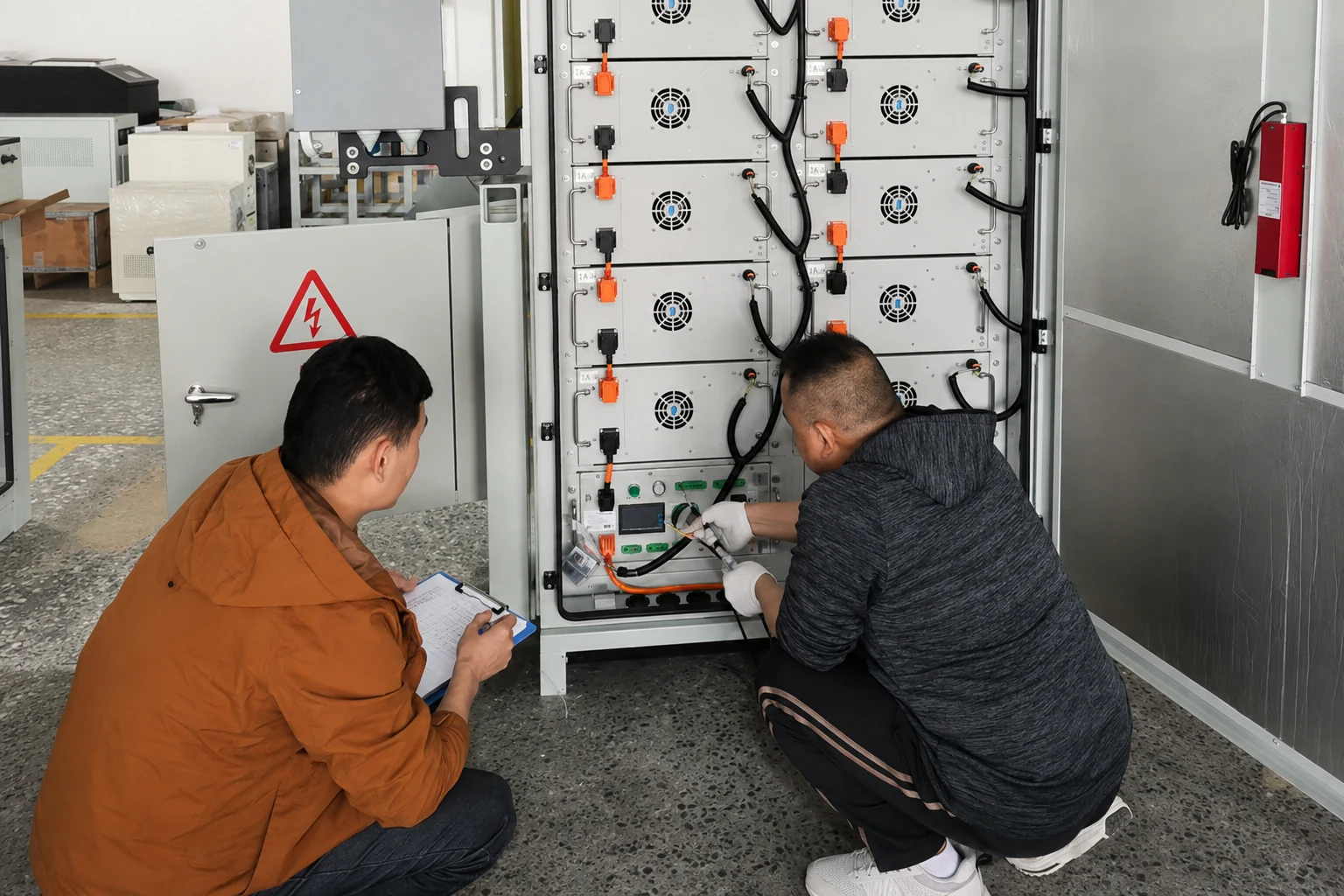
Factory and site acceptance tests for off grid power should trace back to the design basis. Check normal operation, load steps, source loss, low state of charge, communications loss, alarm handling, controlled load shedding, generator interaction, emergency stop, restart, and black start. Confirm signal scaling and aligned event timestamps. Operators should also demonstrate alarm recognition, safe isolation, and tested recovery rather than attendance alone.
Preserve a Handover Record That Supports Future Decisions
The handover package should include approved drawings, device and protection settings, firmware versions, control states, test records, warranties, spares, maintenance intervals, contacts, configuration backups, and baseline data. Future teams can then distinguish seasonal variation from deterioration or unexpected load growth.
Project cases can illustrate architectures, but every new site needs verified inputs and an acceptance plan. Document departures from the design basis and assess their effect before sign-off.
Frequently Asked Questions
What are the minimum building blocks of an off-grid system?
The minimum functional set is a defined load, one or more energy sources, power conversion, distribution and protection, controls, and an operating method. Storage is usually included when variable generation must supply loads outside generation hours, but the exact capacity follows the service requirement.
How much battery autonomy is enough?
There is no universal number. Autonomy should be calculated for stated critical loads, weather conditions, usable state-of-charge range, conversion losses, reserve policy, end-of-life capacity, and the availability of another source. The scenario and assumptions are more meaningful than an isolated number of hours.
Can solar and batteries eliminate the backup generator?
Sometimes, but only when chronological modeling, acceptable load management, seasonal resource, storage capacity, and recovery plans support that conclusion. For some sites, a seldom-used generator may be a practical resilience layer; for others, fuel logistics or emissions goals may justify a different architecture.
Why does a grid-forming inverter matter?
An islanded AC network needs a stable voltage and frequency reference. A suitably specified grid-forming device establishes that reference and manages disturbances within its capability. The design must still verify overload behavior, protection coordination, transitions, and black-start performance.
Which documents should buyers request before ordering?
Request the design basis, chronological energy model, one-line diagram, equipment data for the exact models, control-state description, protection study, environmental derating, layout, communications map, acceptance procedures, warranties, service plan, and a clear schedule of exclusions and assumptions.
Reliable Operation Comes From a Connected Design
The core lesson is simple: off grid power is reliable only when the load evidence, generation profile, storage duty, conversion behavior, control states, protection scheme, environmental design, and operating procedures agree with one another. Each building block has a distinct job, and every interface needs an owner, an assumption, and a test.
A disciplined project therefore progresses from service definition to load evidence, architecture, modeling, equipment selection, coordinated engineering, staged testing, and documented handover. That sequence makes tradeoffs visible early and gives decision makers a verifiable basis for comparing designs across remote projects.
 How Does Offgrid Solar Balance Sunlight, Storage, And Essential Loads?
  Address: A401, Junxu Junchuang Park, 03A Qingyi Road, Nanhai District, Foshan City, Guangdong Province, China





